What should you look for when choosing?
First, check which ingredients your child needs to avoid. Then compare the ingredients in the rice cakes and consider how they fit into a varied selection of snacks.
| What to consider |
What to check when buying |
Who it matters to |
| Allergens and traces |
Check the ingredients and highlighted allergens against the specific substance your child needs to avoid, and read any warnings about possible traces. For example, REWE lists sesame as an ingredient in its gluten-free organic rice cakes, as well as possible traces of milk and soya. |
If my child needs to avoid a particular allergen, I don’t want to assume a product is suitable just because it says ‘gluten-free’. This check is the main priority for around 42% of consumers. |
| Salt and sweetness |
Compare the salt content per 100 g and the ingredients list. For fruit varieties, look out for fruit concentrate. The Healthy Start network recommends avoiding added salt and a strong sweet flavour in ready-made weaning foods. |
For a simple snack, I want to know whether a variety is salted or contains extra fruit ingredients. This is the main concern for around 33% of consumers. |
| Variety instead of relying on rice |
Consider how often your child is already offered rice products, and include rice-free snacks too. The Federal Institute for Risk Assessment recommends variety because rice products may contain inorganic arsenic. |
If rice products are already on our menu quite often, I look for other options for additional snacks. Around 25% of consumers put this kind of variety first. |
Suitable products on Joybuy
This section focuses on an apple rice cake described as a snack for babies from 8 months. When choosing between a fruity and a plain variety, or if your child needs to avoid a specific allergen, the information on the current pack remains the deciding factor.
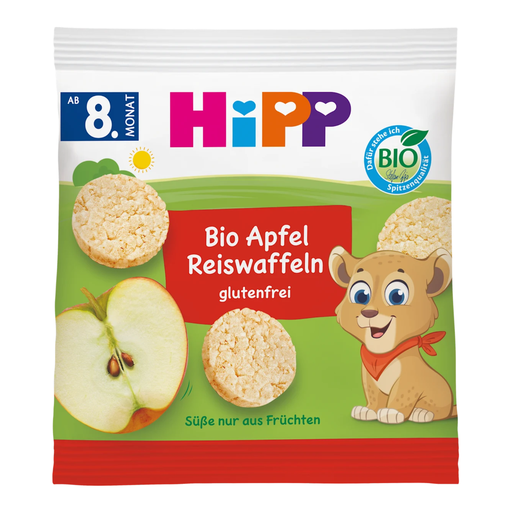 Image unavailable
HiPP Apple Rice Cakes from 8 months, 30 g
A fruity rice cake for families looking for a variety described as suitable as a snack from 8 months. The age recommendation doesn’t replace assessing your child’s readiness to eat. Stay with your child while they snack.
If your child needs to avoid a specific allergen, check the ingredients and trace warnings on the current pack. Only compare salt content when the same serving size is used.
View on Joybuy
Frequently asked questions
Are rice cakes automatically suitable for a gluten-free diet?
No. You need to check the current label on the specific rice cake. Rice itself is gluten-free, but added ingredients and possible cross-contamination can vary from product to product. For example, REWE’s gluten-free organic variety contains sesame and may contain traces of milk and soya.
Does ‘gluten-free’ also mean ‘allergen-free’?
No. EDEKA warns that its organic plain rice cakes may contain traces of sesame, while its organic apple rice cakes may contain traces of soya, sesame and milk. Whether a variety is suitable depends on the specific allergen your child needs to avoid and their individual requirements.
What should I look for in the salt content?
Compare the salt content per 100 g and the ingredients in each variety. The Healthy Start network recommends avoiding added salt in ready-made weaning foods. EDEKA lists 0,01 g of salt per 100 g for its organic plain rice cakes, and 0,31 g per 100 g for its organic sea-salt variety.
Should I offer rice cakes as a snack every day?
The Federal Institute for Risk Assessment recommends alternating rice cakes and other rice products with rice-free snacks for babies and young children. Rice products can contain relatively high levels of inorganic arsenic, so it’s also important to consider what other rice products your child eats.
Is finger food alone enough for baby-led weaning?
Finger food and purées aren’t mutually exclusive. The Healthy Start network points out that a diet consisting only of finger foods may not provide enough nutrients, and recommends seeking individual advice from your child’s doctor.


