Shoppers keeping an eye on fat content
If you’re packing rice cakes for a day out and want to compare their fat content, check the figures per 100 g. If you’re considering a topping or coating, assess that separately.


If you’re choosing rice cakes for the summer holidays with their fat content in mind, compare the nutritional values per 100 g rather than relying on claims such as ‘light’. For snacks for children, you should also check the age recommendation, ingredients and precautionary allergen information. For regular consumption, the consumer advice centre recommends choosing a variety of grains.
If you’re packing rice cakes for a day out and want to compare their fat content, check the figures per 100 g. If you’re considering a topping or coating, assess that separately.
For snacks for children, check the age recommendation, sugar content and any precautionary allergen information. The consumer advice centre also recommends including a variety of grains in meals for babies and toddlers.
A short ingredients list is no substitute for checking the allergen information. EDEKA says its organic plain rice cakes may contain traces of sesame; Kallo says its Lightly Salted variety may contain traces of milk, sesame and soya.
Start by comparing the nutritional information for the specific variety. For a day out, also consider the pack size and storage instructions. If you’re buying for children or managing allergies, pay particular attention to the labelling.
| What to consider | What to check before buying | Who it matters to |
|---|---|---|
| Fat content | Compare fat and energy per 100 g, and take any planned topping into account. | If fat content is my main priority, I don’t want to treat plain and topped rice cakes as if they were the same. Around 33% of shoppers share this priority. |
| Snacks for days out | Check the pack size, storage instructions and how long the product keeps once opened. | For a day out, I need a snack I can pack to suit the break I have planned. Around 27% of shoppers put this practical consideration first. |
| Ingredients and flavour | Read the ingredients list and check sugar and salt per 100 g, particularly for salted or fruit-flavoured varieties. | I want a particular flavour, but I also want to know how salt or fruit ingredients affect the nutritional information. This balance comes first for around 20% of shoppers. |
| Children and allergens | Check the age recommendation and precautionary allergen information on the pack; include other grains if the product is eaten regularly. | If a child will be eating the snack or allergen information is important, it needs to suit your specific needs. Around 20% of shoppers prioritise this. |
A low fat content doesn’t tell you everything about a product’s nutritional value. ALDI SÜD lists GUT BIO Organic Rice Cakes with Salt as containing 0.6 g of fat and 381 kcal per 100 g.
Compare fat, energy, sugar and salt using the same serving basis. If you’re adding a topping, remember to include that too.
The German Federal Institute for Risk Assessment points out that rice products can contain inorganic arsenic. The consumer advice centre recommends varying the grains in meals, particularly for babies and toddlers.
As well as rice cakes, include snacks made from other suitable grains, and check the age recommendation for each product.
Even plain rice cakes can carry precautionary allergen information. The substances listed vary between products.
If you have allergies, check the labelling on the specific pack rather than relying on the product name or a general description of the brand.
The details below apply to the specific rice cake varieties mentioned, not to a brand’s entire range.
EDEKA lists its organic rice cakes in plain, sea salt and apple varieties.
ALDI SÜD sells 135-g packs of GUT BIO Organic Rice Cakes with Salt.
Kallo describes its Lightly Salted Wholegrain Rice Cakes as rice cakes made with wholegrain rice and sea salt.
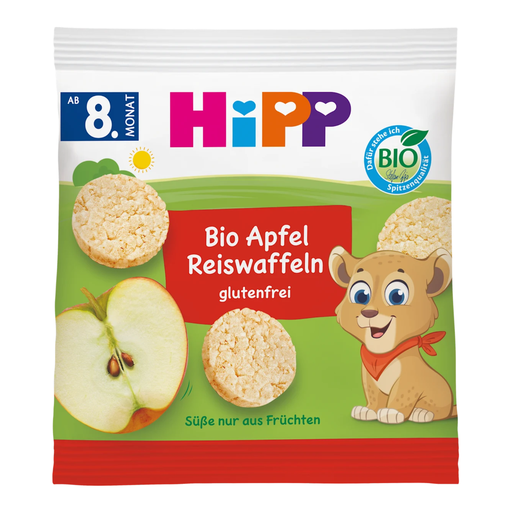
This selection features apple rice cakes for children aged 8 months and over. When choosing a snack for the summer holidays, check the nutritional information and precautionary allergen information on the pack as well as the age recommendation.
 No image available
An apple rice cake snack for anyone looking for a product suitable for a child aged 8 months and over.
To make a choice with fat content in mind, compare the nutritional information on the pack and check the precautionary allergen information if you have allergies. Supervise your child while they eat, and make sure they are sitting upright.
No. ALDI SÜD lists GUT BIO Organic Rice Cakes with Salt as containing 0.6 g of fat but 381 kcal per 100 g. Compare fat and energy per 100 g, and include any topping in your calculations if relevant.
No. Check the fat content per 100 g, along with the other nutritional values and the ingredients list. If the pack makes a comparative claim, it’s also important to check what the comparison is based on.
Check the age recommendation for the specific product, and don’t rely solely on rice-based snacks. The German Federal Institute for Risk Assessment notes that rice products may contain inorganic arsenic; the consumer advice centre recommends including a variety of grains in meals for babies and toddlers.
Yes, depending on the product. EDEKA says its organic plain rice cakes may contain traces of sesame; Kallo says its Lightly Salted variety may contain traces of milk, sesame and soya. If you have allergies, check the labelling on the specific pack.