Parents comparing fat content
They want a rice cake as a crunchy base for an easy school-holiday lunch. The fat content per 100 g helps them distinguish plain varieties from coated ones.


If fat content matters when planning a school-holiday lunch for children, plain or lightly salted rice cakes are a useful starting point for comparison with coated varieties. Check the nutritional information per 100 g on the specific pack: one rice cake does not make a complete lunch, and if snacks are served often, rice should not be the only grain on the menu.
They want a rice cake as a crunchy base for an easy school-holiday lunch. The fat content per 100 g helps them distinguish plain varieties from coated ones.
If children prefer sweet rice cakes, they may want to compare their nutritional values with those of a plain variety and plan suitable lunch accompaniments.
They check the labelling on the specific rice cakes, including any ‘may contain’ warnings. If rice cakes feature regularly on the menu, they also consider varying the grains they eat.
Start by comparing the fat content per 100 g of the specific varieties. Then consider taste, accompaniments and how often rice products feature in your children’s meals.
| Criterion | What to check when buying | Who it matters most to |
|---|---|---|
| Fat content of the variety | Compare the fat per 100 g and ingredients of the plain, salted or coated rice cakes you’re considering. With supermarket own-brand products, check the current information on the pack. | If I’m looking for a lower-fat base, I don’t want to assume a plain rice cake has the same nutritional profile as a chocolate variety just because they’re both rice cakes. For around 46% of consumers, comparing varieties is the main priority. |
| Taste and lunch pairings | Check the coating and sugar content; if you choose a plain rice cake, plan suitable lunch accompaniments. | I want my child to enjoy the snack, but the rice cake shouldn’t replace the whole lunch. Around 27% of consumers mainly focus on combining good taste with a practical meal. |
| Variety if eaten frequently | If snacks are served regularly, include other grains too; if there are younger children at home, take note of the guidance on rice products. | If rice cakes are offered often during the school holidays, I don’t want to rely solely on rice products. For around 27% of consumers, variety is the priority. |
A coating can make a significant difference. ALDI SÜD lists 0.6 g of fat per 100 g for GUT BIO Organic Rice Cakes with Salt; EDEKA24 gives 21.2 g per 100 g for EDEKA Herzstücke with dark chocolate and raspberry pieces. These figures apply to two specific products and do not represent all plain or chocolate rice cakes.
Compare the fat and sugar per 100 g, along with the ingredients, of the packs you’re actually choosing between.
A plain rice cake can make a crunchy base. The nutritional value of the whole lunch also depends on the toppings and accompaniments.
Plan rice cakes alongside other foods rather than assuming the information for the rice cake reflects the whole meal.
The Federal Institute for Risk Assessment notes that rice products, including rice cakes, can contain relatively high levels of inorganic arsenic. The German Consumer Advice Centre recommends varying grains, particularly for babies and toddlers.
If snacks are served often, alternate between different grains, especially if younger children will be eating them too.
ALDI SÜD notes that different suppliers may provide GUT BIO Organic Rice Cakes with Salt with different nutritional values.
When you buy them again, check the information on the current pack if a particular fat or salt content is important to your choice.
Kallo’s wholegrain rice cake range includes Organic Lightly Salted, a good example of a simple, lightly salted variety.
The Organic Rice Cakes with Salt provide a specific nutritional value for comparing plain varieties.
The range listed by REWE includes plain, salted, mini and coated rice cakes.
A coated rice cake from this range shows why the exact variety matters when comparing fat content.
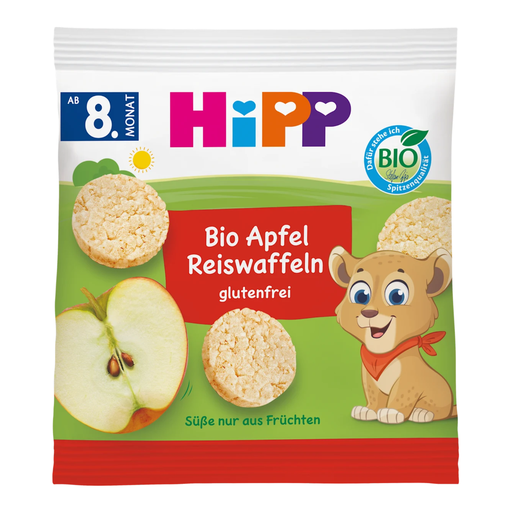
This selection features an apple rice cake for babies aged 8 months and over as a rice-based snack. When comparing fat content for a school-holiday lunch, the figure per 100 g on the specific pack is what matters; the product type alone doesn’t mean it’s a lower-fat lunch option.
 No image available
An apple rice cake for snack time if you’re looking for a product without a chocolate coating.
The pack contains 30 g and is labelled for ages 8 months and over. Before buying, compare the fat per 100 g on the pack with that of other rice cakes.
Check the pack for guidance on supervised eating and possible traces of milk, sesame and soya.
No, the nutritional values of specific varieties can differ significantly. ALDI SÜD lists 0.6 g of fat per 100 g for GUT BIO Organic Rice Cakes with Salt, while EDEKA24 gives 21.2 g per 100 g for EDEKA Herzstücke with dark chocolate and raspberry pieces. So compare the information on the packs of the products you’re considering.
The term ‘rice cake’ alone doesn’t guarantee that a product is gluten-free. Kallo describes its Organic Lightly Salted rice cake as gluten-free, but if you need to avoid gluten, still check the labelling and ‘may contain’ warnings on the specific pack.
If snacks are served frequently, it makes sense to vary the grains. The Federal Institute for Risk Assessment notes that rice products may contain inorganic arsenic; the German Consumer Advice Centre particularly highlights the importance of varying grains for babies and toddlers. This does not establish a general consumption limit for school-age children.
Keep them dry and away from heat. These are the storage instructions REWE gives for an organic rice cake listed on its site. You can also check the guidance on your specific pack before taking it with you.