For a shared family stash, plain, unsalted rice cakes may be a good option if the ingredients and pack sizes suit everyone who’ll be eating them. Smaller packs may be more convenient for outings, provided the age guidance applies to that particular variety. When choosing a multipack, check the individual packs, ingredients, allergen warnings and best-before date. The Verbraucherzentrale recommends offering babies and toddlers a variety of grains rather than relying solely on rice products.
Which formats suit different needs?
Parents stocking up for the whole family
If you’re sharing rice cakes with adults and older children, or topping them in different ways, a plain variety can be a good starting point. Choose ingredients and pack sizes that suit how your household will actually use them.
Parents looking for snacks on the go
Small portions are handy for days out or lunchboxes. If a baby or toddler will be eating them, check the age guidance for that particular variety. The Verbraucherzentrale also recommends offering a range of grains.
Parents checking ingredients and allergen warnings
If several people will be eating the same variety, it’s worth comparing the ingredients, salt content and allergen warnings. Plain rice cakes can carry these warnings too: EDEKA Bio Natur may contain traces of sesame, while Kallo’s unsalted wholegrain variety may contain traces of milk, sesame and soya.
What should you look for when buying?
First, think about who will be eating the rice cakes. Then you can decide whether smaller portions or a multipack that can be shared is more practical, and which ingredients suit everyone who’ll be eating them.
| What to consider |
What to check |
Who it matters most to |
| Suitable for children |
Check the age guidance for the specific variety, and consider including other grains in young children’s diets too. |
If my baby or toddler will be eating them, I want to see suitable age guidance and avoid relying solely on rice products. Around 42% of consumers make this their priority. |
| A multipack that can be shared |
Compare the number and size of the individual packs, storage advice and best-before date. |
For home and lunchboxes, I need portions that are easy to split up and use in time. Around 33% of consumers prioritise this when stocking up. |
| Ingredients and allergen warnings |
Check the ingredients list, salt content and allergen or trace warnings for each variety. |
If several family members will be eating them, I want to know in advance which ingredients and potential allergens the variety contains. Around 25% of consumers put this check first. |
Common mistakes when stocking up
-
Assuming the age guidance applies to other varieties
ALDI Nord labels its BIO Mini Rice Cakes “From 8 months”. This guidance doesn’t automatically apply to other rice cakes or multipacks.
Check the label on the pack you’re buying. The Verbraucherzentrale also recommends offering babies and toddlers a variety of grains.
-
Comparing only the total weight
The total amount tells you little about whether the rice cakes can be split into portions for outings or used up in time at home.
Compare the number and size of the individual packs, storage advice and best-before date.
Rice cakes can lose quality when exposed to moisture, so consider how you’ll store each pack once opened.
-
Treating plain, salted and chocolate varieties as the same
Recipes vary. EDEKA lists 0.01 g of salt per 100 g for its Bio Rice Cakes Natur and 0.31 g per 100 g for the sea salt variety. Chocolate-coated varieties may contain additional ingredients and allergens.
Check the ingredients, nutritional information and allergen warnings for each variety before choosing one for the whole family to share.
Brands to consider
REWE Bio
The REWE range includes rice and corn cakes in different formats, and REWE Bio also offers mini rice cakes.
- If you want to compare different formats, you can check the range shown at your local store.
- Availability depends on location. Check the number of individual packs for each product separately.
EDEKA Bio
EDEKA lists Bio Rice Cakes Natur and Bio Rice Cakes with Sea Salt, both in 135-g packs.
- The product information makes it easy to compare the ingredients and salt content of both varieties.
- The plain variety may contain traces of sesame. Always check the information on the pack you buy.
ALDI Nord BIO
ALDI Nord sells BIO Mini Rice Cakes in a 50-g pack, labelled “From 8 months”.
- The pack size and age guidance are stated for these mini rice cakes.
- The age guidance applies only to the product it appears on and shouldn’t be assumed to apply to other varieties.
Kallo
Kallo describes unsalted organic wholegrain rice cakes on its product page and also offers chocolate-coated varieties.
- Kallo lists wholegrain rice as an ingredient in its unsalted variety.
- Kallo warns that this variety may contain traces of milk, sesame and soya. Check the label on the specific pack.
Rice cakes for little snack portions at Joybuy
This product may suit you if you’re looking for a small snack portion with age guidance. If you’re planning to stock up with a multipack you can share, check whether the format on offer contains several individual packs.
 No image available
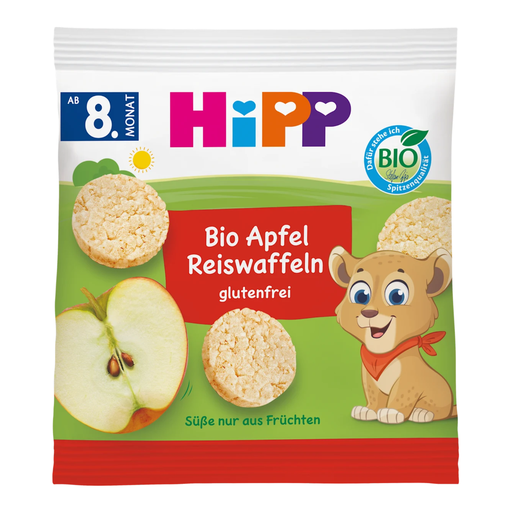
Hipp Apple Rice Cakes from 8 months, 30 g
These apple rice cakes could be a handy little snack portion if the age guidance is suitable for your child. The product name states 30 g and suitability from 8 months. Check the information on the pack you receive, as well as the ingredients and trace warnings. Before buying to stock up, check whether the product contains several individual packs.
View at Joybuy
Frequently asked questions
Should babies and toddlers eat rice cakes every day?
Rice cakes shouldn’t become the only grain in babies’ and toddlers’ daily diets. The Verbraucherzentrale notes that rice products can contain inorganic arsenic and recommends offering a variety of grains.
From what age are mini rice cakes suitable?
Check the age guidance on the specific pack. ALDI Nord labels its BIO Mini Rice Cakes “From 8 months”; this doesn’t provide general age guidance for other varieties.
Are plain, unsalted rice cakes free from allergen traces?
Not necessarily. EDEKA Bio Rice Cakes Natur may contain traces of sesame, while Kallo warns that its unsalted wholegrain rice cakes may contain traces of milk, sesame and soya. Check the current label for the variety you’re planning to buy.
When does a multipack make more sense than individual packs?
A multipack can be a good choice if you can split the individual packs between home, lunchboxes and outings, and use them up in time. Compare the number and size of the individual packs, storage advice and best-before date – not just the total amount.


