Plain rice cakes are an obvious choice when you want a snack that’s easy to portion during a busy day as a parent. To see whether a portion suits your needs, though, check the energy content per 100 g and per cake. The chocolate-coated EDEKA products compared here differ considerably from the plain rice cakes. If your young child is having a snack too, check the age guidance for the specific product and alternate rice cakes with rice-free snacks, as recommended by the German Federal Institute for Risk Assessment.
Who this guide is for
Parents keeping an eye on snack portions
If you’re considering a single rice cake as a snack between appointments, its weight and energy content per cake are more useful than the pack size alone. REWE states that its organic rice cakes contain 26 kcal per 6.7 g cake.
Parents who want to add a topping
For a savoury snack, consider the topping, salt and ingredients as well as the rice cake itself. If you need to take allergens into account, check the labelling on the specific product: for example, the REWE organic rice cakes described here contain sesame.
Parents whose young child shares their snack
For a child, the age guidance on the specific pack matters; the term ‘rice cake’ on its own isn’t enough. The German Federal Institute for Risk Assessment recommends alternating rice cakes with rice-free alternatives for snacks between meals.
What to look for when buying
First compare the nutritional information per 100 g, then consider the size of the portion you’ll actually eat. If your child will be having some too, also check the age guidance and ingredients for that specific product.
| What matters | What to check | Who it matters most to |
|---|
| Portion size and energy |
Compare energy per 100 g and per cake; for coated varieties, also check sugar and fat. |
If I only want a small snack portion, I want to know how big each cake is and how many I’ll eat. Around 39% of consumers would put portion control first. |
| Ingredients, salt and toppings |
Read the ingredients, allergen information and salt content per 100 g; include any topping as part of the snack. |
For a savoury snack with a topping, I want to know what’s already in the rice cake. This would be the main reason for choosing a product for around 23% of consumers. |
| Suitability for young children |
Check the age guidance, ingredients and allergens on the specific pack; plan some rice-free snacks too. |
If my young child is sharing my snack, my first priorities are choosing a suitable product and offering a varied range of snacks between meals. Around 38% of consumers would prioritise this. |
Common mistakes when choosing
-
Assuming a light, airy rice cake is automatically low in calories
A small serving per cake doesn’t tell you much about its energy density. EDEKA states that its organic plain rice cakes contain 379 kcal per 100 g, while the organic rice cakes from REWE in this comparison contain 383 kcal per 100 g. EDEKA’s chocolate-coated raspberry variety contains 478 kcal per 100 g.
First compare the figures per 100 g, then check the weight of each cake, how many you’ll eat and what you might add on top.
-
Giving your child an adult rice cake without checking first
Age guidance applies only to the specific product. Rice products can also contain inorganic arsenic, so the German Federal Institute for Risk Assessment recommends alternating rice products with rice-free options for snacks between meals.
Check the age guidance, ingredients and allergens on the pack, and alternate rice snacks with rice-free options between meals.
-
Overlooking salt and allergens in plain rice cakes
Products that look similar can still differ: EDEKA states that its plain rice cakes contain 0.01 g of salt per 100 g, while ALDI SÜD’s salted GUT BIO rice cakes contain 0.28 g. The REWE organic variety described here contains sesame.
Before buying, read the current ingredients list, allergen information and salt content.
-
Relying on online information instead of checking the pack
ALDI SÜD notes that its GUT BIO rice cakes may have different nutritional values depending on the supplier.
Use product pages to help narrow down your options, then check the nutritional information on the pack you’re actually buying.
Brands to consider
The product ranges below show which details are useful when comparing plain and salted rice cakes, as well as products labelled as suitable for children. The information applies to the specific products mentioned.
EDEKA Bio / EDEKA Herzstücke
Alongside organic plain rice cakes, EDEKA also offers an apple variety labelled for children and chocolate-coated rice cakes.
- For its organic plain rice cakes, EDEKA lists rice as an ingredient and 379 kcal per 100 g. Its organic apple rice cakes are labelled ‘from 8 months’.
- EDEKA Herzstücke raspberry and dark chocolate rice cakes aren’t nutritionally equivalent to the plain variety: EDEKA states that they contain 478 kcal and 36.8 g of sugar per 100 g.
REWE Bio
The REWE organic rice cakes considered here have nutritional information per 100 g and per cake.
- REWE states that they contain 383 kcal per 100 g and 26 kcal per 6.7 g cake.
- The product contains sesame and, according to REWE, may contain milk and soya. If you have allergies, always check the current labelling on the pack.
GUT BIO (ALDI SÜD)
The salted GUT BIO rice cakes considered here are a savoury option to compare with plain rice cakes.
- ALDI SÜD states that this product contains 381 kcal and 0.28 g of salt per 100 g.
- According to ALDI SÜD, nutritional values may vary depending on the supplier. Be sure to check the specific pack.
Rice cakes at Joybuy
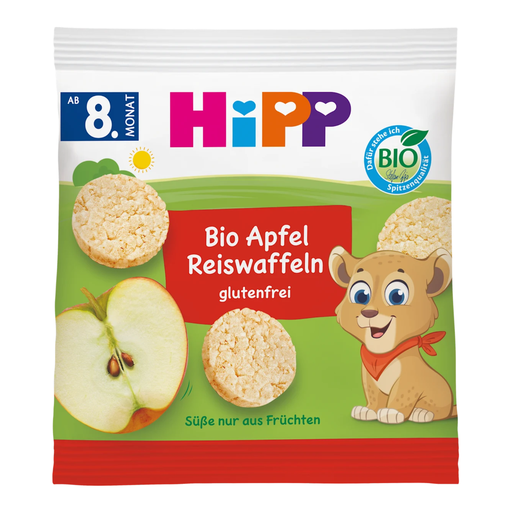
This selection features an apple rice cake labelled as suitable for children from a specified age. To help you decide on a portion, also check the nutritional information on the specific pack.
 No image available
HiPP apple rice cakes, from 8 months, 30 g
If you’re choosing a snack for a child from the age shown on the pack, check the ingredients and nutritional information. Children should be supervised while eating and should not be lying down. For snacks between meals, the German Federal Institute for Risk Assessment recommends alternating rice cakes with rice-free alternatives.
View at Joybuy
Frequently asked questions
Are rice cakes automatically low in calories?
No. A light rice cake isn’t automatically low in energy density. EDEKA states that its organic plain rice cakes contain 379 kcal per 100 g; the organic rice cakes from REWE considered here contain 383 kcal per 100 g; and EDEKA’s chocolate-coated raspberry variety contains 478 kcal per 100 g. The size of each cake, how many you eat and what you add on top also matter when choosing a snack.
From what age can a child eat rice cakes?
Age guidance doesn’t apply to all rice cakes. For example, EDEKA’s organic apple rice cakes are labelled ‘from 8 months’. For any other product, check its own age guidance, ingredients and allergens.
Why shouldn’t young children always have rice cakes as a snack?
Rice products can contain inorganic arsenic. For this reason, the German Federal Institute for Risk Assessment recommends alternating rice cakes with rice-free alternatives for snacks between meals, rather than always offering the same rice snack.
Do I need to check for allergens in organic rice cakes?
Yes. An organic label doesn’t mean a product is free from allergens. The REWE organic rice cakes considered here contain sesame and, according to REWE, may contain milk and soya. If you have allergies, check the labelling on the current pack.


