What should you look for when buying?
First, decide whether you’d prefer a cake with no topping, a ready-to-eat cracker or a plain rice cake with a topping of your choice. Then compare the nutritional information for the amount you actually plan to eat.
Lentil and maize and pulses cakes
A good choice if: you want a cake-style base without an extra topping. REWE lists 25 g of protein per 100 g for REWE Bio lentil cakes and 18.4 g for Verival Bio Protein Cakes.
Bear in mind: the figures per 100 g don’t show how much protein is in a single cake. Verival also uses maize and pulses rather than rice alone.
Ready-to-eat lentil crackers
A good choice if: you want to take a savoury snack with you that needs no preparation. The Risbellis varieties listed by REWE provide 10 and 11 g of protein per 40 g pack respectively.
Bear in mind: according to REWE, the seasoned varieties contain 1.27 to 1.45 g of salt per 100 g; Sour Cream & Onion contains milk ingredients.
Classic rice cakes with a topping
A good choice if: you want a plain cake and plan to add a separate source of protein to your snack.
Bear in mind: the classic rice cakes listed by EDEKA and ALDI SÜD contain 8.7 and 6.7 g of protein per 100 g respectively, less than the lentil and maize and pulses cakes compared here.
| What to consider |
What to check when buying |
Who might find it especially important |
| Protein without a topping |
Compare the protein per 100 g with the amount you plan to eat. |
I want to eat the cake without any extra ingredients, so I check its protein content first. This would be the top priority for around 34% of consumers. |
| A portion to take with you |
Check the pack size and the stated amount of protein per pack or portion. |
After training, I want to be able to eat my snack straight from the pack. Around 20% of consumers are likely to prioritise a convenient, ready-to-eat portion. |
| Plant-based recipe and allergens |
Check the ingredients, vegan label and any relevant allergen and ‘may contain’ information for the specific variety. |
A plant-based recipe or checking for specific allergens matters more to me than choosing the product with the most protein. This would be the main buying priority for around 20% of consumers. |
| Salt and seasoning |
Compare the salt per 100 g and the ingredients in plain and seasoned varieties. |
I want to choose how strongly my snack is seasoned, rather than choosing based only on its protein content. Around 13% of consumers would check the salt and ingredients first. |
| Variety in your snack base |
If you eat these snacks regularly, consider other cake or cracker bases as well as rice products. |
If I often reach for crunchy snacks, I don’t want to choose a rice product every time. This variety would come first for around 13% of consumers. |
Lentil cakes at Joybuy
If you’d like a crunchy lentil-based cake instead of a classic rice cake, this Joybuy product could be an option. Compare the nutritional information on the pack with the amount you plan to eat as a snack.
 No image available
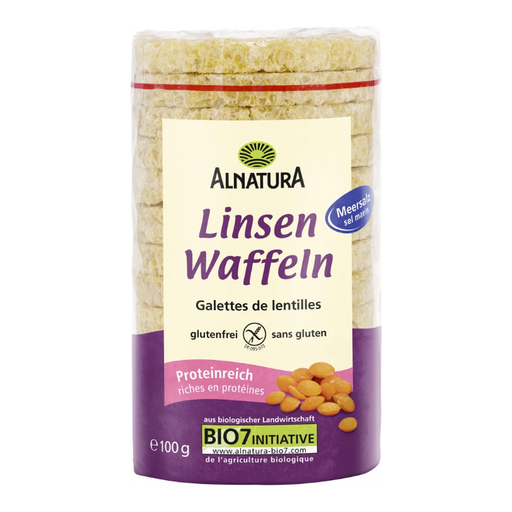
Alnatura organic lentil cakes, 100 g
A lentil cake for anyone looking for a crunchy alternative to rice cakes after training.
Pack size: 100 g. Check the nutritional information for the amount you actually eat as a snack.
As the soya information is contradictory, if you have a soya allergy, check the labelling on the specific pack before eating.
View at Joybuy
Frequently asked questions
Does ‘High Protein’ tell me enough about my post-workout snack?
No. The name alone doesn’t tell you how much protein you’ll get in your portion. Compare the protein information with the amount you actually plan to eat, and consider the snack as part of your overall diet.
Which of the cakes compared here are labelled vegan?
The Verival Bio Protein Cakes are labelled vegan on the REWE product page. REWE lists red lentils and sea salt as ingredients in its REWE Bio lentil cakes; if vegan labelling is important to you, check the label on the specific pack. Risbellis Sour Cream & Onion, on the other hand, contains milk ingredients.
Do classic rice cakes provide as much protein as lentil cakes?
Not in the products compared here, when you look at the same amount: EDEKA lists 8.7 g of protein per 100 g for its Bio rice cakes, plain, and ALDI SÜD lists 6.7 g for its organic rice cakes; REWE states that its Bio lentil cakes contain 25 g per 100 g. If you prefer a classic rice cake, you could add a separate source of protein to your snack.
What should I bear in mind if I eat rice cakes often?
If you eat them often, vary your snack base rather than choosing only rice products. The German Federal Institute for Risk Assessment points out that rice products such as rice cakes can contain relatively high levels of inorganic arsenic; this doesn’t tell you how much is in any particular pack.


