Preparing portions for the week
If you want to make several lunch portions in one dish, compare its dimensions with the usable interior space of the oven you’re considering. The number of portions alone won’t tell you whether the dish will fit.


Choose your oven type based on how many portions you want to make, the size of your dish and the space available in your kitchen. A countertop oven could be right for you if a smaller dish will do and you don’t want to use a built-in space; depending on the model, a built-in oven offers more capacity and additional heating functions. Before you buy, check the recipe and the dimensions of your dish. More oven space or a fan setting won’t guarantee a particular result for rice pudding. Also allow time to pre-cook the rice according to the recipe, then cool it quickly and keep it chilled until you take it with you. An oven won’t take care of these steps for you, as the German Federal Institute for Risk Assessment (BfR) explains in its food safety guidance.
If you want to make several lunch portions in one dish, compare its dimensions with the usable interior space of the oven you’re considering. The number of portions alone won’t tell you whether the dish will fit.
If you don’t have a suitable space for a built-in oven or worktop space is limited, weigh up a smaller countertop model against a larger oven capacity. For countertop models, check the installation instructions too.
If you want to use the oven for other dishes or cook on several shelves, compare the heating functions, oven capacity and installation dimensions. A dedicated rice pudding setting shouldn’t be your only deciding factor.
A good fit if: You want to use a smaller dish and don’t want to take up a built-in space. Severin lists a 20 l capacity and top and bottom heat for the TO 2067.
Keep in mind: The TO 2067 doesn’t have a fan function, and its timer is limited to 60 minutes (Severin).
A good fit if: You need space for a larger dish to make several lunch portions, but don’t want a built-in model. Rommelsbacher lists a 42 l capacity and a usable interior area of 34 × 28 cm for the BG 1805/E.
Keep in mind: According to Rommelsbacher, the appliance is 55 cm wide including its feet. You’ll also need to follow the installation instructions in the manual.
A good fit if: You have a suitable space and want to use the oven for other kinds of baking too. Bosch lists a 71 l capacity and fan-assisted cooking on up to three levels for the HBA571BB4.
Keep in mind: The dimensions of the space and the electrical connection must suit the specific model. Cooking on several levels doesn’t guarantee an even result for rice pudding.
| What you’re looking for | What to check before buying | Who is this important to? |
|---|---|---|
| Dish size and number of portions | Measure the dish, including its rim, and compare its width, depth and height with the oven capacity. Rommelsbacher lists a usable interior area of 34 × 28 cm for the BG 1805/E; your dish will need to be smaller. | If I’m preparing several lunch portions, I want to know whether my dish will fit. Around 31% of consumers are likely to put dish size and portion numbers first. |
| Kitchen space and oven type | Compare the appliance’s dimensions with the available worktop space or built-in space. Rommelsbacher lists an overall width of 55 cm for the BG 1805/E; Bosch specifies a required space width of 560–568 mm and a depth of 550 mm for the HBA571BB4. | If I have limited worktop space or need an oven to fit a built-in space, I want to choose a model that suits the space. Around 25% of consumers are likely to prioritise kitchen space and oven type. |
| Heating function and recipe steps | Check that the recipe steps, temperature and heating function match the manual. The manufacturer lists no fan function and a 60-minute timer for the Severin TO 2067. | If I want to make a particular rice pudding recipe, its steps need to suit the oven settings. Around 25% of consumers are likely to prioritise the recipe steps and heating functions. |
| Energy use and running costs | For household ovens covered by the relevant rules, you can compare energy use per standard cycle in kWh. The European Commission excludes small ovens from the scope of the rules described here. | If I use the oven often, I want to understand its energy use and any possible installation costs. Around 19% of consumers are likely to prioritise energy use and running costs. |
A capacity in litres won’t tell you whether your dish will fit in terms of width, depth and height.
Measure your dish and compare it with the usable interior space of the specific model. Rommelsbacher lists 34 × 28 cm for the BG 1805/E; your dish should be a little smaller.
Pre-cooking adds an extra step and may mean you need another pan.
Heating doesn’t remove every risk: spores of Bacillus cereus can survive standard heat treatments, explains the German Federal Institute for Risk Assessment.
Plan to cool the food quickly, store it in the fridge and keep it chilled during transport. Choosing a particular oven model won’t take care of these steps.
A smaller oven capacity doesn’t automatically mean lower energy use; standardised label figures don’t measure the energy used for your specific rice pudding recipe.
Only compare figures measured on the same basis, and take your own usage into account. The Verbraucherzentrale recommends checking the appliance’s actual electricity use; the European Commission excludes small ovens from the scope of the rules described here.
Countertop ovens for smaller dishes, if you don’t want a built-in model.
Larger countertop ovens for a suitably sized baking dish, without needing a built-in space.
Built-in ovens for a suitable space and other kinds of baking.
Built-in ovens to consider if you have a suitable space.
Built-in ovens with model-specific features for other kinds of baking.
This selection includes built-in ovens and compact countertop models. Compare the dimensions of your dish, the available worktop or built-in space, and the heating function your recipe calls for.
 No image available
An option if you’re looking for a built-in model with top and bottom heat and fan-assisted cooking for other kinds of baking.
71 l; 3D hot air for up to three levels; pyrolytic self-cleaning; AutoPilot 10; LED touch controls. Required space width 560–568 mm and depth 550 mm; check that your space is suitable before buying.
 No image available
A built-in option if you want to use additional baking or grilling functions as well as making rice pudding.
60 cm; 70 l; 3 kW; hot air; grill and pizza function; AquaClean steam cleaning; timer. Check that the built-in space is suitable for the appliance before buying.
 No image available
A built-in option if you’re looking for extra features for other kinds of baking, as well as top and bottom heat.
60 cm; AirFry; 3D hot air; pyrolytic cleaning; stainless steel. Check the built-in space and the dimensions of the specific appliance before buying.
 No image available
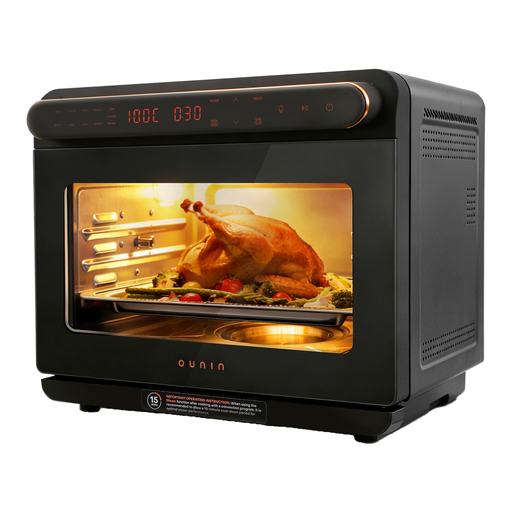
A countertop option if you’d prefer a compact combination oven to a built-in model.
24 l; Steam Bake and Steam Roast; rotisserie; 1-litre water tank; 304 stainless steel interior.
 No image available
A countertop option if a mini oven is big enough for your chosen dish and you have a suitable space for it.
32 l; 1,600 W; temperature range 100–250 °C; 60-minute timer; crumb tray.
It depends on the recipe. Check whether the rice pudding needs to be cooked on the hob before baking, and don’t assume the same steps will work for a different recipe.
Cool it quickly after cooking and keep it chilled until you eat it. The German Federal Institute for Risk Assessment recommends a fridge temperature of 2 °C to no more than 7 °C for perishable foods, and keeping them chilled when travelling too. If you’re making a large quantity, dividing it between shallow containers helps it cool down. Reheating later won’t reliably make up for unsafe storage.
No. A missing label doesn’t automatically mean the appliance is faulty or uses less energy. The European Commission excludes small ovens from the scope of the rules described here; for household ovens covered by the rules, the label shows, among other things, energy use per standard cycle. Check the product documentation to find out how a specific countertop oven is classified.
Your statutory rights for faulty goods are generally against the seller, not the manufacturer. Section 438 of the German Civil Code (BGB) generally provides for a two-year period from delivery; Section 439 covers repair or replacement as remedies. A voluntary manufacturer’s guarantee is separate from these rights.