Bookbinders working at a small table
When you need room for paper, books and tools, the mount matters. A clamp can keep the tabletop clear, but you’ll need a suitable table edge.


Start by choosing a mount that won’t get in the way of your book, hands or tools on a small table, then check the overhead view with your actual setup. A clamp keeps the tabletop clear, but you’ll need a suitable edge; a tabletop stand is more flexible to position, but takes up space. Adjustable brightness and colour temperature make it easier to set things up, but they’re no substitute for a test recording with your paper and existing lighting.
When you need room for paper, books and tools, the mount matters. A clamp can keep the tabletop clear, but you’ll need a suitable table edge.
For overhead shots, you need to position your smartphone and light so your hands, project and each step remain in frame. Check the position with your largest book.
If you film in daylight by a window or in other changing light conditions, adjustable brightness and colour temperature can help you fine-tune your setup. A test recording is the best way to see how the paper and materials look.
First, decide where you can place or attach the light. Then check the framing with your book and hands. You can assess the colour temperature, brightness and any possible flicker in a test recording.
| What matters | What to check before buying | Who will find this most important? |
|---|---|---|
| Clear workspace | Measure the table edge and check that the clamp is within reach, while leaving enough room to move your book and tools. NEEWER lists a maximum clamp opening of 5.5 cm for the NEEWER N31. | If I need to move my book, tools and hands around in a small space, a mount that doesn’t sit on the tabletop matters. This is the top priority for around 33% of consumers. |
| Clear overhead view | Set up the shot with the largest book you plan to use, along with your hands and tools. Check whether the mount, tilt and height of the specific set will let you achieve the right position. | If you want to film folding or stitching from above, you need a frame that captures your hands and book at the same time. Being able to position the camera for a suitable overhead view is the top priority for around 27% of consumers. |
| How your materials look | Test the lighting with light and dark paper, and a glossy cover if relevant. If you see reflections, change the angle of the light. | If I want to see the paper, thread and details clearly in my video, how my materials look is especially important. Around 20% of consumers say this matters most to them. |
| Consistent video lighting | Save a test recording at the dimming level you plan to use and check for changes in brightness or flickering. For regions with a 50 Hz power supply, Sony suggests shutter speeds of 1/50 or 1/100 of a second as possible options. Test what works with your camera and light source. | If you’re filming a longer tutorial, you’ll want to be able to control the light throughout the recording. Consistent video lighting is the top priority for around 20% of consumers. |
A larger ring won’t solve space problems or guarantee that your book and hands will be fully visible from the camera position you choose.
First, check where you can mount the light and where the camera can reach. Test the framing with the largest project you plan to film.
A tabletop stand needs space, while a clamp requires a suitable, accessible table edge.
Measure the table edge and allow room for your book, tools and hand movements before choosing a style of mount.
The image also depends on the existing light, your materials and the camera. Adjustable colour temperature therefore doesn’t guarantee a particular colour rendition.
Record a short test video with your paper and final lighting setup before filming the tutorial.
The N31 and RL7B tabletop ring lights offer different ways to set up your smartphone for filming.
The SpotLight Smart 80 II is a tabletop tripod set with a smartphone holder and a tilting ring light.
The LUMIS Comfort Bi-Color combines a ring light and smartphone holder with a taller tripod.
The options below include ring lights with tripods, as well as a compact model that attaches to your device. Before buying, check that the setup and camera position will fit on your table and give you the shot you want.
 No image available
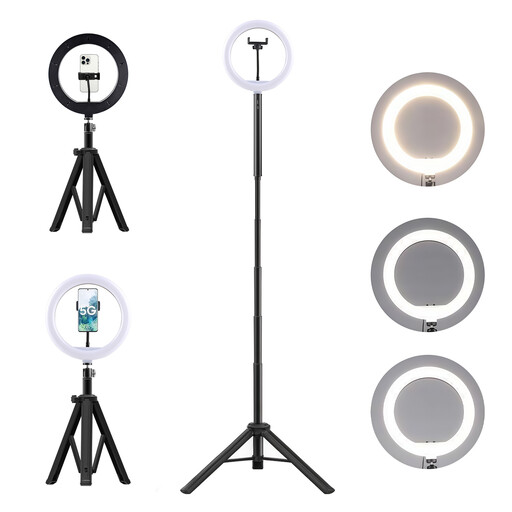
Could be worth considering if you want to position your smartphone higher up. Check that the tripod and holder can give you the shot you want above your table.
The product name specifies a floor tripod and a 10,000 mAh power bank.
 No image available
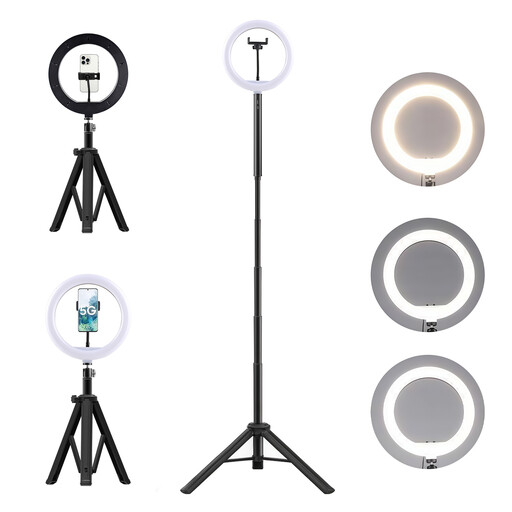
The product name specifies a floor and tabletop tripod for smartphones. Check which setup will leave enough room for your book and tools on a small table.
The power bank is listed as having a capacity of 10,000 mAh.
 No image available
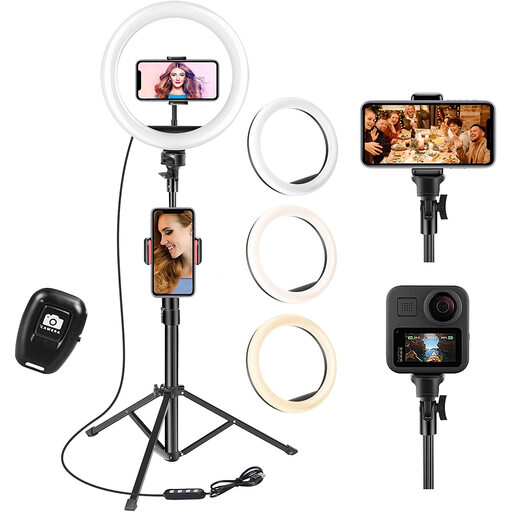
A taller tripod could be an option if you want to position the light higher up. Check that its legs will fit in your workspace and that the camera holder can give you the shot you want.
The product name specifies a 10-inch ring light, a 63-inch tripod, three colour temperatures and ten brightness levels.
 No image available
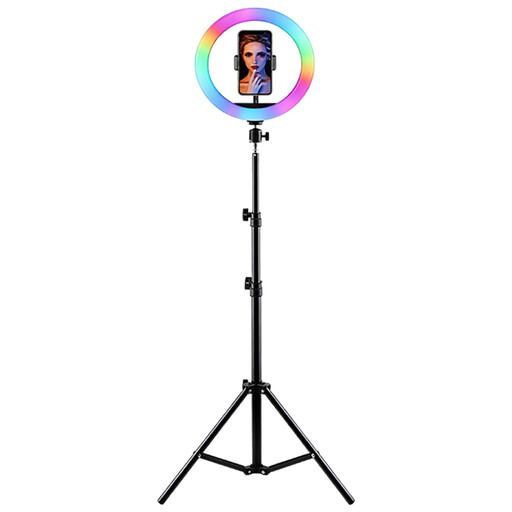
The central smartphone holder and tilting ring light could be useful if you want to change the light position. Check the framing with your book and hands.
The product name specifies a height-adjustable tripod, adjustable brightness and adjustable colour temperature.
 No image available
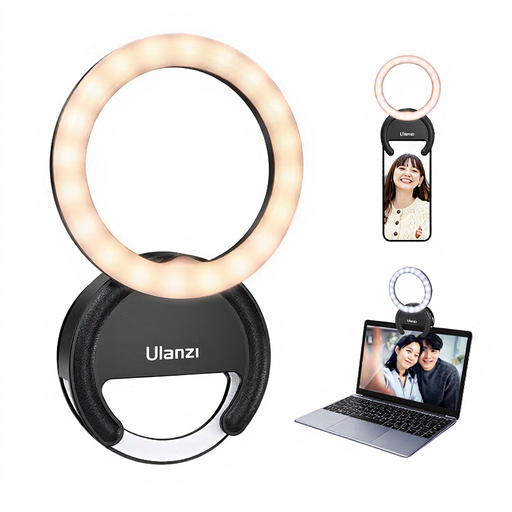
This compact light, described as clip-on, could be an option if you want to attach it directly to your smartphone. Check whether this position gives you an overhead view of your project.
The product name specifies three colour temperatures from 3000K to 7000K and five brightness levels.
No. The holder and the positions you can achieve vary by model. Set up the shot with your largest book and your hands. A tripod can help you keep the camera in the same position for repeat recordings.
First, check a saved recording made with your paper and the dimming level you plan to use. If you see reflections, try changing the angle of the light. If there’s flickering, a different shutter speed or a suitable anti-flicker feature may help, depending on your camera and light source.
Position the holder and cables so your hands and tools won’t catch on them. Follow the instructions for your specific model on power and cleaning, as the sets vary in design and power supply.
For online purchases by consumers, you generally have a 14-day right to cancel; you must notify the retailer that you wish to cancel. Separately, if goods are faulty, you have a statutory right to a remedy from the seller for at least two years. A voluntary manufacturer’s guarantee is different. The Verbraucherzentrale explains the right to cancel, while the European Union provides information about guarantees for goods bought in the EU.
Check the information for the specific product and the safety regulations that apply to it. CE marking is required if the product falls under the relevant harmonised EU rules; it is a declaration made by the manufacturer, not an official approval. A ring light that has reached the end of its life should be taken to a separate collection point for waste electrical and electronic equipment, not put in household rubbish. The European Union explains the requirements for CE marking, and the Umweltbundesamt provides information about waste electrical and electronic equipment.