Teachers who need an overhead view
If you mainly film your hands, tools and clay on the work surface, the camera needs a stable, unobstructed view of the area. SmallRig describes a separate mount for overhead shots.


For a clay modelling session, a ring light is only suitable if the camera can be securely positioned above the work independently of the light. A tilting light head alone does not guarantee a safe overhead view. Match the light colour and camera white balance to the room lighting, and compare a test shot with side-on, diffused light if you want edges and indentations to remain visible. Canon Europe describes side lighting as a way to use shadows to bring out shape.
If you mainly film your hands, tools and clay on the work surface, the camera needs a stable, unobstructed view of the area. SmallRig describes a separate mount for overhead shots.
If you show different clay colours or intricate techniques, match the light colour and camera white balance to the room lighting. The Verbraucherzentrale explains the importance of Kelvin and CRI or Ra ratings, while Canon Europe explains how light colour affects white balance.
If you switch between filming your face and your work, or pack everything away after a class, consider the footprint, mount and power supply together. Hama and Rollei describe kits with floor stands, but you still need to check that the camera can be positioned as required.
Suitable if: You switch between filming your hands and speaking to camera, and have space beside the table.
The trade-off: An all-in-one kit can make setup easier, but may limit your ability to position the light and camera independently. The stand’s height alone does not guarantee a safe overhead view.
Suitable if: You have a dedicated filming space and want to position the light and camera independently. For the RP18B Pro, NEEWER lists 2.900–7.000 K, CRI 97+ and TLCI 98; these are the manufacturer’s specifications for this model.
The trade-off: The larger setup needs floor space. The NP-F battery accessories listed by the manufacturer for the RP18B Pro are sold separately.
Suitable if: A front-facing test shot doesn’t show the edges and indentations in the clay clearly enough. Side lighting can use shadows to bring out shape.
The trade-off: The lighting may look less even. If the shadows are too harsh, you may need to add fill light.
| Priority | What to check when buying | Who is it important to? |
|---|---|---|
| Clear, secure overhead view | Check the camera mount, the angle it can reach and its load capacity; don’t assume a tilting light is also a camera mount. SmallRig describes separate mounts for overhead shots. | If I want to show my hands and work from above, the camera needs to stay stable without blocking the work area. Around 33% of consumers put a clear, secure frame first. |
| Accurate clay colours | Check that the light colour is adjustable, look for a CRI or Ra rating, and check the camera’s white balance. Film a clay sample under the room lighting you plan to use. The Verbraucherzentrale and Canon Europe explain these factors. | If I show different clay colours under artificial light, I want to match the recording to the actual lighting in the room. Around 27% of consumers prioritise accurate colour in clay. |
| Visible details and shape | Test the light angle with your own work to see whether it brings out edges and indentations; consider fill light if the shadows are harsh. Canon Europe explains how side lighting can use shadows to bring out shape. | I want indentations and hand movements to remain visible in my videos, rather than disappear under even front lighting. Around 20% of consumers prioritise the visibility of details like these. |
| A suitable setup and power supply | Check the space required, cable routing and connections, and confirm exactly what’s included: power adapter, battery and stand. Hama, NEEWER and Walimex pro list different stand and battery specifications depending on the model. | If I pack up after teaching or have limited space at my workstation, the kit needs to suit the available space and power source. Around 20% of consumers prioritise setup and power supply. |
A floor stand’s stated height or a swivelling light head doesn’t prove that the camera can be held securely above the clay.
Plan the framing and the positions of the light and camera separately. Check the connections and load capacity of the complete setup.
Depending on your setup, you may need an additional mount suitable for your camera.
Very even front lighting can soften the shadows that make edges and indentations visible. On the other hand, shadows that are too strong can obscure what you’re doing.
Compare test shots with a ring light and with side-on, diffused light. Check whether hand movements and surface details are visible from the camera’s angle.
Wattage indicates power consumption; the room lighting and camera white balance also affect how clay colours are recorded. A CRI or Ra rating describes a property of the light source, not the video result on its own.
Check the specifications for the exact model and film a clay sample under the conditions you’ll use for recording. The Verbraucherzentrale explains CRI and Ra, while Canon Europe describes how light colour affects white balance.
What’s included varies by model and kit version. NEEWER lists the NP-F battery accessories for the RP18B Pro as sold separately; batteries and a light stand aren’t listed as included with the Walimex pro RLL-500BV.
Before ordering, compare the parts list for the exact model and kit version.
Depending on the kit, you may need to buy a battery, power adapter or stand separately.
The SpotLight Steady 120 III is a smartphone ring light kit with a floor stand and tilting light.
The RP18B Pro is a larger ring light kit with mounting options for a camera and smartphone.
According to the supplier, the RLL-500BV is a bi-colour ring light that can also be used with a separately mounted camera.
According to Rollei, the LUMIS Comfort Bi-Color combines a swivelling ring light with a smartphone holder and stand.
The LR160 is a continuous ring light with adjustable light colour and brightness, according to the manufacturer’s manual.
The ring lights and kits below are described as suitable for smartphone photography, video recording and changing lighting conditions. For each model, check whether the camera mount is suitable for the overhead view you want.
 No image available
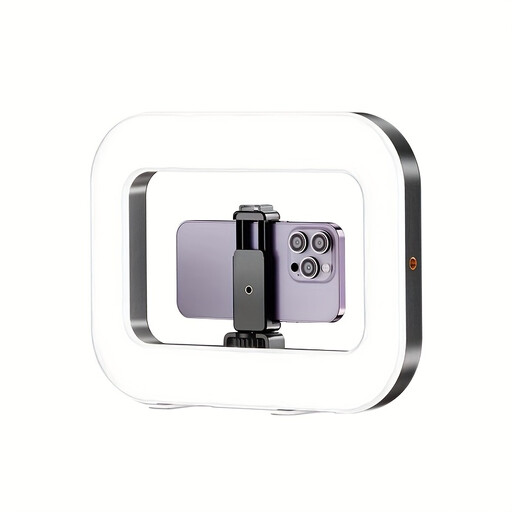
For a flexible smartphone filming setup, provided you use a suitable mount.
The product specifications list a built-in battery, three adjustable light colour and brightness settings, and 1/4-inch threads on the bottom and sides.
 No image available
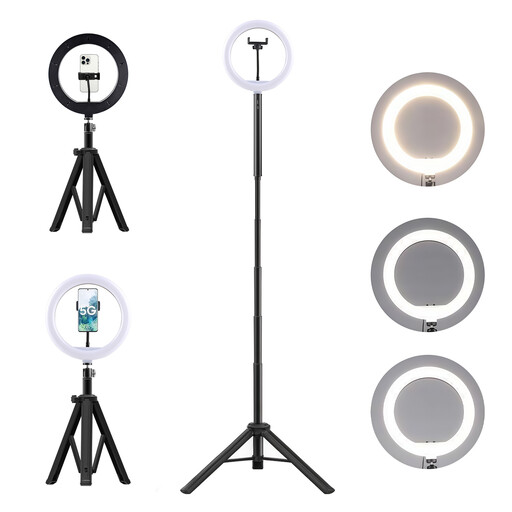
For video recording when you want the ring light and smartphone together on a floor stand.
Kit features include a 10.000-mAh power bank, a 178-cm floor stand and a smartphone holder. The product description lists three colour temperature modes and ten brightness levels.
 No image available
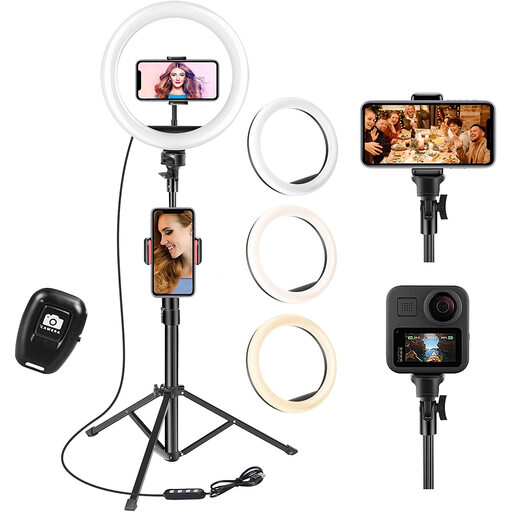
For video recording when you want the ring light and recording device positioned on a stand.
The specifications list a holder for a smartphone or camera, a remote control, three colour temperatures and ten brightness levels. The stand is height-adjustable; check whether the holder allows for the overhead view you want.
 No image available
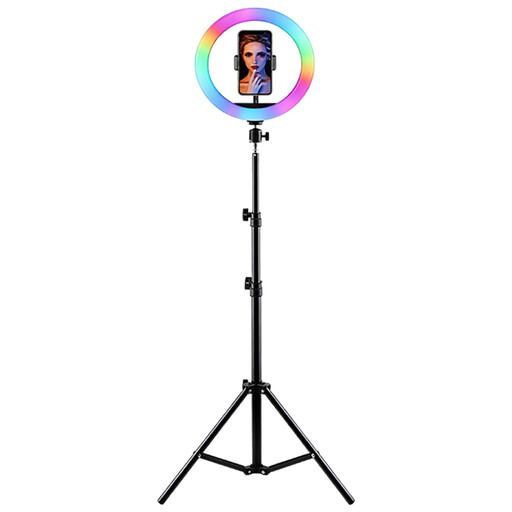
For filming when you want a tilting ring light and an integrated smartphone holder.
The product description lists a height-adjustable stand, adjustable brightness and colour temperature, and RGB colours. It advises using the light on a stable surface, keeping it away from moisture and using the correct power adapter.
 No image available
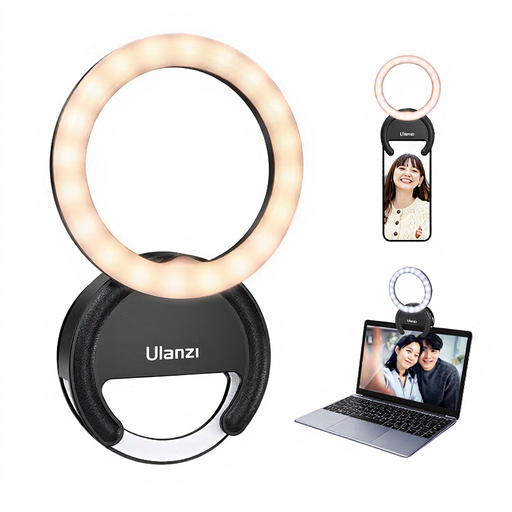
A compact extra light that, according to the product title, clips directly onto a smartphone or laptop.
The specifications list three colour temperatures from 3.000–7.000 K and five brightness levels. Don’t look directly at the LEDs at maximum brightness, and keep the light away from water and high humidity.
Not necessarily. What matters is whether the camera can be held securely in the position you need, with both hands still in frame. Check the mount and its load capacity independently of the light’s tilt angle.
Match the adjustable light colour to the rest of the room lighting, then check the camera white balance using a clay sample in your planned frame. A CRI rating describes a property of the light source, not the camera’s results on its own. The Verbraucherzentrale and Canon Europe explain this in their guidance on colour reproduction and white balance.
Keep the light, power adapter and cables outside the damp work area, and follow the instructions for the specific model. Godox explicitly requires dry operating conditions for the LR160; this guidance is not a general protection rating for other devices.
For a consumer purchase made at a distance, you generally have a 14-day right to cancel from the date of delivery, subject to legal exceptions, as explained by Your Europe. If an item is faulty, your statutory rights are against the seller. The Verbraucherzentrale distinguishes these rights from a voluntary guarantee with its own terms and conditions.
The Bundesnetzagentur lists correct CE marking, identifiable product and manufacturer details, and German operating and warning instructions among the checks it carries out as part of market surveillance. Check the information for the specific listing; a CE mark alone is not an independent quality test mark.