Artists filming in changing window light
If you film by a window for a while, the daylight can change. Adobe Stock Contributor and Canon Europe point out that changing light conditions can affect exposure and colour balance.


Start with indirect window light. Adjustable continuous lighting is most worthwhile when shadows are a problem or daylight changes during filming. Choose a ring light based on how easily you can position it, whether it has a suitable camera or phone holder, and whether you can adjust the brightness and colour temperature—not just its diameter. If you’re using shiny drawing materials, first check the camera view to see whether moving a light to the side shifts unwanted reflections.
If you film by a window for a while, the daylight can change. Adobe Stock Contributor and Canon Europe point out that changing light conditions can affect exposure and colour balance.
To film your paper and drawing hand from above, the holder, angle and tripod need to suit your desk and framing. Hama and Rollei describe phone holders and tripods in their ring light kits, but still check the setup in your own space.
With glossy paper, markers or film, what matters is whether the light creates reflections in the camera view. Nikon USA explains that reflections can affect your footage, so test the light’s position with the material you’ll be using.
Suitable if: Indirect daylight lights your paper and hand well enough, and you can adjust the recording if needed.
The trade-off: You won’t need any extra equipment, but the weather and time of day can change the exposure and colour balance.
Suitable if: You film on a smartphone, have limited space and mainly want to fill in shadows.
The trade-off: A shared tripod makes setup easier, but limits how independently you can position the camera and light.
Suitable if: You want to light a larger work area and adjust the brightness or colour temperature during longer recordings.
The trade-off: More adjustment and mounting options take up space, so check the footprint, power supply and what’s included.
Suitable if: A light near the camera causes unwanted reflections on shiny materials and you want to change the angle of the light.
The trade-off: Position the light so your hand and pen don’t obscure important details, and check the result on your subject.
Adobe Stock Contributor and Canon Europe point out that daylight can change while you’re filming. So consider light controls, camera position and available space alongside the drawing materials you’ll be using.
| What you need | What to check before buying | Who is this important to? |
|---|---|---|
| Changing light and shadows | Check for dimming and adjustable colour temperature. Assess the light across the whole sheet of paper, not just the area near the light. | If the window light changes during a longer recording, I want to be able to adjust the additional light. Around 31% of consumers put even additional lighting first. |
| Overhead view of the paper and hand | Compare the tilt, reach and footprint with the size of your paper and camera position; check that the assembled kit is stable. | If I want to film the paper and my hand from above, I need to be able to position the camera appropriately. Around 25% of consumers prioritise a workable overhead view. |
| Reflections and visible colours | Test your paper, pens and, if applicable, film in a sample recording. The Verbraucherzentrale describes CRI/Ra as an indicator of colour rendering; it doesn’t guarantee a reflection-free image. | When I’m using shiny materials, I want to spot unwanted reflections and colour casts in the image. Around 25% of consumers prioritise clear colour reproduction with minimal reflections. |
| Space, power and what’s included | Check whether the tripod, a suitable phone or camera holder, and the power supply you need are included—and whether they’ll fit beside your desk. | If my drawing desk has limited space, I want to know in advance which parts are included in the kit. Around 19% of consumers prioritise a compact, complete setup. |
The stated tripod height and a smartphone holder don’t, by themselves, tell you whether the reach, angle and stability are right for an overhead view of your paper.
Plan the camera position, paper size and available space together before choosing a kit.
Depending on your setup, you may need a separate holder that’s compatible with your recording device.
Wattage describes power consumption. For an illuminance figure, the measurement distance matters; neither tells you on its own how the light will look on your paper.
Only compare figures that use the same units and measurement basis, and test the dimming, colour temperature and positioning in a sample recording.
A best-buy list may feature a different model version from the product page. For example, Testberichte.de lists the SpotLight Steady 120, while Hama provides details for the SpotLight Steady 120 III.
Compare the full model name and what’s included with the specific version you’re considering.
The SpotLight Steady 120 III combines a 12-inch light with a phone holder and extendable tripod.
According to the manufacturer, the LUMIS Comfort Bi-Color is designed for compact smartphone video setups, with a holder and tripod.
NEEWER lists a 45 cm ring for the EU model RL-18.
According to the supplier, the 380 Bi Color Set combines a larger ring light with a lighting stand and smartphone holder.
This selection includes ring lights and tripod kits for adjustable additional lighting and smartphone overhead shots. Compare the stated holder, tripod height and power supply with your desk setup.
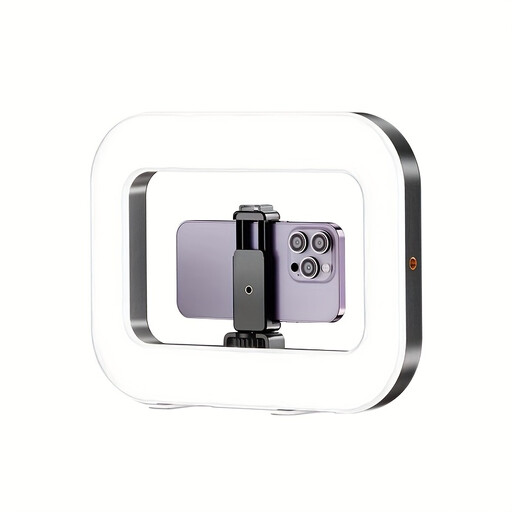 No image available
For adjustable additional lighting and a height-adjustable position for your smartphone or camera.
10-inch ring light with 120 LEDs; three colour settings and ten brightness levels.
The tripod is height-adjustable from 44 cm to 156 cm.
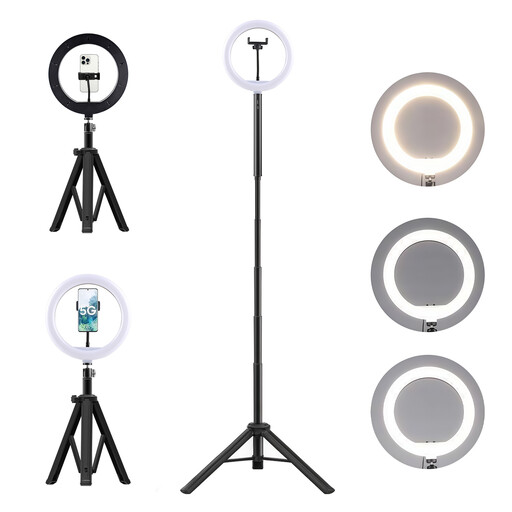 No image available
For overhead smartphone shots with adjustable lighting and a phone holder.
10-inch light with 72 LEDs, ten brightness levels and three colour temperature modes.
The light head adjusts through 360°; the tripod is listed as 70 inches. The title mentions a 10,000 mAh power bank.
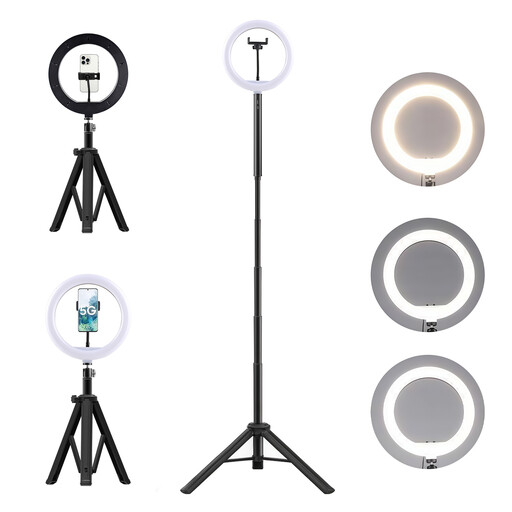 No image available
For adjustable recording heights and additional lighting for smartphone or camera shots.
10-inch ring light with 72 LEDs, ten brightness levels and three colour temperatures.
The light head adjusts through 360°; the tripod is listed as 70 inches.
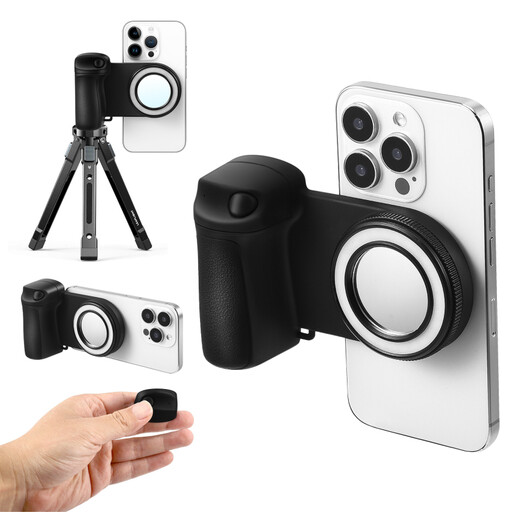 No image available
For hands-free smartphone shots with a Bluetooth remote control and adjustable lighting.
Five brightness levels.
Don’t look directly at the LEDs at maximum brightness. Keep away from water and high humidity, and don’t leave switched on and unattended for long periods.
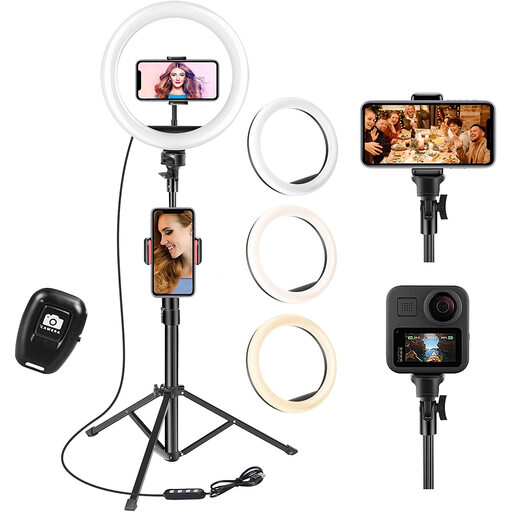 No image available
For adjustable additional lighting and a height-adjustable position for your smartphone or camera.
Three colour settings and ten brightness levels; the tripod is listed as 63 inches.
According to the product description, the tripod is height-adjustable from 44 cm to 156 cm.
If indirect daylight lights your paper and hand well enough, you can start filming without an additional light. For longer recordings, the weather and time of day can affect exposure and colour balance, so check with a short test video.
First, frame the whole sheet of paper, then check for shadows cast by your hand and pen. Adjust the angle or position of the light if needed; having a phone holder doesn’t in itself mean the kit will stand securely over your drawing desk.
Compare a test recording with and without additional light, and look for reflections and visible colour casts. CRI/Ra is an indicator of colour rendering, but it doesn’t guarantee a particular result with your materials.
Check whether the tripod, a suitable holder and the power supply you need are included in the kit. According to Your Europe, when you buy from a trader, you generally have a minimum two-year legal guarantee from the date you receive the goods. For a distance purchase, you generally have a 14-day right to cancel from delivery. Before buying, also check when you might have to pay return costs.
No. For products where the relevant EU legislation requires CE marking, the manufacturer declares that the product complies with the requirements. According to Your Europe, no central EU body issues a general CE certificate for this. Still check the specific product information and instructions for safe use.