Fine slicing for roast beef
You want to slice cooked, chilled roast beef as thinly as possible. So check the type of blade and what comes with the exact model variant.


For especially thin slices of cooked, chilled roast beef, a suitable smooth slicing blade is important; check whether it comes with the exact model variant. For a larger batch, you should also consider your workflow, cleaning options and permitted operating time. A foldable appliance saves storage space, but that alone does not indicate how well it is suited to longer slicing sessions.
You want to slice cooked, chilled roast beef as thinly as possible. So check the type of blade and what comes with the exact model variant.
For a larger batch, you need a practical workflow for slicing, cleaning, chilling and packaging. Permitted operating time varies by model.
If you want to free up worktop space after slicing, weigh up a foldable appliance against the space available and the features you need.
When preparing a batch of cooked, chilled roast beef for freezing, the key factors are your choice of blade, a hygienic workflow, the quantity you need to process and storage space.
| Consideration | What to check when buying | Who should pay particular attention |
|---|---|---|
| Thin slices of roast beef | Check the exact model variant, whether it has a suitable smooth slicing blade, and the adjustable slice thickness. ritter recommends a smooth blade for soft foods; GRAEF lists one as an additional blade supplied with the G52 TWIN. | If I want to portion cooked, chilled roast beef as thinly as possible, choosing the right blade is my top priority. Around 31% of consumers would put fine slicing first. |
| Hygiene and cleaning | Look for a food holder, a stable base and easily accessible surfaces; read the cleaning instructions for the specific appliance. The SEVERIN AS 3915 manual says to unplug the appliance before cleaning and not to immerse it in liquid. | When I handle meat, I want to be able to clean the work surfaces and appliance safely after slicing, and keep the portions chilled. Around 31% of consumers would prioritise hygiene and cleaning. |
| Workflow for larger quantities | Compare the operating time, carriage travel and collection options with the size of your batch. For the ritter E 18, the manufacturer specifies a short-time operation of 5 minutes and carriage travel of around 15 cm; these details do not apply to other models. | If I want to portion a larger quantity, the workflow needs to suit both the appliance and the piece of meat. Around 23% of consumers would make portioning a batch their top priority. |
| Limited worktop and storage space | Check the folded dimensions, the worktop space required and the features of the exact variant. A folding function alone says nothing about the blade type or permitted operating time. | If I want to put the slicer away after occasional use, the space it takes up is crucial. Around 15% of consumers would put storage space first. |
GRAEF specifically lists an additional smooth blade with the G52 TWIN. A suitable smooth blade may be sold separately for other variants.
Before buying, check the full model name against the list of included features.
If the variant does not come with a suitable smooth blade, you may need to buy an additional accessory that is compatible with the model.
Power consumption and permitted operating time are different specifications. For the ritter E 18, the manufacturer specifies 65 W and a short-time operation of 5 minutes.
Check the operating time in the manual for your chosen model, and plan suitable work periods for a larger batch.
A food slicer does not keep cooked meat chilled. The German Federal Institute for Risk Assessment explains that chilling slows or stops the growth of most bacteria.
Make space for collecting, packaging and temporarily storing the portions in the fridge. You may need suitable containers and extra space for chilled storage and packaging.
The G52 TWIN is worth considering if you’re looking for an additional smooth blade for thin slices that comes in the box.
The E 18 is an option if you’re looking for a metal appliance with the food carriage on the left.
The AS 3915 is designed for slicing different types of food, while the foldable AS 3912 is an option if storage space is limited.
The Curve is a foldable option if you want to put the appliance away after occasional use.
The MS171 is a basic model whose features you can compare with your needs for finely sliced meat.
The foldable food slicers below are described as suitable for meat and easy to store. Mains-powered appliances within the scope of the EU Low Voltage Directive must carry the CE marking; check the details for the specific appliance.
 No image available
The product description lists roast beef as a food to slice before freezing.
Foldable design; adjustable slice thickness from wafer-thin to 15 mm; stainless steel blade.
According to the product description, it is not designed for frozen foods or bones.
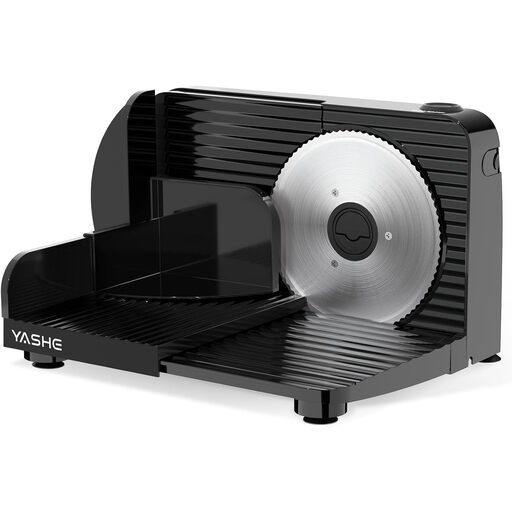 No image available
The description lists meat as a food it can slice and says the foldable design makes it easy to store. For soft roast beef, bear in mind that the listed blade is serrated.
180 W; 17-cm stainless steel blade; slice thickness from 0 to 15 mm; removable parts and safety switch according to the product description.
This buying guide focuses on cooked, chilled meat before it is portioned and frozen, rather than slicing a frozen block. If you want to slice frozen food, follow the instructions for the specific appliance; a general slice-thickness specification does not mean it is suitable for this.
Check the carriage travel, food holder and stated operating time for the exact model. For example, ritter specifies a short-time operation of 5 minutes for the E 18; this figure does not apply to other appliances.
Follow the instructions for the specific appliance. For the SEVERIN AS 3915, the manufacturer says to unplug it before cleaning and not to immerse it in liquid.
In its guidance dated 2 December 2024, Verbraucherzentrale says cooked meat can be kept in the fridge for 2 to 3 days. Plan your portioning so the meat stays chilled, and follow the guidance on storage and freezing.
Electrical equipment with a rated voltage of 50 to 1,000 V AC that falls within the scope of the EU Low Voltage Directive must carry the CE marking. EUR-Lex describes the scope of the directive; Your Europe explains that the CE marking is a manufacturer's declaration of conformity, not an EU quality mark awarded by an independent body. Check the details for the specific appliance.