If you prefer thin slices of roast beef
If you want to freshly slice cooked roast beef for different meals, pay particular attention to choosing the right blade. Ritterwerk recommends a smooth blade for soft foods and especially thin slices.


For especially thin slices of roast beef, Ritter recommends a smooth slicing blade for soft foods; according to the manufacturer, this blade is not suitable for bread. If you eat at different times, you’ll also need easy-to-reach surfaces that are simple to clean, and somewhere chilled to store the remaining meat: a food slicer is no substitute for refrigeration.
If you want to freshly slice cooked roast beef for different meals, pay particular attention to choosing the right blade. Ritterwerk recommends a smooth blade for soft foods and especially thin slices.
If you portion meat more than once, you’ll need a routine that keeps the remaining roast beef chilled between meals and lets you clean the appliance’s contact surfaces after use. The German Federal Institute for Risk Assessment recommends keeping perishable foods chilled until they are eaten.
If you’ll be slicing bread or other foods as well as roast beef, and you have limited space for setting up or storing the appliance, consider the blade and design together. Graef and Ritterwerk distinguish between smooth slicing blades and serrated blades in their recommendations.
Suitable if: thin slices of soft roast beef are your priority.
Things to consider: Ritterwerk advises against using this blade for bread. Check whether it comes with the specific model or is available as a compatible accessory.
Suitable if: you regularly slice bread or other foods as well as meat.
Things to consider: If you want especially thin slices, you may want to consider an additional smooth blade that’s compatible with the model.
Suitable if: you need to put the slicer away between meals.
Things to consider: A space-saving design alone tells you nothing about the blade, how safely it can be used or how easy it is to clean.
First check that the blade is right for your needs and see what’s included. Then look at access for cleaning and safe handling; if space is tight, consider the design too.
| Priority | What to check when buying | Who will find this most important? |
|---|---|---|
| Thin, even slices | Whether a smooth slicing blade is included or available as a compatible accessory, and the adjustable slice thickness. | If I want to slice roast beef as thinly as possible, choosing the right blade is essential. Around 33 % of consumers put thin slices first. |
| Hygiene when portioning | How the blade and carriage can be cleaned according to the instructions, and how to keep the remaining meat chilled between meals. | If I serve roast beef at several mealtimes, I want to slice it into portions and put the rest back in the fridge. Around 27 % of consumers pay particular attention to hygiene when portioning food again. |
| Several slicing tasks | Whether the blade is suitable for bread and soft foods, and whether a second blade is included with the specific model. | If I want to use the same appliance to slice bread and other foods too, versatility matters more than a special focus on thinly sliced meat. Around 20 % of consumers prioritise being able to use their slicer for several tasks. |
| Space and ease of use | The dimensions and storage options, as well as the finger guard, food holder and operating instructions for the specific model. | If my kitchen has limited worktop space or I need to consider a particular way of operating the appliance, it should be easy to position and use as needed. Around 20 % of consumers see space or ease of use as their main priority. |
The additional smooth blade is a manufacturer specification for the Graef G52 TWIN and does not apply to every G52 version.
Compare the full model name and what’s included with the specific offer. If you need a second blade, check that it’s compatible.
A separate compatible blade may mean an additional accessory purchase.
Even if you eat at different times, perishable meat should be kept chilled until it is eaten. The German Federal Institute for Risk Assessment recommends a fridge temperature of 2 °C to no more than 7 °C for perishable foods.
Slice only the amount you need each time and put the remaining roast beef back in the fridge. Clean contact surfaces according to the appliance instructions.
These features alone don’t show that the appliance has a suitable smooth blade, is easy to clean or can be handled safely.
Check the blades, cleaning instructions, stability and safety features on the specific model. Unplug the appliance before cleaning if the instructions require it.
Worth considering if you’re comparing a multi-purpose slicer with a confirmed option for thin slices.
Worth considering if you’re choosing between a smooth slicing blade, a multi-purpose slicer and different designs.
Worth considering if storage or specific handling features are high on your list when choosing a model.
The Domo MS171 is listed as a multi-purpose alternative by F.A.Z. Kaufkompass.
This selection includes electric food slicers for portioning roast beef, including foldable models and one with specifications for both smooth and serrated blades.
 No image available
An option if you’re looking for a foldable slicer that’s easy to store away.
The slice thickness is specified as 0–15 mm. It also has a stainless steel blade, a food holder and a safety cover.
 No image available
An option if you want to slice roast beef and bread with the same appliance and value safety and handling features.
The product specifications list a smooth blade for fine slices of meat, a serrated blade for bread and adjustable slice thickness from 0–15 mm. They also mention a finger guard, food holder and pivoting carriage.
 No image available
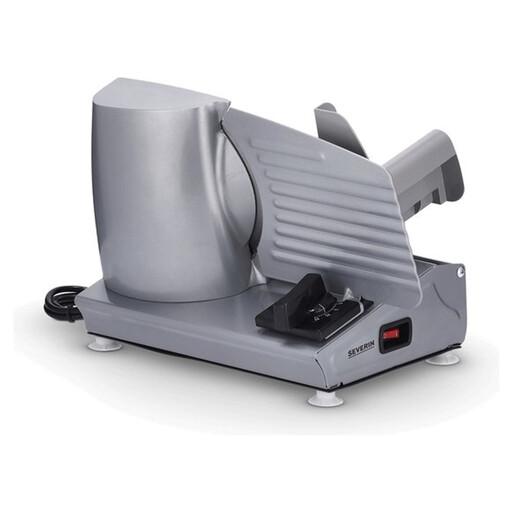
An option if you’re looking for a foldable food slicer with adjustable slice thickness.
The specifications list 0–15 mm, a 17 cm serrated stainless steel blade, a safety switch, a food stopper and non-slip feet. Ritterwerk and Graef recommend a smooth blade for especially thin slices, so check that the specified blade is right for your needs.
Yes. The German Federal Institute for Risk Assessment recommends keeping perishable foods chilled until they are eaten; its kitchen hygiene guidance specifies 2 °C to no more than 7 °C. Slice only the portion you need and put the remaining meat back in the fridge.
The German Federal Institute for Risk Assessment recommends using separate kitchen utensils for raw and cooked foods, and for foods that will be eaten without further heating. Keep this in mind when planning your food preparation, and clean surfaces that come into contact with meat according to the appliance instructions.
Place the appliance securely and follow the instructions for your specific model. The Ritter E 18 instructions state that the appliance must be unplugged before it is taken apart or cleaned; check the instructions for your own model too.
The European Union describes CE marking as the manufacturer’s declaration that the product meets the relevant EU requirements; it is not a central EU testing certificate. When checking electrical products, the German Federal Network Agency lists points including the marking, manufacturer details and German-language instructions.
No. The German consumer advice centre distinguishes statutory rights against the seller in the event of a fault from a guarantee, which is an additional voluntary promise subject to its own terms and conditions.