Hosts cooking several trays of carrots
You want to prepare a larger vegetable side dish in as few batches as possible. Focus on tray sizes and a heating function that’s specified for cooking on multiple levels.


For cooking several trays of carrots at once, a built-in oven with explicitly stated multi-level fan cooking is an obvious choice, provided the housing, connection and trays are suitable. Bosch home appliances and NEFF list this feature for certain models, but that doesn’t tell you how well fully loaded trays will cook in every kitchen. If you don’t have space for a built-in model, a countertop oven could work, as long as its usable tray area is large enough for the amount you’re planning or you can cook in batches.
You want to prepare a larger vegetable side dish in as few batches as possible. Focus on tray sizes and a heating function that’s specified for cooking on multiple levels.
You need a freestanding appliance and can plan for smaller quantities or several cooking batches. Tray dimensions and a suitable place to position the oven are also important when choosing.
You’ll use the oven after the gathering too, so you’re comparing cleaning functions, energy information and the accessories you’ll need against the usable tray area.
A good fit if: you want to use several suitable trays at once and have an appropriate built-in space. Bosch home appliances and NEFF list fan cooking on up to three levels for certain models.
Keep in mind: the dimensions of the housing, electrical connection and supplied trays must suit your kitchen and the quantity you plan to cook.
A good fit if: you don’t plan to install a built-in oven and can spread the carrots across suitable trays or cook them in batches. Severin lists a 42 l capacity, fan cooking and four shelf positions for the TO 2058.
Keep in mind: four shelf positions don’t guarantee that four full trays will fit inside at once. The space available for the oven and the safety guidance in the specific instruction manual should also factor into your choice.
| Priority | What to check when buying | Who is it important to? |
|---|---|---|
| Space for the quantity of carrots | Tray dimensions, the number of suitable levels and which trays are included; a manufacturer’s claim about multi-level fan cooking doesn’t guarantee that every load will fit. | If I need several trays for the gathering, usable space matters more to me than the capacity in litres. Around 36% of consumers put tray capacity first. |
| Built-in installation or countertop space | For a built-in oven, check the housing dimensions and connection requirements; for a countertop model, check its external dimensions and the instructions for where to position it. | If there’s no suitable space for a built-in oven, the appliance needs to fit in a suitable spot. Around 29% of consumers prioritise a design that suits their built-in space or available countertop area. |
| Energy use and accessories | For household ovens with the relevant energy label, compare the kWh per cycle for conventional and fan-assisted cooking separately. Also check which trays are included. | If I use the oven regularly, I look at the figures for each cooking mode and the accessories I’ll need. Around 21% of consumers put energy use and features first. The European Commission lists the consumption per cycle separately for both cooking modes. |
| Cleaning up after roasting | Check which cleaning function the specific model offers and how to clean its trays and other accessories. | If there are several items to clean after roasting, I want to know how much work will be involved in cleaning the oven and accessories. Around 14% of consumers prioritise easy cleaning. |
A capacity figure in litres doesn’t tell you how large a suitable tray is or how much of the quantity of carrots you’re planning will fit on it at once.
Divide the quantity you’re planning across suitable trays, then check their dimensions and the included accessories against the specific model.
Depending on the quantity you’re planning, you may need to buy an additional suitable tray.
Severin lists four shelf positions and a fan function for the TO 2058 countertop oven. This doesn’t prove that four full trays of carrots will roast well at the same time.
Only rely on information about shelf positions and heating functions for the uses explicitly specified for the particular model, and check the usable tray area.
If everything won’t fit in at once, cooking in batches could take longer.
A built-in oven needs to fit the dimensions of your kitchen housing; a countertop model needs a suitable clear space. The instruction manual for the Severin TO 2058 warns that accessible surfaces can get very hot.
Measure the housing or available space in advance, and check the connection requirements and safety guidance in the manual for the model you’ve chosen.
A Good Food carrot recipe uses conventional or fan-assisted cooking. That doesn’t establish a need for steam injection or Air Fry functions.
Start by checking the tray area and suitable heating function. Then decide whether you’ll need extra features for other dishes you cook regularly.
Bosch home appliances lists a 71 l capacity and 3D hot-air cooking on up to three levels for the HBA571BB4 built-in oven.
Beko Germany lists a 72 l capacity and AeroPerfect fan cooking for the BBIM17300BMPEF built-in oven.
NEFF home appliances lists Circo Therm for cooking on up to three levels and a 71 l capacity for the B54CR31N0 built-in oven.
Siemens home appliances lists a 71 l capacity and 4D hot-air cooking for the HR776G1B1 built-in oven.
Severin describes the freestanding TO 2058 mini oven with a 42 l capacity and fan cooking.
This selection includes built-in ovens with fan cooking, as well as a freestanding countertop oven for households that aren’t planning a built-in installation.
 No image available
Worth considering if you want to cook several trays of carrots on different levels and have a suitable built-in space.
71 l capacity, 3D hot-air cooking on up to three levels and pyrolytic cleaning. The listed accessories include a combination wire rack and a universal pan; check the housing dimensions before buying.
 No image available
A built-in option if fan cooking on multiple levels suits the way you plan to use it; check the usable tray area separately.
The product name lists 70 l and 3 kW. The description includes fan cooking on multiple levels, AquaClean steam cleaning and an ECO mode.
 No image available
A built-in option for households looking for multi-level fan cooking and considering the additional Air Fry accessory.
71 l capacity and 3D hot-air cooking on up to three levels. The product information lists pyrolytic cleaning, a baking tray and an Air Fry tray; check the housing dimensions before installation.
 No image available
A built-in option if the stated larger capacity suits your needs; still check the tray dimensions and whether they’ll work for the quantity you’re planning.
The product name lists 78 l and an A+ energy efficiency rating. The description lists nine cooking functions and the housing dimensions.
 No image available
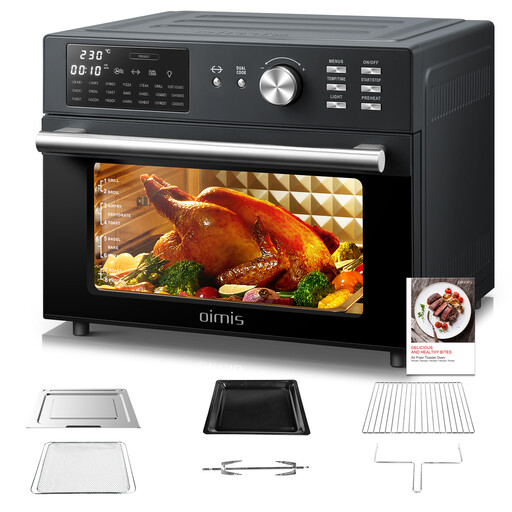
A freestanding option if you’re not planning a built-in installation. Check whether the tray area is large enough for your quantity or whether you’ll need to cook in batches.
The product name lists 30 l, 1800 W, 21 presets, a rotisserie and a dehydrating function. The description lists baking and roasting as uses.
No, the number of shelf levels alone isn’t enough to tell you that. Check the multi-level heating function specified for the particular model, suitable trays and the instruction manual; a manufacturer’s claim doesn’t guarantee that every load will work.
Plan the number of batches around the trays that will actually fit in the oven. In one recipe, Good Food suggests quartering carrots and cooking them on a tray at 200 °C using conventional heat or 180 °C using fan-assisted heat, and recommends turning them during roasting. These instructions apply to that recipe; they aren’t general settings for every oven.
Follow the instructions for the specific appliance. The instruction manual for the Severin TO 2058 warns that accessible surfaces can get very hot and says to unplug the appliance before cleaning and let it cool down.
For household ovens with the relevant energy label, the EU energy label gives consumption in kWh per cycle separately for conventional and fan-assisted cooking. The European Commission lists these as separate figures for comparison; they don’t, on their own, predict how much energy will be needed to cook a particular quantity of carrots.
If work is needed on the electrical installation downstream of the main fuse, § 13 NAV generally restricts it to the network operator or an installation company listed in its register of installers; there’s an exception for certain maintenance work. The Federal Ministry of Justice publishes the regulation. You can’t tell from the appliance name alone whether this work will be needed for a particular oven.