
Lieferung heute & morgen

Qualitätsgarantie

Willkommens-Angebote freischalten: KOSTENLOSE Lieferung | Bis zu 80 % RABATT | Kostenlose 30-Tage-JoyPlus-Testphase
App herunterladen
A remote-controlled robot building kit is more than just a toy. It's a gateway to the world of technology, mechanics, and programming. However, the market is vast, and not every set delivers on its promises. Many parents and grandparents looking for a meaningful gift for boys or girls aged 6 and up face the challenge of finding the right model. This guide will help you avoid common purchasing pitfalls and make an informed decision.
Before you make a decision, it's important to understand the three most common issues that can quickly spoil the fun.
To make a good choice, you should carefully examine three technical aspects. These are crucial in determining the quality and long-term value of the building kit.
A high-quality tech building kit for kids is made of precisely manufactured parts. The material of choice is often ABS plastic. This material is robust, dimensionally stable, and free of harmful plasticizers. A high degree of precision in the fit of the blocks ensures that the models are stable and easy to assemble and disassemble. Pay attention to the manufacturer's specifications regarding material and quality assurance.
The method of control defines the play experience. Simple models often come with a classic 2.4 GHz remote control that allows for basic driving commands. More sophisticated kits also offer app control for smartphones or tablets. This often opens up additional possibilities:
The heart of any remote-controlled model is the construction toy with a motor. The motor's performance, often specified in revolutions per minute (RPM), determines the model's speed and power. However, the power supply is more critical. A set with a rechargeable battery in the main module is preferable to disposable batteries. Pay attention to the battery's capacity (measured in mAh) and the manufacturer's stated playtime per charge. This avoids constant interruptions and running costs.
Instead of presenting an overwhelming list, we are highlighting one model that combines the aforementioned quality criteria into a versatile package.
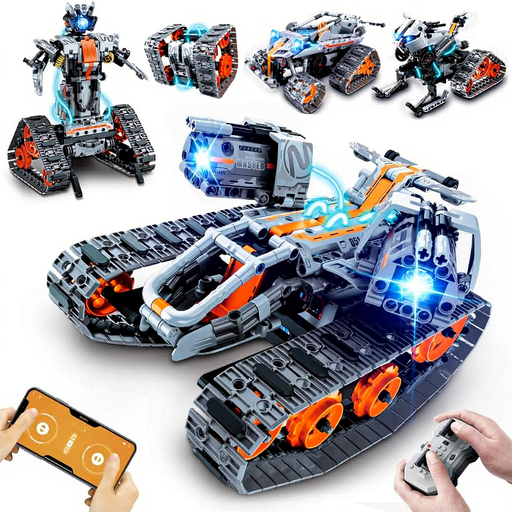
Why This Fits Their Persona: This set is ideal for kids who love variety and don't want to be limited to a single model. With 604 pieces, they can build five fundamentally different vehicles, from a robot to a racing tank. It's a fitting gift for boys aged 10 and up, but also suitable for younger children from 6 years with assistance, and specifically promotes STEM skills.
The set avoids the "X-in-1" trap by enabling genuinely different models. The integrated 300 mAh lithium battery in the main module is USB-rechargeable, eliminating the cost and waste of disposable batteries. The dual-control system offers flexibility and long-term play value.
The main advantage is the combination of a classic 2.4 GHz remote and a versatile app with four different control modes, including a simple programming mode. This provides a gentle introduction to the world of coding.
We have compiled a complete, up-to-date list of products that fully meet these strict selection criteria and German safety regulations.
1. At what age is a programmable robot for kids a good idea? Simple, block-based programming environments, like those found in many STEM toys for ages 6+, are already suitable for elementary school children. They provide a playful introduction to logical sequences and the principle of cause and effect, with no prior coding knowledge required. For more complex, text-based programming, sets for children aged 10 or 12 and up are more appropriate.
2. What is the difference between an RC car kit and a robot building kit? A classic RC car kit typically focuses on the detailed replication of a specific vehicle model, with an emphasis on mechanics and remote control. A robot building kit is often more modular and places a stronger focus on the combination of building, electronics, and simple programming functions. The ability to create different models and control their behavior is the main priority.
3. How long does the battery of a remote-controlled building kit last? Battery life varies greatly depending on the model and intensity of use. For sets with rechargeable lithium batteries, the active playtime per charge is often between 15 and 30 minutes, according to manufacturer specifications. Charging time is typically 60 to 120 minutes. It is advisable to look for models with a USB charging function, as they can be flexibly charged using power banks or laptop ports.