Families looking for a dog that really walks
If your child expects a dog that moves forwards on four legs, check the drive system for the exact version. The word “walks” on its own doesn’t tell you whether a model uses legs or wheels.


If walking on legs matters, look for documented leg movements for the exact model: Petoi describes the Bittle X V2 as a four-legged walking robot, while SunFounder says the PiDog can walk. Rolling or interactive models may also be a good fit for pretend play and responses. Check the age guidance and warnings, supported languages and, if the product is intended as a toy for children, the applicable CE marking.
If your child expects a dog that moves forwards on four legs, check the drive system for the exact version. The word “walks” on its own doesn’t tell you whether a model uses legs or wheels.
If controlling, stroking and playing together matter more than walking on legs, a wheeled model could also be an option. What matters is which responses and controls your child can actually use.
If you want your child to try voice commands, check which commands and languages the exact model supports. A product page or manual in German doesn’t automatically mean the robot has German voice control.
| Buying priority | What to look for | Who it matters most to |
|---|---|---|
| Walking or rolling | For the exact version, check whether it has documented powered legs and walking movements, or whether wheels provide the movement. | If my child specifically wants a dog that walks on legs, I check the drive system rather than relying on the product name. Around 33% of consumers put walking on legs first. |
| Controls and pretend play | Compare the remote control, touch responses and app controls; check which features work without an app. | If my child wants to control, stroke or play with the dog, the specific controls matter to me. Around 27% of consumers prioritise this kind of interactive pretend play. |
| Voice commands | Distinguish fixed voice commands from recorded sounds, and check which languages are actually supported. | If my child is going to speak to the dog, they need to understand the commands it offers. Around 20% of consumers put easy-to-understand voice control first. |
| Age, safety and ease of use | Check the age guidance and small-parts warnings for the exact version, as well as the applicable CE marking for products intended as toys. | If I want my child to be able to use the robot as independently as possible, I look for suitable warnings and a straightforward set-up. Around 20% of consumers prioritise age-appropriate products that are easy to handle. |
An interactive robot dog may move on wheels instead. That could leave you disappointed if you were looking for a dog that really walks on legs.
Compare the stated drive system for the exact version. Choose a wheeled model only if the way it moves isn’t essential for how you plan to use it.
The language used in the documentation and the language used for commands are different things. Petoi lists English and Chinese for the Bittle X V2’s fixed commands.
Check the command language for the exact model and the software version it uses.
Assembly, additional hardware and compatibility can all affect when your child can start playing with the robot.
Compare kit and pre-assembled versions, and check which devices you’ll need for set-up.
The Raspberry Pi isn’t included in SunFounder’s PiDog offer. SunFounder also lists different compatibility with Raspberry Pi 5 for the standard and V2 versions.
Petoi describes the Bittle X V2 as a four-legged walking robot for families interested in using its controls and programming features, too.
According to SunFounder, PiDog is a walking robotics kit for families who are prepared to factor in assembly and technical set-up.
Lexibook describes the Power Puppy DOG01 as an interactive toy dog with a remote control, touch responses and programmable movements.
KEYi describes Loona Petbot as a mobile, interactive petbot for families who aren’t necessarily looking for a four-legged robot that walks.
The Joybuy products below include a model with both wheels and legs, toys described as walking and explicitly wheeled versions. Check the actual drive system and toy marking for the exact version rather than relying on the product name alone.
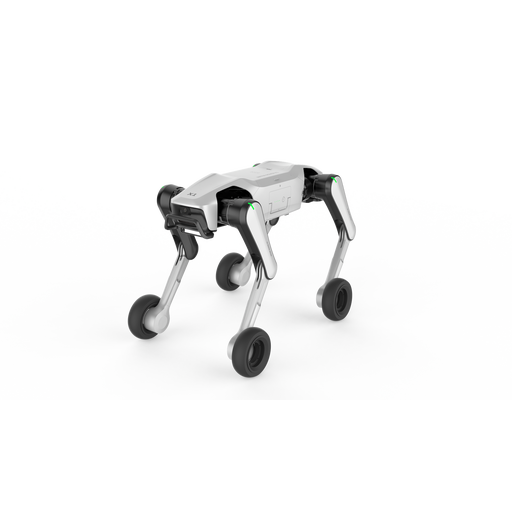 No image available
For families comparing different ways of moving and interactive controls: the product name describes a quadruped robot dog with a dual wheel-leg mode.
Listed features include UWB Follow, Vision Follow and voice interaction. Before choosing, check which type of movement the exact version actually uses in the play mode you want.
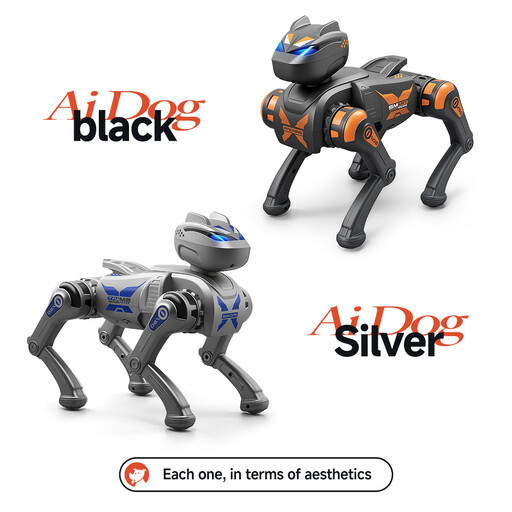 No image available
For families comparing a remote control, app and voice control in one model: the product name lists walking, dancing and programmable features.
The product name gives an age rating of 3+. Check the warnings and instructions for the exact version as well.
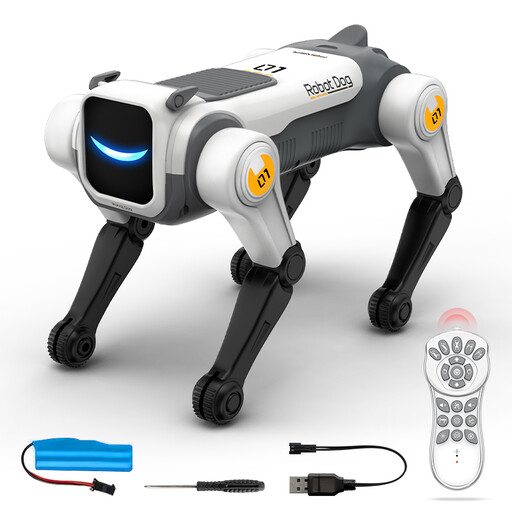 No image available
For pretend play with a controllable pet, the description lists a remote control and voice control.
The description recommends the product for ages 8 and over, and mentions small parts and adult supervision. The remote control requires two AAA batteries, which aren’t included.
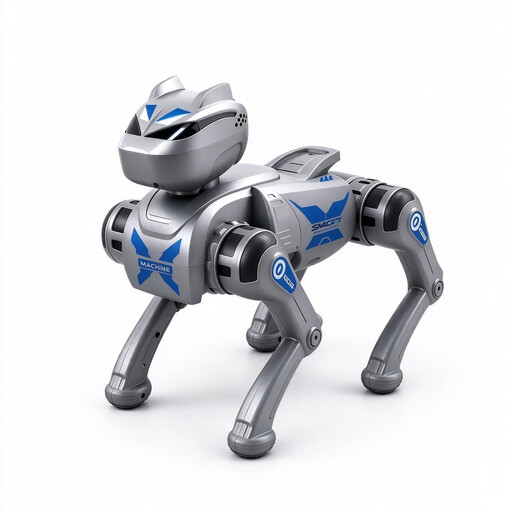 No image available
For families who want to try out movement and responses together, the listed features include gesture and voice control, plus a remote control.
The product details also list stunts, dancing and a rechargeable battery.
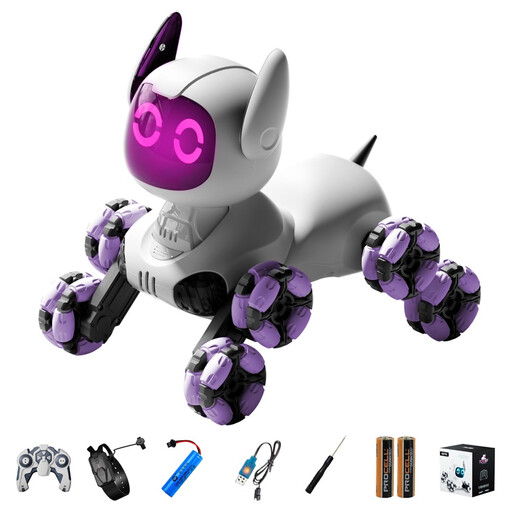 No image available
If walking on legs isn’t essential, this remote-controlled stunt model could be a fun wheeled option.
The product details describe a model with eight wheels; it moves on wheels rather than powered legs.
For the exact version, check whether powered leg joints and walking movements are documented. Petoi describes the Bittle X V2 as a four-legged robot, while SunFounder lists servos for walking movements in the PiDog. KEYi, by contrast, describes Loona as a robot on wheels.
Petoi lists English and Chinese for its fixed commands. Individually recorded sounds are a different feature and don’t confirm built-in German commands.
The Raspberry Pi isn’t included in the manufacturer’s offer described here. Check the exact kit version before choosing a computer: according to SunFounder, Raspberry Pi 5 isn’t compatible with the standard version, but is compatible with the V2 version.
No. By applying the CE marking, the manufacturer declares that the product meets the relevant EU requirements; it isn’t a certificate automatically issued by an EU authority. For products intended as toys for children under 14, check whether the product is classified as a toy and whether the exact version carries the applicable marking. The new EU Toy Safety Regulation won’t replace the existing Toy Safety Directive until 1 August 2030.
The seller is responsible for statutory consumer rights. A manufacturer’s guarantee is separate and voluntary. If the product is faulty, the first remedy may be a repair or replacement.