
Lieferung heute & morgen

Qualitätsgarantie

Willkommens-Angebote freischalten: KOSTENLOSE Lieferung | Bis zu 80 % RABATT | Kostenlose 30-Tage-JoyPlus-Testphase
App herunterladen
Finding the right programmable robot for your child can quickly become a complex task. The market is flooded with models, all promising technological wonders and educational value. However, not every device lives up to its advertising. As a Joybuy Product Recommendation Officer, I'll help you identify the crucial features and avoid common purchasing pitfalls, ensuring your investment leads to lasting enjoyment and real learning outcomes.
Before you make a decision, it's important to be aware of the most common issues that can quickly spoil the fun and lead to disappointment.
To avoid a bad purchase, you should focus your attention on a few objective, technical parameters. These are the key determinants of the robot's quality and long-term value.
A simple remote-controlled robot is fundamentally different from a model that promotes genuine logical thinking. A good programmable robot for kids allows them to create, save, and execute command chains. For a learning robot for ages 5 and up, programming should be intuitive, for instance, via buttons on the device itself or a clear remote control with distinct symbols. An innovative addition is gesture control, where the robot responds to hand movements. This offers a fascinating and direct way to interact, making the entry into robotics much easier.
The number of programmable actions is a critical quality indicator. A robot that can store a sequence of 40 or more commands offers exponentially more creative potential compared to a model limited to 10 steps. Additional interactive elements are also important. A toy robot with sound and light gives children direct feedback on their programmed commands. Models advertised as a robot that can dance combine the technical aspect with playful movement and music, which significantly boosts motivation.
A toy that is actively used must be robust. Look for a sturdy construction made of high-quality plastic like ABS, which can withstand minor drops. For sale in the EU, the CE marking is essential. It signals that the product meets the applicable EU safety standards. Also, check the battery requirements. Models that run on standard AA or AAA batteries are generally more straightforward and cost-effective to operate.
Instead of presenting an overwhelming list, we are highlighting one model that stands out for its balanced combination of play factor and learning potential, making it particularly suitable for a specific user profile.
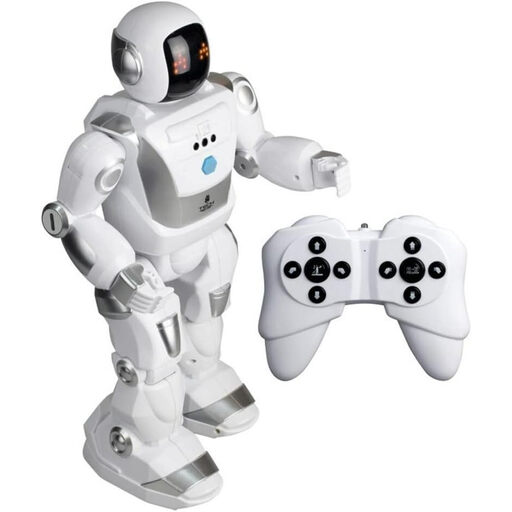
Why It's a Great Fit: Perfect for children aged 5 and up who are looking for a playful introduction to the world of robotics and programming. It's an ideal gift for tech-savvy kids that teaches complex concepts in an accessible way without being overwhelming.
This model operates with an infrared remote and gesture control, eliminating any app dependency. With 48 programmable functions, it offers long-lasting play value. Its use of standard batteries prevents hidden follow-up costs.
The combination of programmable movements, motorised arms, sound and light effects, and a dance function (Moonwalk) creates a versatile and interactive play experience.
We have compiled a complete, up-to-date list of products that fully meet these strict selection criteria and safety regulations.
1. What's the best way to start teaching a child to program with a robot?
Start with the basics. First, let the child control the robot with the normal remote or via gestures to get a feel for its movements. Then, introduce the programming function by creating a very simple sequence together, such as "three steps forward, then turn left." Increase the complexity slowly and encourage the child to invent their own small choreographies or tasks.
2. What batteries are needed for most toy robots and how long do they last?
Most models in this segment, including the YCOO Programm a Bot X, use standard batteries like AA or AAA. This is convenient as they are widely available. The battery life depends heavily on the intensity of use. Features like motorised movements, lights, and sound consume more energy than standby mode. It's advisable to use rechargeable batteries to reduce costs and be more environmentally friendly.
3. Is a programmable robot a good gift for tech-savvy kids?
Yes, such a toy is an excellent gift for tech-savvy kids. It goes beyond simple play and enjoyably promotes important STEM skills (Science, Technology, Engineering, and Mathematics). Children learn logical thinking, problem-solving, and the principle of cause and effect in a playful manner. It's a gift that stimulates creativity and sparks curiosity for technology.