
Lieferung heute & morgen

Qualitätsgarantie

Willkommens-Angebote freischalten: KOSTENLOSE Lieferung | Bis zu 80 % RABATT | Kostenlose 30-Tage-JoyPlus-Testphase
App herunterladen
Finding a gift that not only entertains but also sparks a child's curiosity for technology and science can be a challenge. A robot building kit for kids offers a meaningful alternative to screen-only activities, playfully developing crucial skills. However, the selection is vast, ranging from simple mechanical models to complex, programmable robots.
This guide is designed to help you understand the different options and find a model that matches your child's interests and age. We will present a selection of kits and provide you with objective criteria to make an informed decision.
From your Joybuy Product Recommendation Officer
To find the right kit, a few fundamental aspects should be considered. These criteria will help you objectively evaluate the product features.
The manufacturer's age recommendation is a crucial starting point. A kit that's too simple can quickly become boring, while a model that's too complex can lead to frustration. Pay attention to the number and size of the parts, as well as the complexity of the building instructions. A good tech toy for ages 8 and up, for instance, is structured differently than a set for younger children, which often uses larger components and simpler snap-together systems.
Robot kits pursue different educational goals. Consider which area interests the child most:
The type of control significantly influences the play experience. A classic remote-controlled robot kit offers immediate fun right after assembly. Models with app control often expand the possibilities with additional features like programming movement sequences, controlling via the smartphone's motion sensor, or following drawn paths.
Here you'll find a selection of kits that focus on different areas and are suitable for various age groups and interests.

Why It Stands Out: This set combines classic building block fun with modern technology. From 604 pieces, five different remote-controlled models can be built, including a robot and various vehicles. It can be controlled either with the included 2.4 GHz remote or a smartphone app that offers four different modes.
Advantages:
Who It's For: This set is ideal for children aged 6 to 12 who love to build and want to start driving right away. It serves as a great introduction to the world of remote-controlled technology and offers a simple first step into programming through its app features.
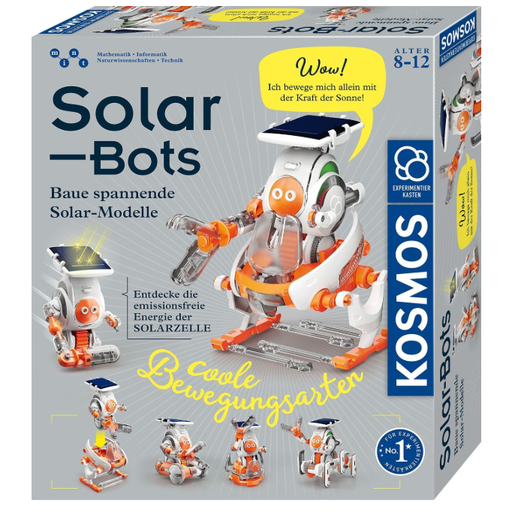
Why It Stands Out: This robotics experiment kit from KOSMOS focuses entirely on solar energy. Children build eight different models from a motor and a solar cell that move using only sunlight. The set intentionally omits batteries and remote controls, instead highlighting an understanding of technology and renewable energy.
Advantages:
Who It's For: This kit is aimed at children aged 8 to 12 with an interest in science and mechanics. It's a classic STEM toy for kids that encourages experimentation and builds a fundamental understanding of physical principles.

Why It Stands Out: Miika isn't a traditional building kit, but a pre-built robot whose artificial intelligence (AI) is trained by the child. Developed in collaboration with the AI Center Tübingen, this set playfully introduces the complex topics of machine learning and AI. The robot responds to gestures and voice commands configured via an offline app.
Advantages:
Who It's For: Miika is designed for children aged 10 and up who are enthusiastic about computers, programming, and future technologies. It's the perfect product for anyone who wants to gain a deep insight into how a programmable robot and artificial intelligence work.
The models presented here already cover a broad spectrum. However, if you're looking for more alternatives or want a more comprehensive overview of different brands and features, you'll find a larger selection in our main category.
? Explore Our Full Range of Kids' Robot Kits
1. At what age is a robot kit suitable for children? This largely depends on the specific model. Simple snap-together systems are suitable for children as young as 6. More complex kits with many small parts or programming functions, such as a tech toy for ages 8 and up, require more patience and abstract thinking. Always follow the manufacturer's age recommendation.
2. What do children learn from a programmable robot? A programmable robot primarily fosters logical thinking and problem-solving skills. Children learn to create command sequences (if-then logic) and find errors in their code (debugging). This trains the fundamentals of algorithmic thinking, a core competency in the STEM field.
3. Does every robot kit require a smartphone or tablet? No. Many kits, like the classic remote-controlled robot kit or solar-powered models, work without any additional devices. However, sets with programming functions or advanced controls usually require an app to be installed on a smartphone or tablet. Check the product description for specific system requirements.