
Lieferung heute & morgen

Qualitätsgarantie

Willkommens-Angebote freischalten: KOSTENLOSE Lieferung | Bis zu 80 % RABATT | Kostenlose 30-Tage-JoyPlus-Testphase
App herunterladen
A robot vacuum and mop combo promises to be a huge help around the house. But the market is flooded with models whose marketing promises often suggest more than the technology can deliver. Many devices turn out to be inadequate, get stuck on obstacles, or leave behind more streaks than cleanliness. This guide highlights which technical features truly matter and how you can avoid the common pitfalls when buying.
Before you make a purchasing decision, it's important to know the most common flaws that often only become apparent in daily use.
To avoid making a bad purchase, focus on the following core technical parameters. These determine the efficiency and reliability of your future household helper.
Suction power, measured in Pascal (Pa), describes the negative pressure the motor generates. For homes with hard floors, values from 2,500 Pa are often sufficient. For cleaning carpets or dealing with pets, higher power is advantageous. However, pay attention to how the power can be regulated. A quiet robot vacuum often offers a mode with reduced suction for daily cleaning, which significantly lowers the noise level. Just as important is the brush system. A combination of a main brush (ideally made of rubber or with V-shaped bristles) and side brushes ensures that dirt is captured from corners and edges and directed to the suction opening.
Navigation technology is the robot's brain. Here, Laser Navigation (LiDAR) has established itself as the standard for precise and efficient cleaning.
A modern robot vacuum with an app offers much more than just a start-stop function. An intuitive app is crucial for convenient daily use. Important features include:
Instead of presenting an overwhelming list, we are highlighting one model designed for a specific user type that meets the criteria mentioned above.
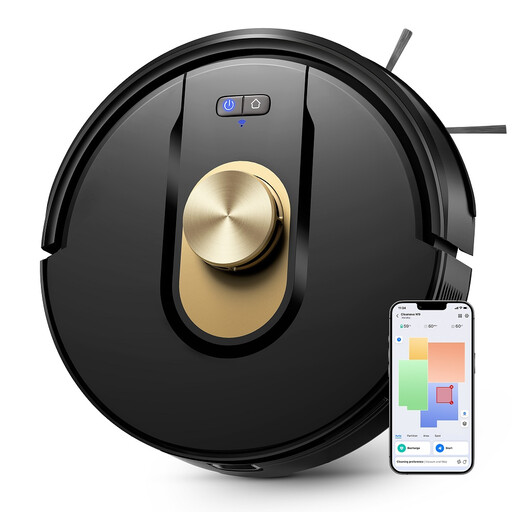
Why This Fits Their Persona: This model is designed for users seeking a comprehensive and customisable cleaning solution for complex living situations. The combination of strong suction, precise navigation, and the ability to save maps for multiple floors makes it ideal for homeowners with various floor types, pets, and an active lifestyle.
The advanced LiDAR navigation prevents chaotic and inefficient cleaning. The high suction power of up to 8000Pa (according to the manufacturer) is not just a marketing figure; it's made practical by three adjustable levels for different types of messes, thus avoiding the "High Suction Power" trap. The 3-in-1 function with adjustable water flow offers more than just passive mopping.
Precise LiDAR navigation with storage for up to 5 maps.
Combined vacuuming and mopping for carpet and hard floors with app-controlled adjustment of suction power and water flow.
We have compiled a complete, up-to-date list of products that fully meet these strict selection criteria and relevant safety regulations.
1. How often does a robot vacuum's dustbin need to be emptied? The frequency depends on the size of your home, the level of dirt, and whether you have pets. With daily use in an average-sized home (approx. 80 m? / 860 sq ft), emptying it every 2-4 days is typical. Models with self-emptying stations can extend this interval to several weeks.
2. Can a robot vacuum and mop combo detect and avoid carpets? Yes, many modern devices with advanced sensors or cameras can detect carpets. In mopping mode, they either lift the mop pad or avoid the carpet entirely to prevent it from getting wet. Alternatively, you can set up no-go zones for your carpets in the app.
3. Is a quiet robot vacuum truly effective? Effectiveness and noise level are a trade-off. A quiet robot vacuum (approx. 50-55 dB in eco mode) is ideal for daily maintenance cleaning while you are at home or working from a home office. For a deep clean, especially on carpets, a mode with higher suction power (and thus more noise) is usually necessary. Good models offer various suction levels, so you can adjust the performance as needed.