
Lieferung heute & morgen

Qualitätsgarantie

Willkommens-Angebote freischalten: KOSTENLOSE Lieferung | Bis zu 80 % RABATT | Kostenlose 30-Tage-JoyPlus-Testphase
App herunterladen
A clean pool is the centerpiece of summer relaxation, but manual cleaning can be time-consuming and tedious. A robotic pool cleaner handles this task autonomously, ensuring crystal-clear water while you use your time for more important things. However, the selection of models is vast, and the technical differences can often be confusing.
This article serves as your guide. We will introduce different types of devices and explain the crucial criteria to help you find an automatic pool cleaner that perfectly matches your pool and your needs.
To make an informed decision, three main aspects should be considered: the cleaning coverage, the power source, and the device's filter performance.
Not every robotic pool cleaner is suited for every task. Simpler models focus exclusively on cleaning the pool floor. These are often a great choice for smaller or shallow pools, such as many robotic cleaners for above-ground pools.
More advanced units offer a robotic pool cleaner with wall-climbing function. Thanks to special drive mechanisms and brushes, they can also climb and clean vertical surfaces. Some models additionally clean the waterline, where stubborn buildup from oils, sunscreen, and dirt often forms. For comprehensive cleaning, such all-in-one units are the most efficient solution.
The choice of power source significantly impacts usability.
The effectiveness of a robotic pool cleaner heavily depends on its suction power and filtration system. Suction power is often specified in liters per hour (LPH) or cubic meters per hour (m?/h). Higher suction power allows it to pick up coarser debris like leaves or small twigs.
The filtration system usually consists of a basket or a cartridge. A large filter canister needs to be emptied less frequently. The filtration fineness (measured in microns, ?m) determines how small the particles it can capture are.
Modern devices also offer convenience features like a remote control or an app-controlled robotic pool cleaner, which allows you to select cleaning modes and set schedules.
Based on the criteria mentioned, we have compiled a selection of devices that cater to different requirements and pool types.
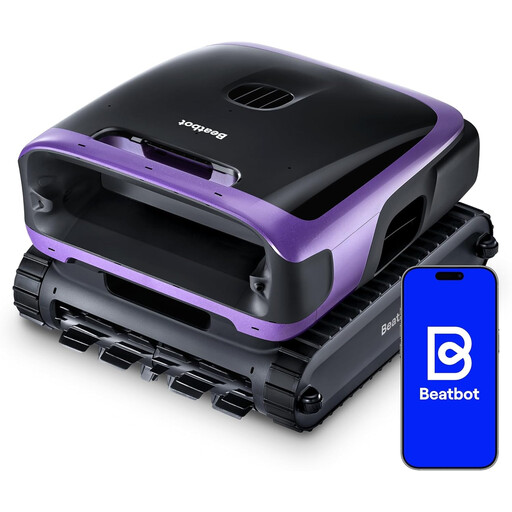
Why it stands out: The Beatbot Sora 70 is a comprehensive cleaning system that not only cleans the floor, walls, and waterline but is also one of the few models that cleans the water surface. The JetPulse system uses water jets to direct surface debris towards the suction inlet.
Pros:
Who it's for: For owners of large pools (both in-ground and above-ground) who are looking for a powerful, all-in-one solution for every area of the pool and value smart control and high efficiency.

Why it stands out: The Gosvor LiteVac 800 focuses on the essential features for straightforward floor cleaning. Its simple one-touch operation and light weight make it a very accessible entry-level model.
Pros:
Who it's for: For owners of smaller above-ground pools or pools with a flat bottom up to 80 m?, who are looking for an affordable and easy-to-use cordless pool vacuum for basic floor cleaning.
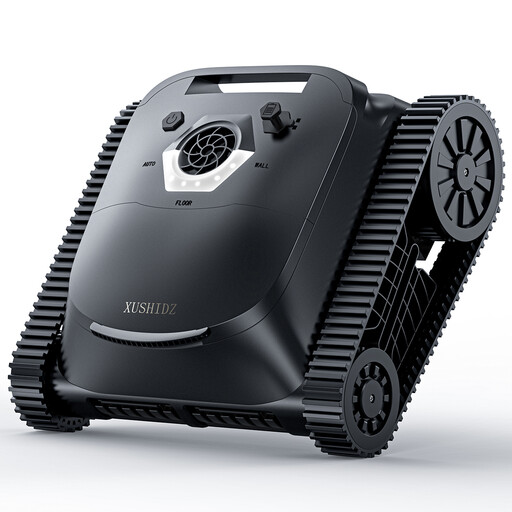
Why it stands out: The XUSHIDZ SP5 combines a very long battery life with wall-climbing capability, making it a powerful all-rounder in its price range. Operation is simple with one-touch control, no app required.
Pros:
Who it's for: For pool owners who want a powerful cordless robotic pool cleaner with wall-climbing functionality for medium to large pools and prefer straightforward operation without app connectivity.
The models presented here cover a wide spectrum. If the right device for your specific needs isn't among them, you can find a larger selection of solutions for pool cleaning in our main category.
1. How often should a robotic pool cleaner be used? The frequency depends on pool usage and the surrounding environment. During the swimming season, it is recommended to run the robot 2-3 times a week to maintain consistently high water quality. In cases of heavy debris, such as from leaves or after a storm, daily use may be beneficial.
2. Does a robotic pool cleaner also clean the pool walls? That depends on the model. Basic devices are floor-only cleaners. Models with climbing capabilities, like the XUSHIDZ SP5, are specifically designed to also clean vertical walls and often the waterline. When selecting a product, look for "wall cleaning" or "floor and wall cleaning" in the description.
3. What is the difference between a pool vacuum and a robotic pool cleaner? Although the terms are often used interchangeably, a robotic pool vacuum (or automatic pool cleaner) refers to a fully autonomous device. It navigates the pool on its own, collects debris in its own filter, and does not need to be connected to the pool's main filtration system. In contrast, manual or semi-automatic pool vacuums must be guided by hand or connected to the skimmer.