
Lieferung heute & morgen

Qualitätsgarantie

Willkommens-Angebote freischalten: KOSTENLOSE Lieferung | Bis zu 80 % RABATT | Kostenlose 30-Tage-JoyPlus-Testphase
App herunterladen
A rocking chair can be used in the living room, bedroom, nursery or home office. However, a classic upholstered rocking chair, a nursing chair and a rocking recliner differ considerably in their design, space requirements and comfort. Looks alone won’t tell you whether a model will meet your needs over time.
Before you buy, check for these three common pitfalls:
A stable design depends on several components. The models available include birch wood, beech wood, steel frames and metal constructions. The rockers should sit flat on the floor and move smoothly without catching.
Look for:
The stated load capacity is a product specification, not a substitute for correct assembly. A model with a maximum load of 150 kg should not be used beyond that limit. According to the product details, the Ckaff rocking chair is designed to hold up to 113 kg, while certain models from JOYFURNOS and SONGMICS are rated for up to 150 kg.
Seat height, seat depth, backrest height and the distance between the armrests all contribute to a comfortable rocking chair. A seat that’s too deep can make it harder to get up, while a short backrest may offer little support during longer periods of use.
Make sure you also leave enough clear space in front of the chair. With a rocking chair with a footrest, you’ll need to allow for its extended length. For example, the HONEYOU recliner measures 105 × 94 × 103 cm when upright and extends to 105 × 164 × 81 cm when opened out. A more compact model may be a better fit for a small living room or narrow reading nook.
An upholstered rocking chair may feature foam, high-resilience padding or a more contoured backrest. The care instructions matter just as much as the material description.
Useful features for everyday use include:
According to the product description, the covers on the SONGMICS model can be removed and machine-washed at up to 30 °C. For the Ckaff model’s Sherpa cover, spot cleaning with a soft cloth and mild detergent is recommended. Check the care instructions before first use, as not every cover is suitable for tumble-drying, bleach or ironing.
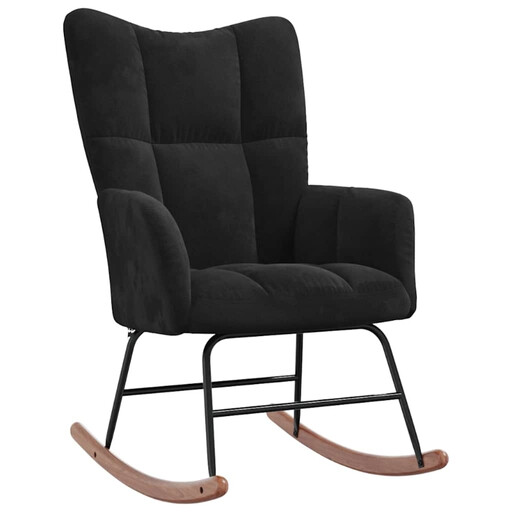
Why this product suits this need: This model combines a compact width of 61 cm with a padded seat and a black polyester cover. It’s a good choice for a living room, bedroom or small reading nook if you want a classic rocking chair without a footrest.
The steel frame and long rubberwood rockers are clearly described. This makes it easier to assess the construction and space needed than it would be with a listing that doesn’t specify the materials.
Seat height and overall dimensions are stated; the cover is made from 100% polyester and the seat is padded with foam.
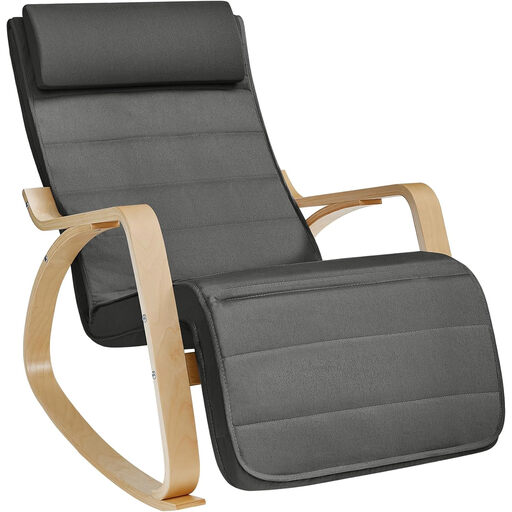
Why this product suits this need: This rocking recliner has a footrest with five adjustable positions, a removable headrest cover and a stated load capacity of 150 kg. It’s a good fit for anyone who prioritises adjustable positions and clear care instructions.
The extendable footrest isn’t just mentioned as a selling point: its five positions, dimensions and maximum load are all specified.
Birch wood and an internal metal frame; according to the product details, the removable covers are machine-washable at up to 30 °C.
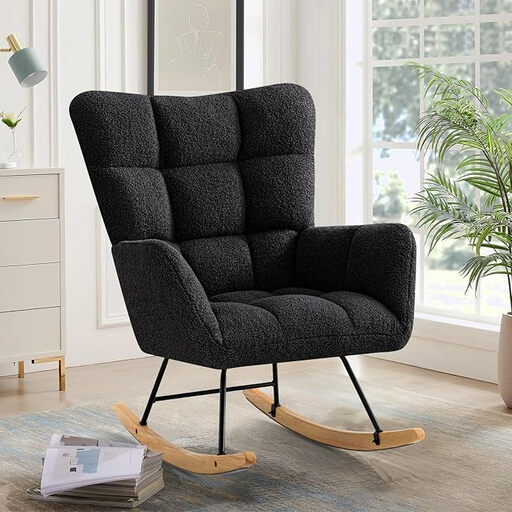
Why this product suits this need: Its high backrest and armrests, along with its stated uses as a nursing chair, reading chair or recliner, make it appealing to anyone looking for a chair to use regularly indoors for extended periods.
The maximum load of 113 kg, dimensions of 95 × 72 × 93 cm and specific care instructions are all provided. The floor-protection pads can help reduce noise and marks.
Steel frame, beechwood rockers, high-density foam and a Sherpa cover; the manufacturer describes the backrest as ergonomically shaped.
We’ve put together a complete, regularly updated list of products that meet these strict selection criteria and fully comply with the safety regulations applicable in the EU.
As well as allowing for the chair’s frame, make sure there’s room for the rockers to move. With a model that has a footrest, you’ll also need to allow for its extended length. So measure not just the available width, but also the distance to tables, walls and other furniture.
Its lifespan depends on factors including how it’s used, how well it’s assembled, the type of floor it’s on and how it’s cared for. Check the screws, rockers, padding and cover regularly. Only use a rocking chair within its stated maximum load.
A model with a high backrest, armrests and a stable rocking motion can be used as a nursing chair, provided its dimensions and seating position suit you. Look for easy-clean covers, a stable position that won’t tip and enough space beside the cot or changing area. This does not mean the chair has any medical or therapeutic benefits.