
Lieferung heute & morgen

Qualitätsgarantie

Willkommens-Angebote freischalten: KOSTENLOSE Lieferung | Bis zu 80 % RABATT | Kostenlose 30-Tage-JoyPlus-Testphase
App herunterladen
A rollable clothes rail can provide additional storage space in the bedroom, dressing room or utility room. It is particularly practical when clothes need to be changed, sorted or moved between several rooms regularly. However, models differ considerably in terms of load capacity, stability and storage options.
Anyone who focuses only on a high load capacity or attractive design can easily overlook important details. Three common purchasing pitfalls occur particularly often:
For lightweight clothing, a simple mobile clothes rail with a lower load limit is sufficient. However, if you want to store coats, suits or several garments, you should check the maximum static load capacity.
A heavy-duty clothes rail with a stated capacity of 100 or 150 kg is not automatically suitable for every use at that load. It also matters whether the clothing is distributed evenly and whether the floor is level. Information about tube thickness, material and the maximum total load provides a better basis for comparison than promotional phrases such as ‘extra sturdy’.
Steel frames are standard on the models considered here. With a sturdy clothes rail, you should also consider the connectors, the width of the base and how the castors are attached.
A clothes rail with wheels should be easy to move in a controlled manner. Four swivel castors make it easier to change direction between the bedroom, hallway and utility room. At least two locking castors are advisable if the mobile clothes rail is intended to remain in one place permanently.
Pay attention to the dimensions of the base. A narrow model may fit well in small rooms, but offers less lateral stability when heavily loaded. Before buying, measure the available floor space and check that doors, drawers and walkways remain clear.
An extendable clothes rail can be adapted to changing wardrobes. On the models included in this selection, the width of the upper rail can be adjusted depending on the version. This creates space for garments, bags, scarves or hats.
A clothes rail with a shelf or lower crossbars can also accommodate boxes or baskets. Check whether the storage area is actually a solid shelf or simply made up of bars. Height is also important: a height-adjustable clothes rail is better suited to long coats or shorter garments. For every model, check the specific minimum and maximum dimensions in the product description.
The following recommendations do not rank the products according to a general order of preference. Instead, they group them according to individual requirements for load capacity, space and intended use.
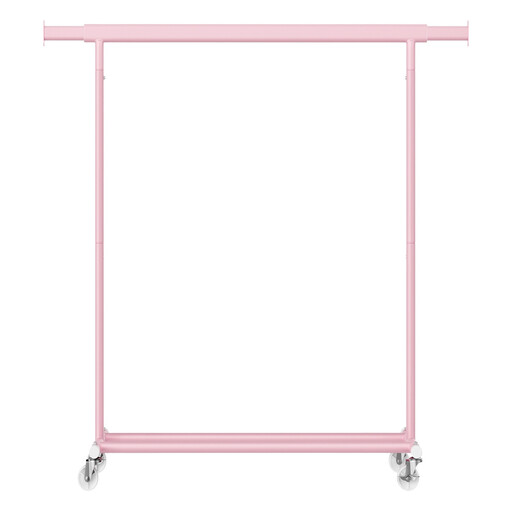
Why this product suits this profile: This model offers an adjustable width of 92 to 132 cm, wheels and tool-free assembly. It is therefore suitable for households that need additional storage without permanent installation.
The product specifications state a maximum static total load of 100 kg, as well as four wheels, two of which have locking functions. This makes the load limit easier to assess than an unexplained promotional claim.
Steel tubes, a net weight of 5 kg, an extendable upper rail and two lower crossbars for boxes or baskets.
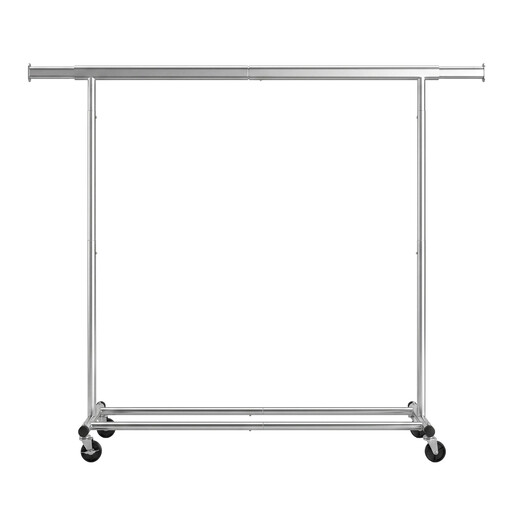
Why this product suits this profile: With an extendable width of 160 to 200 cm, this model is aimed at households with extensive wardrobes, walk-in wardrobes or frequently changing clothing.
The stated maximum static total load of 150 kg and the wider base provide specific points of comparison. However, clothing should still be distributed evenly along the rail.
Steel frame, a net weight of 6.2 kg, an extendable rail and lower bars for additional storage.
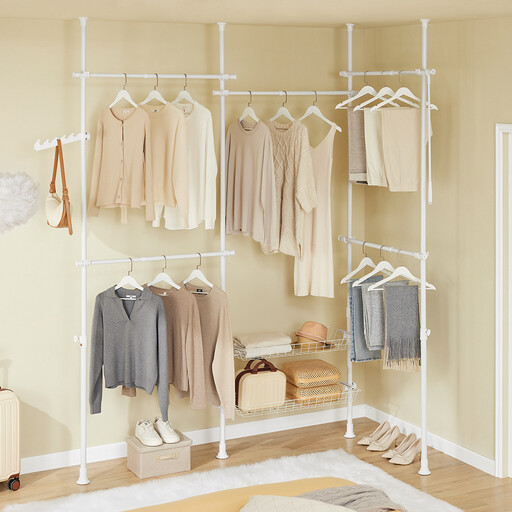
Why this product suits this profile: This telescopic open wardrobe system can be adjusted from 209 to 311 cm in width and from 200 to 295 cm in height. It is designed for larger wall areas or walk-in wardrobes without permanent installation.
The specific load limit of up to 65 kg prevents the system from being confused with an unsupported heavy-duty load specification. The dimensions should be checked carefully against the room before assembly.
Four adjustable rails, five clothes hooks and two baskets according to the product description; supplied as a compact package with assembly instructions.
We have put together a complete, regularly updated list of products that fully meet these strict selection criteria and the safety regulations applicable in the EU.
A clothes rail with wheels should be assembled on a level surface. For tool-free models, we recommend the following sequence:
When retracting a telescopic rail, press inwards from its end. Do not hold the frame firmly at the same time, in order to avoid trapped-finger injuries. Heavy garments should be placed as centrally as possible on the rail. Boxes placed on the lower bars should not exceed the permitted weight.
This depends on the wardrobe. A capacity of 20 kg may be sufficient for shirts and lightweight jackets. Coats, suits or a seasonal wardrobe require a higher stated static total load. It is important to distribute the clothing evenly and not exceed the manufacturer's specification.
Yes, provided that their depth and extended width are suitable for the room. A model with a depth of around 45 cm can fit into many spaces. However, before buying, you should consider clearance for movement, door openings and the distance from furniture. Wheels make it easier to reposition the rail, but they do not replace having suitable floor space.
There is no reliable way to state a general service life. It depends on the load, flooring, how often the rail is moved, and how well the wheels and connections are maintained. Regularly checking the push-fit connections, distributing the load evenly and using the locking brakes can help maintain its everyday usability.