
Lieferung heute & morgen

Qualitätsgarantie

Willkommens-Angebote freischalten: KOSTENLOSE Lieferung | Bis zu 80 % RABATT | Kostenlose 30-Tage-JoyPlus-Testphase
App herunterladen
A rollator with a seat can support people with limited mobility in everyday life when longer distances, waiting times or shopping trips become tiring. At the same time, models vary considerably in terms of weight, folded dimensions, seat size, load capacity and handling. Seniors, family members and people recovering from surgery should therefore take a close look at the technical specifications rather than relying on general marketing claims.
A stated maximum load capacity does not always refer solely to body weight. Depending on the design, it may also include a bag, shopping basket or other items. Anyone looking for a high-capacity rollator should therefore allow sufficient clearance between their own weight and the manufacturer’s maximum rating.
A low product weight makes it easier to lift the rollator into a car boot or store it at home. However, an exceptionally lightweight model may feel less stable on certain surfaces or have a smaller seat. The decisive factor is the combination of frame construction, wheel size, brakes, seat height and folding mechanism.
A foldable rollator can collapse in different ways. Before buying, compare the folded dimensions with the car boot, lift, hallway and intended storage space. The packaging weight should also not be confused with the actual net product weight.
Steel or carbon-steel frames may have a higher overall weight, while aluminium constructions are often designed for easier transport. However, the material specification alone says nothing about whether a model is suitable for a particular person. The key factors are the stated maximum load capacity, frame width and the construction of the seat and wheel mounts.
Examples from the selection:
A height-adjustable mobility aid should be set so that the handles are comfortably within reach when standing upright. Handles that are too low can encourage a forward-leaning posture, while handles that are too high can make the device more difficult to control. The precise adjustment should be made according to the instruction manual. After surgery or if you are unsure, it may be advisable to clarify the correct setting with a medical or care professional.
On a lightweight carbon-steel rollator with a seat, the handle height can be adjusted in five positions between 80 and 93 cm. The model with a shopping basket also offers five-stage height adjustment; depending on the setting, the stated handle heights range from approximately 78.5 to 93.5 cm.
A seat is only practical if the seat height, width and surface are suitable for the user. You should also consider:
One model with a shopping basket is listed with a basket capacity of 10 kg and basket dimensions of 35.5 × 20.5 × 20.5 cm. Other seating aids have a bag capacity of 5 kg. These limits should not be exceeded.
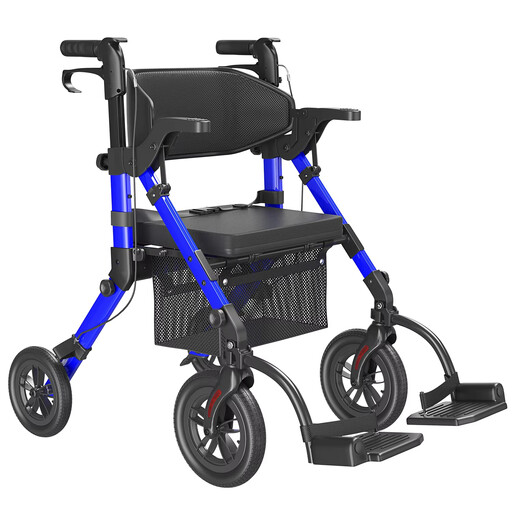
Why it is suitable: A portable, folding mobility aid for people looking for a straightforward solution for use at home, on short journeys and for occasional transport.
The stated folded dimensions of 365 × 605 × 990 mm and product weight of 10.4 kg enable realistic transport planning.
Two different wheel sizes, with 10-inch front wheels and 8-inch rear wheels; maximum stated load capacity of 136 kg.
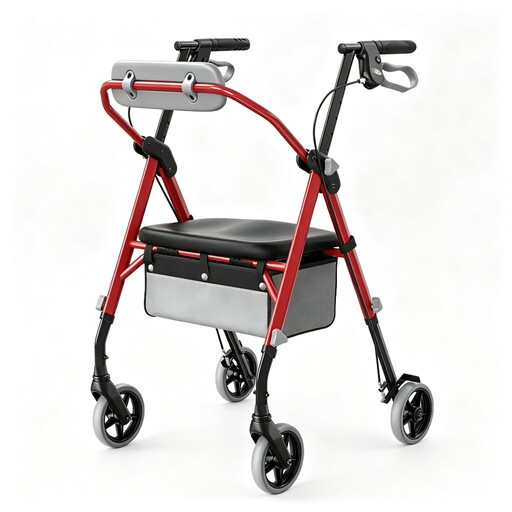
Why it is suitable: For travel, medical appointments or storing in the car when low net weight is the top priority.
In addition to the folded dimensions, seat width, handle height and the different product category are taken into account: this is a mobile seat with push assistance, not a conventional rollator.
Net weight of 8.5 kg, five-stage handle-height adjustment from 80 to 93 cm and a bag capacity of 5 kg.
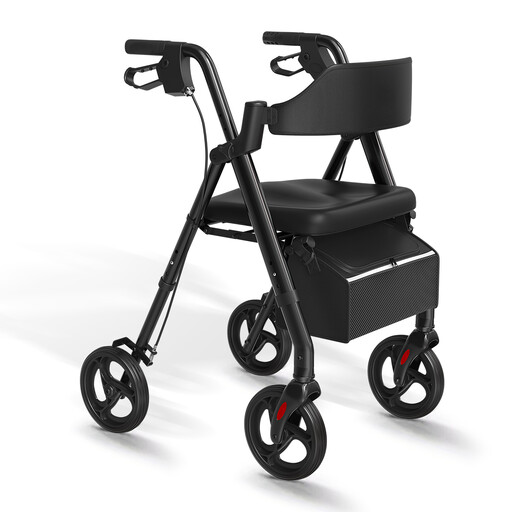
Why it is suitable: An option for users who want to combine a seat and storage space for shopping in one foldable rollator.
The product data clearly distinguishes between overall load capacity and basket capacity: 150 kg for the product and 10 kg for the shopping basket.
Folded dimensions of 40 × 58 × 78.5–93.5 cm, five-stage handle-height adjustment and a shopping basket with a stated capacity of 10 kg.
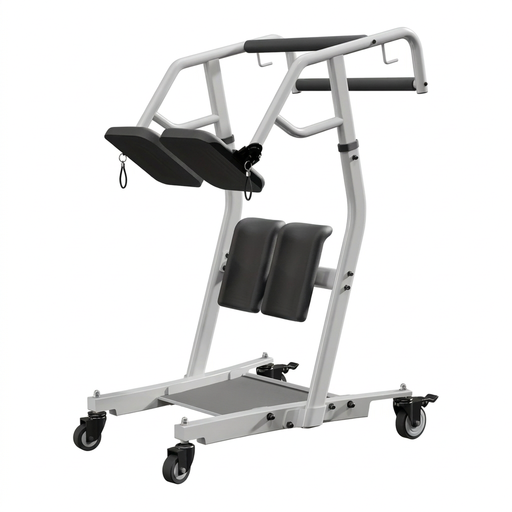
Why it is suitable: For situations where transferring or standing up is the main priority and a mobile mobility aid with a seat is not sufficient.
This solution is not categorised as a conventional travel rollator. It features a seat that rotates through 180 degrees and two lockable rear wheels.
Steel frame, stated load capacity of 180 kg, net weight of 30 kg and packaging dimensions of 850 × 295 × 430 mm.
Before first use, the rollator with a seat should be fully unfolded and checked to ensure that the folding mechanism has locked into place. The brake cables, wheels and handles should also be included in the visual inspection. To sit down, the rollator must be positioned on a suitable, preferably level surface; the parking brakes should be applied according to the instructions.
For use at home, narrow models with smaller wheels are often easier to guide through doorways and tight hallways. Outdoors, larger wheels can make it easier to overcome small edges, although this should not be taken as a blanket indication that the rollator is suitable for every type of terrain. With a rollator for use at home and on the go, the dimensions and wheel design should suit both environments.
A rollator with a seat does not automatically replace every other type of mobility aid. After a medical procedure, in cases of significant balance impairment or when the product is intended for use as a transfer aid, its suitability should be discussed with the responsible professional. The manufacturer’s operating and safety instructions must always be followed.
The complete selection includes various mobility aids, rollators with seats and transfer solutions for different requirements and areas of use.
The handles should be set so that the arms remain slightly bent when standing upright. The exact height in centimetres depends on the user’s height and the specific model. The product’s adjustment positions and the information in the instruction manual are decisive.
Its service life depends on frequency of use, surface conditions, load, care and storage. Moving parts, brakes, wheels and other wear components should be checked regularly. If the brakes are damaged, screws are loose or cracks appear in the frame, the product should not be used again until it has been inspected or repaired.
In addition to the purchase price, costs may arise for replacement parts such as wheels, brake pads or handles. Delivery and, where applicable, assembly should also be taken into account. The products mentioned have different warranty terms; for example, the transfer model is listed with a one-year free warranty covering the complete vehicle, excluding wear parts and damage caused by improper use or human intervention.