
Lieferung heute & morgen

Qualitätsgarantie

Willkommens-Angebote freischalten: KOSTENLOSE Lieferung | Bis zu 80 % RABATT | Kostenlose 30-Tage-JoyPlus-Testphase
App herunterladen
An organized workspace is the foundation of productive work. However, order often fails due to a lack of storage space. A rolling file cabinet offers a flexible solution. It's easy to move, often fits under a desk, and creates space for documents and office supplies. Yet, the selection is vast, and not every model delivers on its promises. As your Joybuy Product Recommendation Officer, I'll help you avoid common purchasing mistakes and make an informed decision.
Many buyers focus on a low price or appealing aesthetics, but overlook critical functional flaws. These three weaknesses often render a new office cabinet unusable after a short time:
To avoid these pitfalls, you should carefully examine three technical specifications. These determine the durability and functionality of your new rolling office cabinet.
The construction is the foundation. Models made of steel are generally more robust and durable than those made of engineered wood (e.g., particleboard). Steel cabinets often offer a higher load capacity and are more resistant to impacts. Engineered wood models, on the other hand, score points with a wider variety of designs and are often more affordable.
Always pay attention to the maximum load capacity specified by the manufacturer. This is usually given in kilograms (kg) and should be listed separately for the top panel and the individual drawers. A good under-desk cabinet intended to hold a printer needs a top surface load capacity of at least 20 kg.
The quality of the casters determines flexibility. Look for the following features:
The drawers are the heart of any cabinet. Full-extension slides allow complete access to the contents without you having to dig around in the back corners. Smooth, ball-bearing slides ensure that the drawers open and close gently, even when fully loaded.
If you plan to store confidential documents, a lockable rolling cabinet is the right choice. Check whether only one drawer or all drawers can be secured with a central lock. For archiving files, a hanging file frame for A4 formats is also essential.
To make your decision easier, we have compiled a few models based on different use cases.
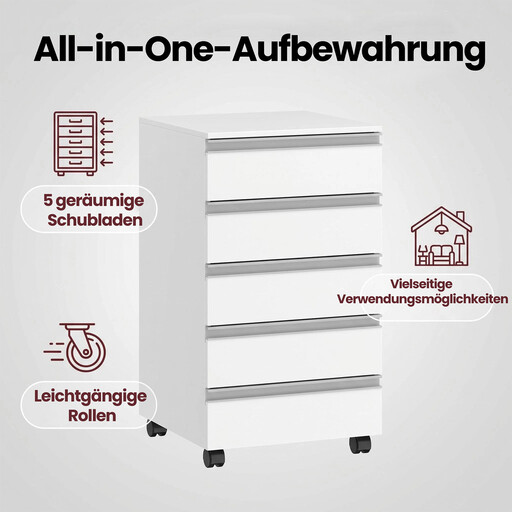
Why This Fits Their Persona: Ideal for anyone looking for a straightforward and functional storage solution for their first home office. Five drawers provide a clear structure for documents and supplies without taking up much space.
The product description specifies a load capacity of up to 50 kg and 360° swivel casters with locking brakes. This addresses the common weaknesses of low load capacity and unstable mobility.
Five spacious drawers for detailed organization; compact footprint (40 x 40 cm base) that fits well in smaller workspaces.
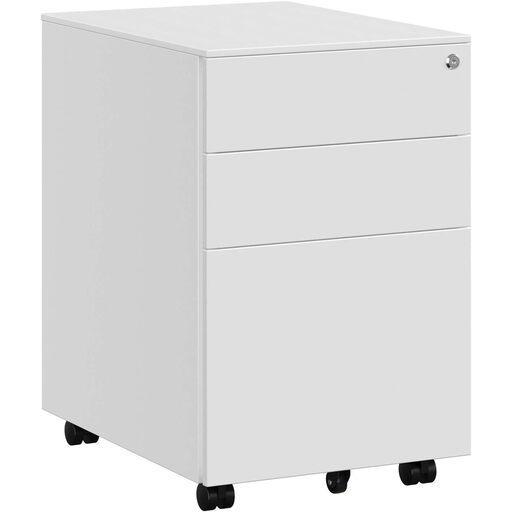
Why This Fits Their Persona: For professionals and small business owners who need to store sensitive data securely. The steel construction and central lock provide the necessary security and durability for daily office use.
The robust steel construction prevents sagging. The lock secures all drawers. The fifth support caster under the bottom drawer provides anti-tipping stability, even when fully loaded with hanging files.
Arrives pre-assembled (only casters need to be attached); suitable for A4, Legal, and Letter hanging files; full-extension slides for easy access.
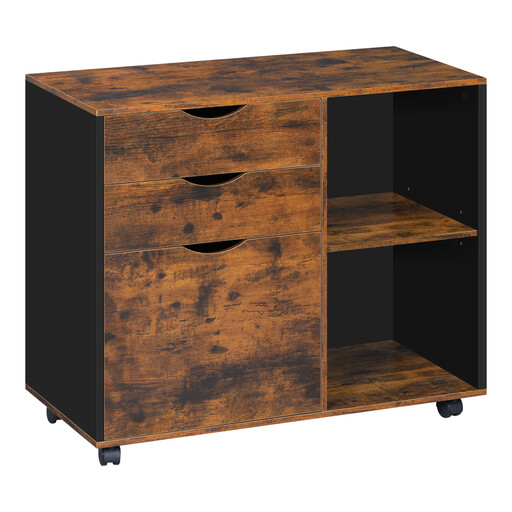
Why This Fits Their Persona: Perfect for users who need more than just a drawer cabinet. This model serves as a side cabinet, printer stand, and file archive in one, intelligently extending your workspace.
With a width of 80 cm and a specified load capacity of 50 kg, the top surface is explicitly designed for printers or scanners. The combination of open shelves and drawers avoids the trap of an inflexible storage concept.
Hybrid storage with drawers and open compartments; large bottom drawer with an adjustable bar for hanging files; fifth caster for anti-tip protection.
We have compiled a complete, up-to-date list of products that fully meet these strict selection criteria and German safety regulations.
Not necessarily. The standard desk height in Germany is between 72 and 76 cm. Most rolling cabinets are designed to fit underneath, with heights ranging from 55 to 70 cm. Before buying, be sure to measure the height from the underside of your desktop to the floor to ensure the cabinet fits and still has some room for movement.
The load capacity varies greatly depending on the material and construction. Simple models made of engineered wood often only support up to 30 kg in total, while robust steel cabinets can handle a total load of over 60 kg. The manufacturer's specification is crucial. Check the maximum load capacity of the top panel (important for printers) and the individual drawers separately.
There's no one-size-fits-all answer; it depends on your priorities.