
Lieferung heute & morgen

Qualitätsgarantie

Willkommens-Angebote freischalten: KOSTENLOSE Lieferung | Bis zu 80 % RABATT | Kostenlose 30-Tage-JoyPlus-Testphase
App herunterladen
An organized workspace is the foundation of productivity. However, keeping things tidy often fails due to a lack of suitable storage. A rolling office cabinet promises a solution: it's mobile, compact, and designed to keep documents and office supplies within easy reach. In practice, however, many models turn out to be a bad investment. Certain design flaws and overlooked details can make this new helper more frustrating than useful.
This guide will show you the three most common pitfalls when buying a rolling cabinet and highlight the crucial features you should look for to find a durable and functional solution for your office or home office.
Many buyers focus on price or appearance, overlooking functional shortcomings that only become apparent in daily use. Pay close attention to these three points to avoid a poor purchase.
To ensure your new rolling file cabinet serves its purpose, you should carefully examine three technical parameters. These features determine its durability, user-friendliness, and safety.
The material determines the cabinet's stability and lifespan. Models made of sheet steel are typically the most robust and are well-suited for storing heavy file binders. Cabinets made from engineered wood like MDF or particleboard are often more affordable and available in a wide range of designs. For these, pay attention to the material thickness and a high-quality coating (e.g., melamine resin), which makes the surface scratch-resistant and water-repellent. A critical value is the maximum total load capacity, especially if the cabinet will be used as a mobile printer stand. A capacity of 30 kg (approx. 66 lbs) or more is recommended here.
For convenient access, full-extension drawers on ball-bearing slides are essential. This is the only way to effortlessly reach the entire contents. If you plan to store confidential documents, a lockable office cabinet is the right choice. Check whether the lock secures just one or all of the drawers. For document organization, models with integrated hanging file rails for letter or A4-sized formats are particularly practical.
The quality of the casters is crucial for mobility. High-quality, 360° swivel casters ensure easy maneuvering. At least two of the casters should be lockable to securely fix the cabinet in place. For models with large, heavy drawers, such as a drawer cabinet on wheels for files, a fifth support caster on the bottom drawer is an important safety feature. It prevents the cabinet from tipping when the drawer is fully extended.
Instead of making a one-size-fits-all recommendation, we have identified models tailored to specific user profiles and their requirements.
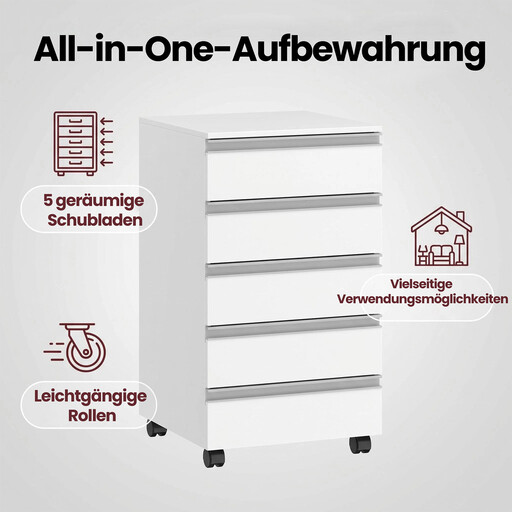
Why it's a good fit: Ideal for users who need maximum, compartmentalized storage for small items, documents, and office supplies without a large budget. The five separate drawers allow for clear separation of different utensils.
The construction is designed for a high load capacity of up to 50 kg (110 lbs), counteracting the "unstable construction" pitfall. The two lockable front casters ensure a secure stance.
Five separate drawers offer highly granular organization, which is often missing in models with only two or three compartments.
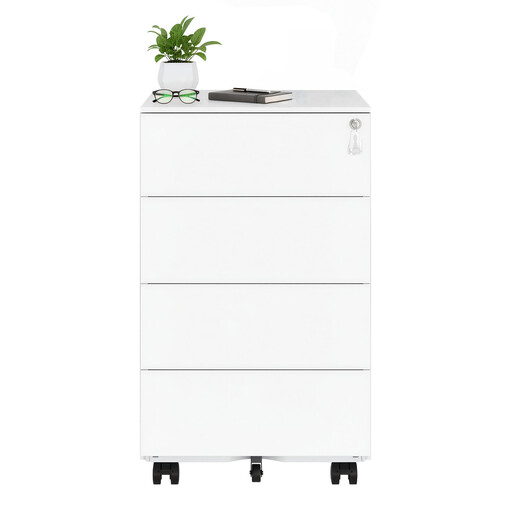
Why it's a good fit: Perfect for users who need to securely store confidential documents and value a robust, durable construction. It arrives pre-assembled, saving time and effort.
The steel construction prevents wobbling and instability. The drawers are equipped with full-extension slides, making the storage space fully usable and avoiding the "hard-to-reach corners" pitfall.
The combination of a robust steel frame, central locking system, and pre-assembled delivery offers a high degree of security and convenience.
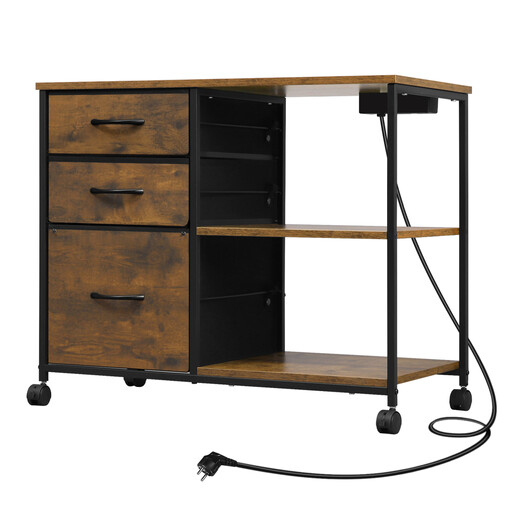
Why it's a good fit: For users who need more than just storage. This model serves as a mobile charging station and printer stand, combining open shelves for quick access with closed drawers.
It solves the "mismatched model" problem by combining multiple functions (charging, printing, storage) in one unit. The sturdy metal frame with a total load capacity of 83 kg (183 lbs) is designed for heavy equipment.
The integrated power strip with 2 outlets and 2 USB ports eliminates the need for separate extension cords and keeps the workspace free of cable clutter.
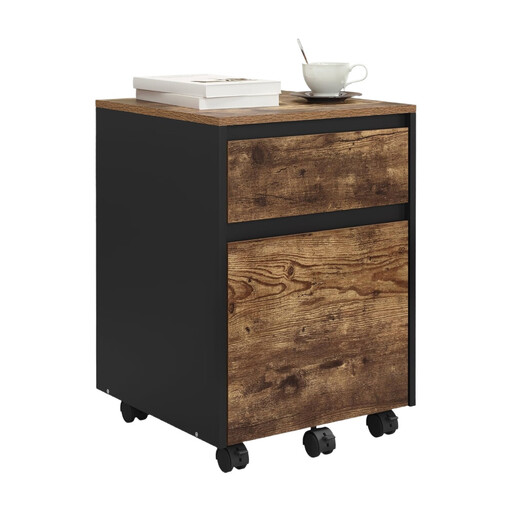
Why it's a good fit: Specifically designed for small workspaces. With a height of 56 cm (22 in) and a width of 40 cm (15.7 in), this cabinet fits under most desks without sacrificing valuable legroom.
It solves the "incorrect dimensions" pitfall with its intentionally compact design. The fifth support caster under the bottom drawer provides necessary anti-tip stability despite its shallow depth.
The large bottom drawer is equipped with rails for A4 hanging files, enabling efficient file organization in a very small footprint.
We've compiled a complete, up-to-date list of products that fully meet these strict selection criteria and applicable regulations.
No, the height is critical. Before buying, be sure to measure the distance from the floor to the underside of your desktop. Compare this measurement with the total height of the rolling cabinet, including its casters. The standard desk height is often between 72 and 76 cm (28 to 30 inches), but individual models can vary.
It depends on the intended use. Metal cabinets (usually steel) are generally more robust, durable, and offer a higher load capacity. They are well-suited for heavy use and storing heavy files. Engineered wood cabinets (MDF or particleboard) offer a wider variety of designs and are often more budget-friendly, making them a good choice for a general home office.
The fifth caster, usually located at the center of the bottom drawer's front edge, is an anti-tip safety feature. It supports the cabinet when the heaviest drawer (often filled with files) is fully extended, preventing the entire unit from tipping forward. This is an important stability feature, especially for narrow and tall models.