
Lieferung heute & morgen

Qualitätsgarantie

Willkommens-Angebote freischalten: KOSTENLOSE Lieferung | Bis zu 80 % RABATT | Kostenlose 30-Tage-JoyPlus-Testphase
App herunterladen
A rolling stool is more than just a simple seat. It's a tool for dynamic work in medical practices, salons, offices, or even home workshops. However, the vast selection can quickly lead to a poor purchase. Certain structural weaknesses often only become apparent after a few weeks of use. This guide will show you what to look for to make an informed decision.
Many models look similar at first glance, but the differences are in the details. These three defects are the most common causes of dissatisfaction and unnecessary expense:
To avoid these pitfalls, you should focus your attention on three core technical areas. These determine the durability, safety, and functionality of your stool.
The quality of the base assembly is non-negotiable. A stool with casters must be stable and roll smoothly. Pay attention to the following features:
A work stool must adapt to you and your work environment, not the other way around. Height adjustability is the key factor here.
The seat surface determines comfort during both short and long periods of use.
Based on the criteria mentioned, we have identified a few models that are well-suited for specific scenarios.

Why This Fits Their Persona: Ideal for professionals in practices, studios, or salons who work actively and on the move for many hours. The saddle shape supports an upright posture, and the faux leather cover is hygienic and easy to clean.
The ergonomic saddle shape prevents the discomfort of a flat, worn-out cushion. The robust metal frame with five 360° casters provides the necessary stability and mobility for a professional workday.
Promotes an active sitting posture; easy-to-clean and water-resistant faux leather cover; maximum load capacity of 120 kg according to the manufacturer.

Why This Fits Their Persona: Suitable for the home office or workshop, where you move between a desk and a shelf but still want light lower back support without restricting freedom of movement.
The small backrest offers a solution to the problem of no support on standard stools, without sacrificing compactness and mobility. The chrome-plated steel frame counteracts the risk of an unstable base.
Combination of mobility and lumbar support; smooth-rolling nylon casters; compact design that slides under the desk when not in use.
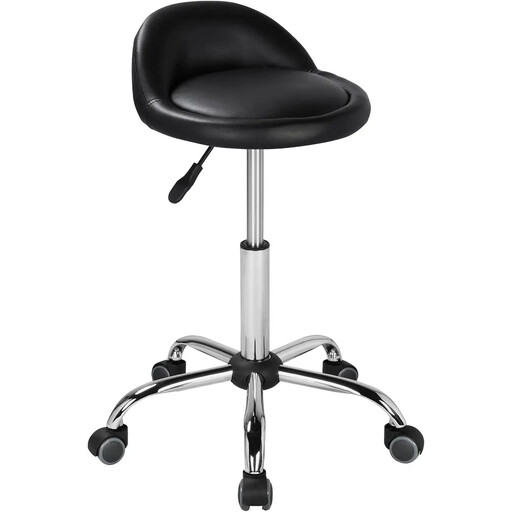
Why This Fits Their Persona: A functional and straightforward choice for anyone needing a mobile stool for occasional use at a vanity, in a workshop, or as a flexible extra seat without a large budget.
This model focuses on the core functions: a reliable gas lift for height adjustment and a stable metal base. It forgoes extra features that are often the first points of failure in this price range.
Solid basic functionality; wide height adjustment range (55.5 cm to 70 cm according to the manufacturer); simple assembly and easy-to-clean PU cover.
We have compiled a complete, up-to-date list of products that fully meet these strict selection criteria and UK safety regulations.
For hard floors like parquet, laminate, vinyl, or tile, hard-floor casters with a soft coating are the right choice. They prevent scratches and roll quietly. For carpeted floors, soft-floor casters, which are made of harder plastic, are suitable as they glide more easily over the carpet.
Sit on the stool and place your feet flat on the floor. Adjust the height so that your thighs are slightly angled downwards or parallel to the floor, and your knees form an angle of about 90 degrees. Your arms should also be able to rest comfortably on the work surface or desk at an approximately 90-degree angle.
The maximum load capacity indicates the static weight that the stool can safely support without expecting structural damage. It is an important safety and quality indicator. Exceeding this weight can damage the gas lift, the base, or the casters and compromise stability.