
Lieferung heute & morgen

Qualitätsgarantie

Willkommens-Angebote freischalten: KOSTENLOSE Lieferung | Bis zu 80 % RABATT | Kostenlose 30-Tage-JoyPlus-Testphase
App herunterladen
In dynamic work environments, whether in an office, a medical practice, a salon, or a home office, flexibility is key. A rigid chair can restrict your freedom of movement and slow down workflows. A rolling stool offers a practical solution by combining mobility with compact seating.
This article serves as your guide. It highlights the key features to consider when choosing a rolling work stool and presents a selection of different models to help make your decision easier.
To find the right model for your needs, several fundamental criteria should be taken into account.
The shape of the seat directly impacts comfort, especially during extended use. There are two common variants:
Some models, like certain office stools, also offer a low backrest that can support the lumbar region.
Making a swivel stool height-adjustable is a standard feature, but the adjustment range varies. Ensure that the minimum and maximum seat heights are compatible with your body height and the height of your work surface. The adjustment is typically seamless via a lever under the seat.
The maximum load capacity is a key safety factor. Most models are designed to support a weight between 120 kg and 150 kg. Check this specification to ensure stable and durable use. The frame, usually made of metal, is a major contributor to stability.
The seat's upholstery material should be functional. Faux leather is a common choice as it is durable and easy to clean—a damp cloth is usually sufficient. This is particularly advantageous in environments where a cosmetology stool or practitioner's stool is used.
The quality of the casters determines its mobility. Five 360° smooth-rolling casters ensure fluid movements in all directions. Pay attention to the caster material to ensure they are suitable for your flooring (e.g., parquet, tile, carpet) and won't leave scratches.
Here is a presentation of various models, each suited for different applications due to their specific features.

Key Features This stool with casters from Yaheetech is distinguished by its ergonomically shaped saddle seat. The design aims to prevent slipping and support a stable sitting position. The faux leather cover is water-resistant and easy to maintain.
Advantages:
Who is it for? Professionals who are frequently on the move at work and value an ergonomic posture, for example in medical practices, studios, or home offices.

Key Features The model from Woltu combines a minimalist design with high functionality. The classic round seat is padded with high-density memory foam. The galvanised metal frame and rubber casters are designed for durability and quiet movement.
Advantages:
Who is it for? Users looking for a robust and versatile office stool for various work areas like offices, salons, or workshops, and who require a higher load capacity.
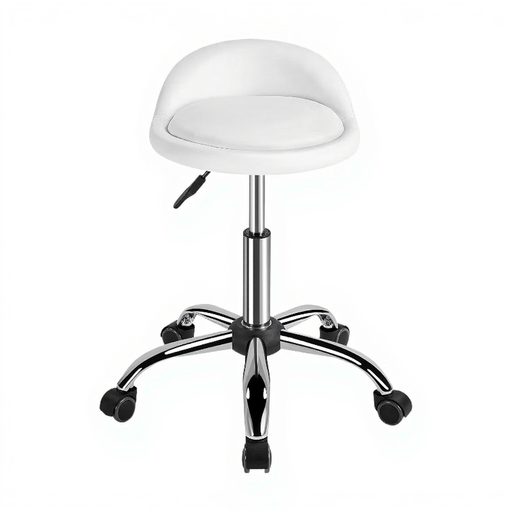
Key Features This rolling work stool offers additional lumbar support thanks to its low backrest. The simple, white design blends well with modern interior styles. Its compact, armless design makes it highly versatile.
Advantages:
Who is it for? Users who prefer a mobile seating solution with light back support for the office, dining room, or home workspace.
Haven't found the right model for you yet, or would you like to compare more variants? You can find a wider range of mobile seating solutions in our Swivel Stools category. There you can discover different designs and features that fit your specific requirements.
1. What is the difference between a saddle stool and a round rolling stool? The main difference lies in the ergonomics. A saddle seat is modelled after a riding saddle and promotes an upright posture by tilting the pelvis forward. A round stool offers a flat, neutral seating surface that allows for more lateral movement and is often used for shorter, varied tasks.
2. How do I care for a rolling stool with a faux leather cover? Maintenance is straightforward. As a rule, it is sufficient to regularly wipe the surface with a soft, slightly damp cloth. For more stubborn dirt, a mild cleaning agent can be used. Aggressive or abrasive cleaners should be avoided to prevent damage to the material.
3. What types of floors are the casters of a work stool suitable for? Most standard casters are designed for hard and smooth floors such as tile, laminate, parquet, or vinyl. For sensitive wooden floors or soft carpets, it may be advisable to look for special casters for the respective surface or to use a floor protection mat to prevent wear and tear or restricted movement.