For afternoon coffee for two, a few fresh rolls are an obvious choice if you’re going to eat them straight away. Part-baked rolls work well if you want to prepare a few at a time on different days. A half loaf is an option if the loaf size and type suit how much you plan to eat. What matters is what you can finish before your next shop or put away for later.
Who needs to think about quantity?
Small two-person households
If you’re only shopping for afternoon coffee, you can choose the number of rolls to suit how many you plan to eat. Germany’s Federal Ministry of Food and Agriculture lists bread and baked goods among the food groups often thrown away by German households.
People who bake rolls a few at a time
You want to prepare only the rolls you need and have an oven available. Whether this works for you day to day also depends on the instructions for the product you choose.
People who need to check for allergens
For them, the information for the specific variety matters more than its name or how it is sold. If you’re buying loose rolls, check the allergen information provided before choosing.
What should you consider when buying?
First, decide whether you’ll serve the baked goods straight away with coffee or save them for another day. You can then choose between individually bought rolls, part-baked rolls prepared a few at a time, and half a loaf.
Fresh individual rolls
A good choice if: You’ll eat the rolls with your coffee straight away and can choose the number you buy individually.
Bear in mind: You’ll need to shop again for future coffee dates or find a way to store any leftovers.
Part-baked rolls
A good choice if: You want to prepare just a few rolls on different days and have an oven available.
Bear in mind: They’re only useful for planning smaller quantities if you can store the remaining rolls separately and don’t bake them all in advance.
Half a loaf
A good choice if: A shop sells the type of bread you want as half a loaf and the quantity suits your planned coffee dates.
Bear in mind: A half loaf isn’t automatically a part-baked product. Check the type, weight, storage instructions and whether the bread needs preparing before serving.
| What you need |
What to check when buying |
Who it matters most to |
| Smaller quantity |
Match the number of rolls or the weight to how much you plan to eat. If you’re buying loose, ask about individual rolls or a half loaf. |
If there’s just one coffee date planned for two people, I don’t want to take home several rolls we won’t use. Getting the quantity right is a priority for around 42 % of consumers. |
| Baking a few at a time |
Check whether you can take out individual rolls and follow the pack’s preparation and storage instructions. |
I want to warm up just the rolls we’ll serve on each of several different days. This is a top priority for around 33 % of consumers. |
| Ready to eat straight away |
Check whether the product is ready to serve or needs preparing. If you’re buying bread, take its type into account when planning how to store it. |
If coffee is about to be served, I want to put out the baked goods without having to bake them first. This immediate convenience is the most important consideration for around 17 % of consumers. |
| Ingredients and allergens |
For packaged products, read the information for the specific variety. If you’re buying loose goods, check the allergen information at the point of sale. |
If I need to avoid a particular ingredient, I want to check the information for the exact product on offer. This takes priority for around 8 % of consumers. |
Which buying mistakes can you avoid?
-
Buying more than you’ll eat
A large pack won’t solve the problem if baked goods are left over before your next shop. Germany’s Federal Ministry of Food and Agriculture lists bread and baked goods among the food groups often thrown away by German households.
Before you buy, decide how many you’ll eat soon and whether you can store any for later. If there are two of you, check whether you can buy individual rolls too.
-
Assuming half a loaf means part-baked bread
The term “half-fresh rolls” doesn’t reliably tell you whether the product is half a loaf, rolls or something to bake at home. It also leaves the preparation and storage requirements unclear.
Ask in the aisle or at the counter what kind of product it is, how much it weighs and how it should be stored. Check whether you need to prepare it before serving.
-
Relying on the variety name to identify allergens
A roll’s name doesn’t replace information about its specific recipe. Germany’s Federal Office of Consumer Protection and Food Safety lists undeclared allergens among the common reasons for food recalls.
If you have an allergy, check the information for the specific product. If anything is unclear about loose goods, ask for the allergen information before buying.
-
Relying on special-offer stock for a planned coffee date
ALDI Nord notes that its special-buy products may be available in limited quantities and can sell out early.
If you need the baked goods for a particular date, check availability before setting off or plan to shop somewhere else.
If the special offer has already sold out, you may need to make an extra trip.
Brands and retailers to consider
REWE
REWE provides product information on part-baked rolls and Harry Doppelbrötchen dough pieces.
- Ingredients and baking instructions are available for the dough pieces covered in its product information.
- Check what your local shop stocks and read the information for the product you choose; this doesn’t mean half loaves are available.
EDEKA
EDEKA publishes guidance on preparing frozen rolls.
- As general guidance, EDEKA recommends around 180 °C using conventional top and bottom heat for frozen rolls.
- Always follow the preparation instructions for the product you’ve bought; this guidance doesn’t refer to a specific product.
Lidl
Lidl describes “Unser Brot” as its own-brand range of bread and baked goods from its in-store bakery.
- Information about the in-store bakery can be a helpful guide if you’re looking for baked goods that are ready to serve.
- Check with your local store to see whether it offers a suitable smaller quantity or a half loaf.
ALDI Nord / GOLDÄHREN
ALDI Nord has listed GOLDÄHREN Meisterbäcker rolls as a special-buy product.
- This refers to a specific roll product, not a general bread category.
- According to ALDI Nord, special-buy products may be available in limited quantities and can sell out early.
Der Meisterbäcker
Der Meisterbäcker is a regional bakery specialising in bread and rolls.
- The bakery describes its range as using long fermentation and natural sourdough; these are the business’s own claims about its products.
- Ask your local branch about smaller quantities, ingredients and whether you can buy half a loaf.
Products for smaller quantities and separate portions
This section features a nine-roll pack of part-baked Kaiser rolls and a 250 g loaf as an alternative to a multi-roll pack. The small loaf isn’t described as half a loaf, so compare its size with how much you plan to eat.
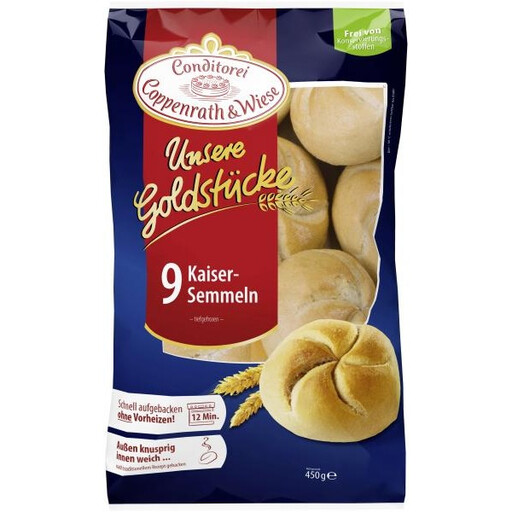 Image unavailable
Coppenrath & Wiese Our Gold Pieces Kaiser rolls, 9 pieces, 450 g
This pack could suit coffee dates on several days if you prepare only the rolls you need each time. It contains 9 rolls, weighing 450 g in total. The rolls aren’t ready to eat, so follow the preparation and storage instructions on the pack.
View at Joybuy
 Image unavailable
Mestemacher Sylt walnut wholemeal bread, 250 g
This 250 g loaf is an alternative if you’d prefer a smaller quantity of bread to several rolls. It isn’t described as half a loaf. Check the way it’s sliced to see whether it suits your portion size, and if you have a nut allergy, check the ingredients and allergen information on the specific pack.
View at Joybuy
Frequently asked questions
When are part-baked rolls a good choice for two people?
Part-baked rolls work well if you can prepare only the number you need on each of several days. Check whether you can take out individual rolls and how to store the rest. Follow the temperature and timings on the pack.
How long does half a loaf stay fresh?
Freshness depends mainly on the type of bread and how you store it, not simply on whether the loaf has been cut in half. Germany’s consumer advice centre says that, when stored optimally, white bread can last up to two days and wheat-and-rye bread around two to four days. Check the type of bread when you buy it and plan the quantity accordingly.
Can I freeze leftover baked goods?
Freezing can be a way to keep baked goods for later. Germany’s consumer advice centre explains that frozen baked goods can go straight into the oven. Also follow the storage and preparation instructions for the specific product.
How can I check allergens in loose rolls?
Check the allergen information for the exact rolls you want to buy. Read the information provided at the point of sale or ask at the counter before choosing a variety.


