For smaller households, the key factor is how much you actually eat on weekdays: small packs of bake-at-home rolls or individually removable frozen rolls suit changing needs, while half a loaf can provide sandwiches for several days. Fresh rolls save you the baking time, but you should buy only as many as you need. For products you’re stocking up on, also check the preparation and storage instructions, along with the ingredients and allergens for the specific product.
Which option suits you?
Smaller households with frequent leftovers
If you’re shopping for one or two people, compare the pack size with how much you actually need for breakfast. Half a loaf could see you through several days of sandwiches; for rolls, consider smaller packs or frozen ones you can take out individually. The Too Good for the Bin! initiative specifically recommends half loaves as a way for smaller households to help prevent food waste.
People with little time on weekday mornings
If you want breakfast on the table without any extra preparation, freshly bought rolls are a different choice from bake-at-home rolls. Follow the instructions on the pack you choose: for its Herzstücke stone-baked rolls, for example, EDEKA gives a baking time of 8–12 minutes, depending on the oven.
People checking ingredients and allergens
If you need to take specific ingredients or allergens into account, check the information for the exact variety you’ve chosen. Germany’s Federal Ministry of Agriculture, Food and Home Affairs says that the main allergens must be labelled. For packaged products, the current packaging is the definitive source; for loose products, ask for the available allergen information.
What to look for when buying
Small pack of bake-at-home rolls
A good fit if: You’d like to eat rolls on several weekdays and the pack size matches how many you get through.
The trade-off: You’ll need a suitable appliance and enough time to prepare breakfast according to the product instructions.
Frozen rolls
A good fit if: Your needs vary and the packaging says you can take out the number you need individually.
The trade-off: You’ll need freezer space; the pack size alone doesn’t tell you whether you can remove individual rolls.
Half a loaf
A good fit if: You eat sandwiches on several days and don’t want rolls every morning.
The trade-off: A smaller quantity doesn’t remove the need to store the bread properly or plan when you’ll finish it.
Fresh rolls
A good fit if: You want breakfast without baking and only want to buy the amount you need straight away.
The trade-off: If you buy extra, you’ll still need to plan when to eat or freeze the remaining rolls.
| What to consider |
What to look for |
Who it matters most to |
| Portion size and leftovers |
Compare the number of rolls and pack size with how much you use in a week. For frozen products, check whether you can take out individual rolls. |
If I only eat rolls on some days, I don’t want to have to use up a whole pack each time; around 36% of consumers say getting the right quantity is their top priority. |
| Time and equipment |
Check the baking time, heating method, and any instructions about preheating and defrosting on the specific pack. |
My breakfast needs to fit into the time I have before work; around 29% of consumers would therefore focus mainly on the preparation time and effort involved. |
| Ingredients and allergens |
Check the current ingredients and allergen information for the variety you’ve chosen, including for loose products. |
If I need to avoid certain ingredients, the variety name alone isn’t enough to help me decide; around 21% of consumers would prioritise the specific product information. |
| Freshness and variety |
Decide whether you want to eat the rolls straight away or store them for breakfasts later in the week, then choose a variety based on what’s available. |
Sometimes I want a particular roll that’s ready to eat that morning, rather than a product to stock up on; around 14% of consumers would prioritise this. |
Common mistakes
-
Assuming half a loaf is the same as a portion of rolls
Half a loaf gives you a smaller amount of bread for several meals. Bake-at-home and frozen rolls, on the other hand, let you choose how many rolls to prepare on a particular morning.
First decide whether you’d rather eat bread or rolls over the next few days. Then compare quantities, storage options and, if relevant, the baking instructions.
-
Buying a large pack without planning how you’ll use it
A pack is only practical for a small household if you can eat its contents in time or store them properly. The Too Good for the Bin! initiative also recommends half loaves for smaller households to help prevent food waste.
Before buying, think about how many weekdays you’ll actually eat the baked goods, and whether you can freeze any leftovers in line with the product instructions.
-
Leaving it until breakfast to read the baking instructions
Baking times vary by product and appliance. For its Herzstücke stone-baked rolls, for example, EDEKA gives a baking time of 8–12 minutes and notes that it varies depending on the type of oven.
Before buying, check the baking time, temperature, heating method, and any instructions about preheating or defrosting. This will help you work out whether the product fits into your morning routine.
-
Guessing allergens from the name of a roll
A variety name is no substitute for ingredient or allergen information. Germany’s Federal Ministry of Agriculture, Food and Home Affairs lists cereals containing gluten and other allergens that must be labelled and may be relevant depending on the product.
For packaged rolls, check the current packaging. For loose products, ask for the allergen information for the specific variety you want to buy.
Supermarkets and bakeries to consider
REWE
REWE’s range of bake-at-home rolls includes different pack sizes, as well as chilled and frozen options.
- The range filters make it easier to narrow down pack sizes and listed product features.
- Check the details for the specific product and what’s available in your area.
EDEKA
For some bake-at-home rolls, EDEKA provides details on ingredients, allergens, nutritional values and preparation.
- You can check a specific product to see whether the number of rolls and baking instructions suit your breakfast.
- EDEKA notes that products may not be available in every store; always follow the information on the pack.
ALDI
ALDI Nord stocks bake-at-home rolls in several varieties, including packs of four; the range may differ between stores and between ALDI Nord and ALDI SÜD.
- The different pack sizes give smaller households something specific to compare.
- Check the current variety and availability at your nearest store.
Lidl
Lidl describes its bakery as offering freshly baked goods several times a day.
- The in-store bakery is an option if you want breakfast without baking rolls at home.
- Check the variety, ingredients and availability at your local store rather than assuming the range is the same everywhere.
Kamps
The local Kamps delivery range also lists individual rolls, including sliced rolls and seeded rolls.
- You can choose individual rolls to buy just a few for breakfast.
- The listed delivery range applies to a specific location; check the range and allergens for the specific product or at your local store.
Bake-at-home rolls at Joybuy
These two roll products could suit a breakfast that involves baking and keeping a supply in the freezer. Whether either pack matches your needs also depends on how many rolls you want to take out and prepare.
 No image available
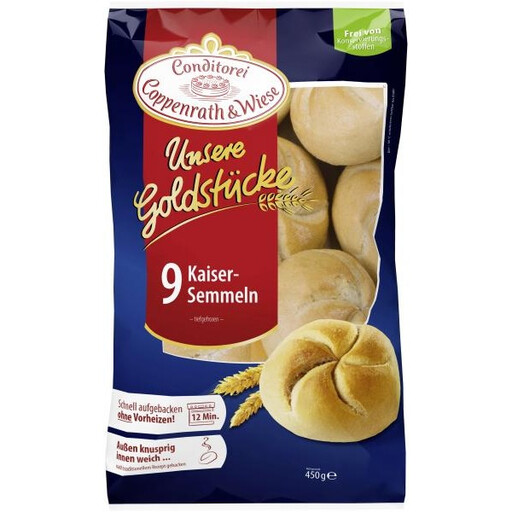
Coppenrath & Wiese Our Gold Pieces Kaiser Rolls, 9 Stück, 450 g
The pack of nine is worth considering if you’re planning rolls for several breakfasts. Check that you can take out the number you need and that baking them in the oven fits your needs and morning routine.
View at Joybuy
 No image available
Schär Kaisersemmel Gluten-Free, 350 g
If you’re specifically looking for these Kaiser rolls, check the current gluten-free and allergen information on the pack, as well as the baking instructions. Also compare the number of rolls and whether you can take them out individually with how many you need.
View at Joybuy
Frequently asked questions
Do bake-at-home rolls automatically mean fewer leftovers for a small household?
No. What matters is whether you can portion the pack to suit your needs and store any remaining rolls according to the product instructions. If you eat bread on several days instead, half a loaf could also work; the Too Good for the Bin! initiative recommends it as a way for smaller households to help prevent food waste.
How long can rolls be kept in the freezer?
The Too Good for the Bin! initiative says frozen rolls can be kept for one to three months. For freshly frozen rolls, it recommends up to six months at −18 °C in a well-sealed freezer bag; also follow the storage instructions for the specific product.
Is allergen information available for loose rolls too?
Yes. Information about allergens that must be labelled also has to be available for unpackaged products. Germany’s Federal Ministry of Agriculture, Food and Home Affairs explains allergen labelling; ask specifically about the loose variety you’ve chosen and check the current packaging for packaged products.
Should I keep rolls in the fridge until breakfast the next day?
For everyday short-term storage, the Too Good for the Bin! initiative recommends room temperature rather than the fridge. The best option may differ in very hot or humid weather; if you want to keep rolls for longer, check whether they can be frozen according to the product instructions.


