
Lieferung heute & morgen

Qualitätsgarantie

Willkommens-Angebote freischalten: KOSTENLOSE Lieferung | Bis zu 80 % RABATT | Kostenlose 30-Tage-JoyPlus-Testphase
App herunterladen
As a Joybuy Product Recommendation Officer, I see parents every day searching for practical yet appealing solutions for their child's room. A common challenge is the clutter that comes with a growing collection of books and toys. However, a well-organised environment can foster a child's independence and love for reading. A rotating kids' bookshelf is a clever solution that saves space and makes all its contents easily accessible.
This article is your guide. It highlights the key features you should consider when making your selection and presents a few models to help you make an informed decision.
Choosing furniture for a child's room requires careful thought. Beyond design, functional and safety-related aspects are paramount.
Safety in a child's room is the top priority. Look for models with rounded corners and edges to minimise the risk of injury from bumps. A freestanding shelf for kids needs a wide, stable base to prevent it from tipping over. Materials like MDF (Medium-Density Fibreboard) with a melamine veneer are durable and easy to clean. Verify that the paints and materials used are non-toxic and safe for children.
Carefully measure the available space in the child's room. A 360-degree rotating shelf is particularly space-saving, as it's accessible from all sides and doesn't require a large footprint. Consider how much storage space you'll need. Models with multiple tiers and additional side pockets offer flexible kids' room storage for books of various sizes, as well as for toys. The height of the shelf should allow your child to reach the compartments independently, which aligns with the principles of a Montessori bookshelf.
An engaging design can boost a child's motivation to interact with books. A house-shaped bookshelf for the kids' room is not just a piece of furniture but also a playful element. For encouraging reading, a front-facing book display is crucial. When children can see the book covers instead of just the spines, they are more likely to pick one out. This type of book storage for kids helps develop a sense of order and self-reliance.
Here is a selection of products that meet different organisational and design needs.

Why It Stands Out This Woltu kids' shelf combines high functionality with a child-friendly design. The 360° rotating function on a metal base allows children to effortlessly access all compartments. The appealing house shape playfully integrates into any child's room and encourages use.
Advantages
Who It's For This model is ideal for parents looking for a multifunctional and space-saving solution for kids' room storage. It's perfectly suited for preschool and primary school-aged children to learn organisational skills and discover the joy of reading.

Why It Stands Out This shelf offers a modern and minimalist aesthetic. Although primarily designed as a plant stand, its sturdy, powder-coated metal construction makes it a versatile storage solution for various living areas.
Advantages
Who It's For This shelf is aimed at users seeking a stylish and flexible storage unit for their living room, balcony, or workspace. It is less intended for a typical child's room and more for general home organisation.
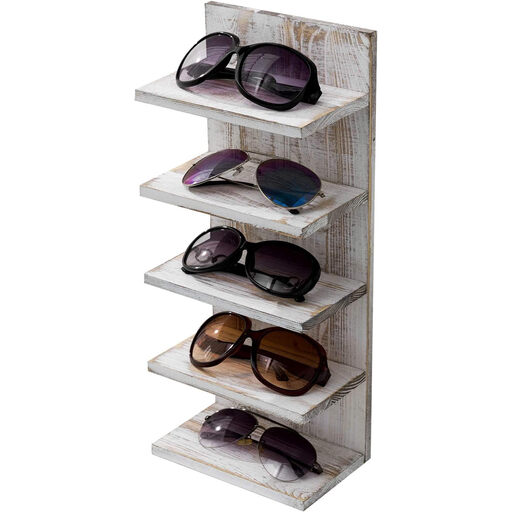
Why It Stands Out This organiser is a specialised solution for space-saving storage of smaller items. Crafted from solid wood with a whitewashed finish, it brings a rustic charm to any room.
Advantages
Who It's For This product is a niche solution for individuals looking for a decorative and functional way to organise glasses or other small accessories and who appreciate a rustic, farmhouse style.
The world of storage furniture is vast. If the models presented don't exactly match what you're looking for, or if you need specific add-ons, there are countless other possibilities to explore.
For a broader overview of organisational aids and accessories, take a look at our Shelving Accessories category.
1. What defines a Montessori bookshelf? A Montessori bookshelf is designed to foster a child's independence. Key features include a low height, allowing the child to access it on their own, and a front-facing display for books. Instead of only seeing the spines, the child can view the covers, which makes selection easier and encourages reading.
2. How tall should a bookshelf for children be? The ideal height depends on the child's age and size. As a general rule, the child should be able to reach most of the shelves without assistance. For toddlers and preschoolers, shelves up to a height of about 125 cm are well-suited. It's important that the most frequently used books and toys are placed at the child's eye level.
3. How do I secure a freestanding shelf in a child's room? To prevent tipping, a freestanding shelf for kids should always have a wide, heavy base. Additionally, it is recommended to secure taller shelves to the wall with an anti-tip kit. Many manufacturers include the necessary mounting hardware. Always place heavy items on the bottom shelves to keep the shelf's centre of gravity low.