
Lieferung heute & morgen

Qualitätsgarantie

Willkommens-Angebote freischalten: KOSTENLOSE Lieferung | Bis zu 80 % RABATT | Kostenlose 30-Tage-JoyPlus-Testphase
App herunterladen
A round dining table is often the centrepiece of a dining room or eat-in kitchen. It encourages conversation and creates an inviting atmosphere. However, the search for the right model for 4 to 6 people can quickly become overwhelming. Many tables look great in product photos but prove to be impractical in daily use. This guide will show you which crucial features to look for to avoid a bad purchase and find a table that is both functional and durable.
Before we dive into the important parameters, let's look at the typical issues that can arise during the selection process. If you know what they are, you can actively avoid them.
To ensure your new table can handle the demands of daily life, you should carefully examine three core aspects.
The most important metric for a round dining table is its diameter. As a rule of thumb, each person at the table needs about 60 cm of width to sit and eat comfortably.
Also, consider the shape of the table base. A table with a central pedestal base offers more legroom than a model with four legs at the edge of the top.
The table base determines not only the look but, more importantly, the stability. A dining table with metal legs is often a good choice here, as metal provides high strength with relatively slim profiles. This is particularly characteristic of an industrial-style dining table or a modern dining table.
Look for the following features:
The tabletop is the most heavily used component. While solid wood radiates natural warmth, modern, high-quality MDF (medium-density fibreboard) tops with a durable coating often require less maintenance.
A good tabletop for a round kitchen table should have the following properties:
Based on the criteria mentioned above, we have identified some products that are suitable for different user profiles.
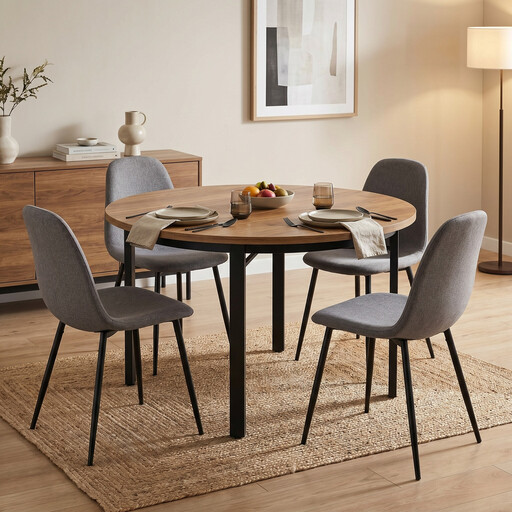
Why this model is a great fit: With its clean lines, wood-effect tabletop, and solid metal frame, this table seamlessly fits into modern and industrial living concepts where a minimalist design language is key.
The solid metal legs and adjustable foot pads directly counteract the pitfall of instability. The 118.5 cm diameter is an honest specification for 4 to 6 people, avoiding the problem of misleading size claims.
According to the manufacturer, the MDF tabletop has a water-resistant surface, which simplifies cleaning and makes it durable enough for daily use.
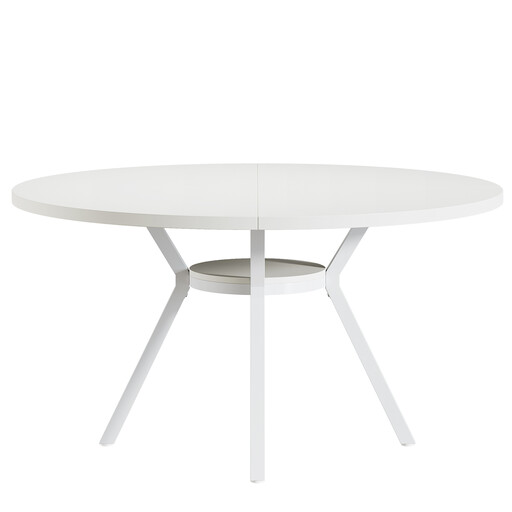
Why this model is a great fit: The integrated lower shelf is an extremely practical solution for families. It can be used to store placemats, napkins, or even children's art supplies, keeping the tabletop clear.
The sturdy X-shaped steel base ensures high stability. With a 120 cm diameter, the table is clearly sized as a dining table for 6 people, and the base design maximises legroom.
The combination of extra storage and a tabletop that is heat-resistant and scratch-proof (according to the manufacturer) makes this table a multifunctional and durable choice for family life.
If you're looking for other models that combine high stability with a modern design, we've put together a curated selection for you.
In addition to the table diameter, which should ideally be 120 to 140 cm, you should plan for at least 75 cm of clearance around the table. This space is needed to pull out chairs and stand up comfortably. For a 120 cm diameter table, this means you need a free area of about 270 x 270 cm.
High-quality medium-density fibreboard (MDF) is very well-suited for daily use and is durable. Look for a sufficient board thickness (e.g., over 2.5 cm) and a resilient, sealed surface. This is often easier to maintain and less prone to warping from humidity fluctuations than solid wood.
Caring for metal legs, especially those made of powder-coated steel, is straightforward. Wiping them with a slightly damp cloth is usually sufficient. Avoid abrasive cleaners, as they can damage the surface. It is also advisable to periodically check that the screw connections between the legs and the tabletop are still tight.