Who are rudder pedals for?

Pilots practising taxiing and braking

If you want to operate the rudder and the left and right wheel brakes separately with your feet in compatible aircraft, check which axes are available and how they’re assigned in the simulator. Thrustmaster and Logitech G document independently controlled brakes on their corresponding pedal models.

Sim builders with a dedicated setup

If your pedals will stay in your sim room, consider more than just their footprint: you’ll also need room to move, a comfortable seating position and a stable base. Turtle Beach and MOZA describe mounting options for their respective models.

Upgrading an existing control setup

If you’re adding pedals to a joystick, yoke or console, check how they connect and whether you’ll need any extra equipment for your existing setup. Connections vary by model and platform.

What should you look for when buying?

Rudder with separate toe brakes

A good fit if: You want to operate both wheel brakes with your feet as well as the rudder in compatible aircraft.

Consider: Three hardware axes alone don’t guarantee a suitable assignment for every aircraft; check how the model connects, too.

Adjustable setup for a dedicated space

A good fit if: You want to adjust the pedal position, resistance or mounting to suit your seating position.

Consider: Adjustability doesn’t remove the need to measure the available space and pedal travel; the damper for the MOZA MRP is sold separately.

Compact single-axis rudder pedals

A good fit if: A rudder axis is all you need and separate physical toe brakes aren’t a priority.

Consider: According to the supplier, the VKB T-Rudder Mk.V has one analogue axis; a compatible BlackBox is required to use it.

Priority What to look for when buying Who is it important to?
Separate rudder and brake controls Check the documented axes and assignments for your simulator and chosen aircraft. If I want to operate the left and right wheel brakes separately when practising taxiing, I need compatible toe-brake axes. Around 31 % of consumers would make separate brake axes their top buying priority.
Space and a stable setup Check the model’s overall dimensions, room for movement, floor contact and mounting points. For my dedicated setup, I need enough space in front of the seat for the pedals and foot movement. Around 25 % of consumers would put space and mounting options first.
Connection to existing controls Check the platform, connections, what’s included, any extra equipment needed and the simulator assignments for the exact variant. If I’m adding pedals to my existing PC or console setup, I want to know how they’ll connect before buying. Around 25 % of consumers would prioritise compatibility with their existing system.
Adjustable pedal feel Check which adjustments, springs and dampers are included with the specific model. If I want to adjust the resistance and foot position to suit my setup, what I can actually adjust matters to me. Around 19 % of consumers would give adjustable pedal feel particular importance.

Common buying misconceptions

  • ‘Rudder pedals’ automatically means three axes

    Models differ in whether they offer separate brake axes as well as a rudder axis. According to the supplier, the VKB T-Rudder Mk.V has one analogue axis.

    Before choosing, decide whether you need two additional physical toe-brake axes for the aircraft you’ll be simulating.

  • A platform listing always means a direct connection

    The connection may vary depending on your PC or console setup. The TFRP and VelocityOne each have their own connection requirements.

    Read the instructions for the specific model variant and check them against your existing equipment.

  • Measuring the base alone is enough

    You’ll also need room in front of the seat for the pedals to move and for your feet to reach them comfortably. Mounting options vary by model.

    As well as checking the overall dimensions, make sure there’s enough room to move and that you can secure the pedals in your chosen spot.

Key brands at a glance

Thrustmaster

The T.Flight Rudder Pedals (TFRP) are designed for rudder control and separate brakes.

  • Thrustmaster documents two independently controlled brake axes and removable heel rests.
  • On PC, the connection depends on your setup and uses either an RJ12/USB adapter or a compatible Thrustmaster device. Check console connections for your specific combination.

Logitech G

The Flight Sim Rudder Pedals are aimed at PC flight simulators and, according to the manufacturer, offer separate toe brakes and adjustable rudder resistance.

  • According to Logitech G, the left and right toe brakes can be controlled independently, and resistance can be adjusted using a dial.
  • These features don’t prove that the model outperforms others. Check whether it’s suitable for your specific console.

Turtle Beach

According to the manufacturer, the VelocityOne Rudder offers toe brakes, adjustable pedal width and options for fixed mounting.

  • Turtle Beach lists differential braking, interchangeable springs and mounting holes.
  • A direct cable connection is described for PC; for Xbox, the manufacturer specifies a connection via VelocityOne Flight.

VKB

The T-Rudder Pedals Mk.V are a compact rudder option if separate physical toe brakes aren’t a priority.

  • VKB FSC Europe documents one analogue axis and an included BlackBox Mk.3.
  • The single axis isn’t a substitute for two physical brake axes; according to the supplier, the model isn’t compatible with BlackBox Mk.1 or Mk.2.

MOZA

The MRP Rudder Pedals are designed for a dedicated PC setup, with adjustable foot positioning and mounting to a simulation rig.

  • MOZA lists a USB connection to a PC, adjustable springs and mounting holes.
  • According to the manufacturer, the damper is optional and sold separately. Claims about durability and precision come from the manufacturer, not an independent comparison.

Rudder pedals at Joybuy

This Joybuy selection includes rudder pedals for rudder control and separate toe brakes during simulated training flights.
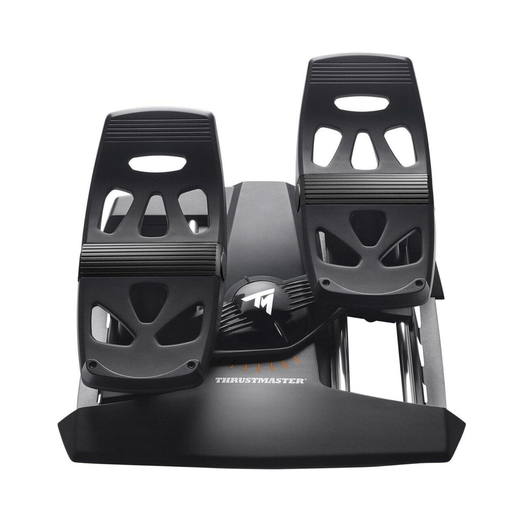
Thrustmaster T.Flight Rudder Pedals (PC/PS4/Xbox One)

Thrustmaster T.Flight Rudder Pedals (PC/PS4/Xbox One)

A good choice if you want to assign the rudder and the left and right wheel brakes separately in your simulator; differential braking is listed as a supported feature.

According to the product description, the pedals measure 34,9 × 31,4 × 20,6 cm and have removable heel rests and four guide rails.

On PC, the connection depends on your setup: you’ll need either an RJ12/USB adapter or a compatible Thrustmaster device. For consoles, check the RJ12 connection with compatible Thrustmaster joysticks.

Joybuy

Frequently asked questions

Do I need two separate toe brakes for virtual taxiing practice?

If you want to operate the left and right wheel brakes separately with your feet in a simulated aircraft that supports it, check for two brake axes in addition to the rudder axis, and make sure they can be assigned in your simulator. This extra hardware isn’t essential for rudder input alone.

How do I set up the pedals once they’re in place?

Connect them according to the instructions for your specific model, then assign the available rudder axis and, if applicable, the left and right brake axes in your simulator. Check the direction of movement and that the brakes respond correctly. The assignment guide referenced from the Microsoft Flight Simulator Forum is a community guide, not a universal recommendation for every simulator.

What ongoing costs and rights should I consider?

Before buying, check whether the connection equipment you need and any accessories you want are included; according to the manufacturer, the damper for the MOZA MRP is sold separately. In Germany, Verbraucherzentrale distinguishes between the statutory rights you have against the seller and a voluntary guarantee.

How should I dispose of old electronic rudder pedals in Germany?

According to the German Environment Agency, old electrical equipment must not go in household waste and needs to be disposed of separately. Options listed by the agency include recycling centres and suitable retail take-back points.