Cross-country pilots with limited foot space
If you mainly want to practise rudder inputs and stow the set after flying, the footprint and room for movement are especially important. VKB FSC Europe describes the T-Rudder Mk.V as space-saving.


If your main aim is to practise rudder inputs on virtual cross-country flights and stow the pedals afterwards, a compact single-axis model could be a good fit. For independent braking while taxiing, you’ll need additional brake axes. Measure the space you have, including room for your feet to move, and check how the pedals connect to your setup. There are no comparable noise measurements for any of these models to show that they’re quiet enough for a shared bedroom.
If you mainly want to practise rudder inputs and stow the set after flying, the footprint and room for movement are especially important. VKB FSC Europe describes the T-Rudder Mk.V as space-saving.
If you share your bedroom, assess the noise when pressing and releasing the pedals in the place where you’ll actually use them. Manufacturer information about the mechanism or sensors doesn’t prove that a product is quiet.
If you want to brake the left and right wheels independently with your feet while taxiing in a simulator, look for separate brake inputs. Thrustmaster, Logitech G and Turtle Beach describe this functionality for their respective models.
First, decide whether you need separate toe brakes as well as rudder control. Then check the footprint, noise where you’ll use the pedals and how they connect to your device.
| What matters | What to check before buying | Who should consider it? |
|---|---|---|
| Noise in the bedroom | Assess the noise when pressing and releasing the pedals, and how much vibration carries through your floor. | If someone else sleeps or works in the room, I want to assess the noise where I’ll actually use the pedals. Around 33% of consumers put noise levels first. |
| Footprint and storage | Measure the width, depth and height, as well as the space needed for your feet to move while seated. | In a shared room, I want to know whether the pedals have enough space while I’m practising and whether I can put them away afterwards. Around 27% of consumers prioritise footprint. |
| Rudder and brakes | Check whether a single rudder axis is enough or whether you need two separate brake inputs. | If I also want to practise taxiing with separate toe brakes, the right inputs need to be available and assigned in the simulator. Around 20% of consumers focus mainly on control and braking functions. |
| Connectivity and controls | Check the model variant, platform, cables or adapters, and axis assignments in the simulator. | With an existing PC or console setup, I want to find out in advance how to connect and configure the pedals. Around 20% of consumers prioritise connection compatibility. |
Features vary: VKB lists the T-Rudder Mk.V as having one analogue axis, while other models are described as having separate braking functions.
Before choosing, decide whether you want to practise rudder inputs only or also use your feet to brake independently.
Details about mechanisms and sensors aren’t comparable measurements of noise in a bedroom.
Assess the sound when pressing and releasing the pedals, as well as any vibration carried through the floor where you’ll use them. Don’t assume a model is quiet based on its mechanism description.
Connecting the pedals may require a specific chain of devices. Turtle Beach says the VelocityOne Rudder connects to Xbox via VelocityOne Flight; Honeycomb says the Charlie requires Alpha Flight Controls XPC and Xbox Hub.
For the exact variant, check which devices and cables are required and whether it’s compatible with your existing setup.
These console connections may require additional compatible flight-control hardware.
VKB FSC Europe describes the T-Rudder Mk.V as a space-saving option with one analogue axis.
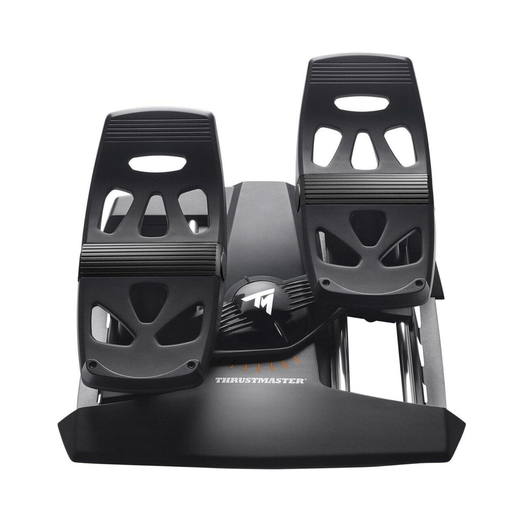
According to the manufacturer, the T.Flight Rudder Pedals combine a rudder axis with separate brake axes. The connection depends on your platform and existing hardware.
Logitech G lists separate toe brakes, adjustable footrests and adjustable pedal resistance for its Flight Rudder Pedals.
Turtle Beach describes the VelocityOne Rudder as having separate brakes, adjustable pedal width and interchangeable springs.
Honeycomb describes the Charlie Rudder Pedals as having adjustable resistance and foot angle, making them suitable for a permanent setup.
This selection includes rudder pedals with a rudder axis and separate braking functions for anyone who also wants to practise taxiing in a simulator.
 No image available
The separate braking functions could be a good fit if you want to practise taxiing with your feet as well as using the rudder.
Features include 25-cm pedals, removable heel rests and a differential braking function.
The stated dimensions are 34,9 × 31,4 × 20,6 cm. Use the pedals on a flat, stable surface, and measure the space needed for them to move.
Not necessarily if you only need rudder inputs for cross-country flights. If you want to brake the left and right wheels independently with your feet while taxiing in a simulator, look for two dedicated brake inputs and check how to assign them in the simulator.
Select the detected device in the control settings and check the profile for your aircraft. According to official Microsoft Flight Simulator support, you’ll need to assign functions manually if there’s no automatic profile.
Keep the area where you use them clear and follow the instructions for your model. Before putting them away, check that the cables and contact surfaces suit your space. The manufacturer information described here doesn’t point to any general way of reducing noise.
For electrical and electronic equipment, the German Federal Network Agency lists points that retailers must check before offering a product for sale. These include correct CE marking, product identification, manufacturer or importer details and German-language instructions. Make sure the specific product listing also includes all the required information on assembly and use.