
Lieferung heute & morgen

Qualitätsgarantie

Willkommens-Angebote freischalten: KOSTENLOSE Lieferung | Bis zu 80 % RABATT | Kostenlose 30-Tage-JoyPlus-Testphase
App herunterladen
A runner rug can add visual structure to hallways, kitchens, bedrooms and entrances, while also protecting the floor from everyday wear. However, unsuitable purchases are often caused not by the design, but by the wrong dimensions, a surface that is difficult to care for or inadequate protection against slipping.
Before buying, it is therefore worth checking the actual product specifications rather than relying solely on terms such as “soft”, “hard-wearing” or “easy-care”.
A runner should fit the available space without blocking doors, cupboard fronts or walkways. The most commonly searched-for sizes include an 80 x 200 cm rug and an 80 x 250 cm rug. A width of 80 cm is suitable for many hallways, but may already be too generous in narrower spaces.
You should therefore measure:
A non-slip rug needs a permanently adhesive backing or a suitable anti-slip mat. On smooth tiles, laminate and vinyl, a rug without sufficient fixing may move or develop creases. This is particularly important in hallways and homes with children.
Some models have an anti-slip backing. For others, a separately cut rug underlay is recommended. Statements such as “reduces movement when used with an underlay” should be assessed differently from an explicitly described anti-slip backing.
A deep pile feels soft, but can collect crumbs, dust and pet hair more readily. A shaggy rug therefore usually requires regular vacuuming and should be positioned so that doors and furniture can still be moved without difficulty. A washable rug can make cleaning easier, provided that its washing size, programme and drying requirements suit your facilities.
Fringing, woven textures and natural fibres also require gentle treatment. Manufacturer instructions such as “wash on a delicate cycle in a laundry bag” or “do not bleach” should be taken into account before buying.
For a long hallway, 80 x 200 cm or 80 x 250 cm are common guidelines. In the kitchen, a shorter mat in front of the worktop may be more practical. Beside the bed, depending on the layout, a runner that remains visible at the side may be sufficient without covering the entire room.
A hallway rug should add as little height as possible so that doors do not catch. In the kitchen, an easy-to-clean surface and a stable position are important. For the bedroom, pile height and comfort may be given greater priority.
If the rug is intended for use with underfloor heating, this suitability must be explicitly stated in the product information. A dense or particularly deep pile may allow heat to disperse differently from a flat runner. The surface beneath should also be clean, dry and level.
Colour affects everyday practicality: A grey runner rug can complement modern, Scandinavian and traditional interiors. Where dirt is regularly brought indoors, flecked or textured surfaces often make marks less noticeable than a completely plain, very light-coloured pile.
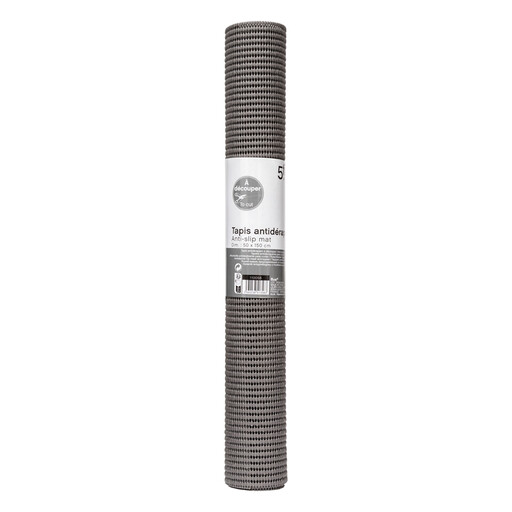
Why this product suits this profile: Its compact size is suitable for entrances, short hallways, kitchen areas or beside the bed. The grey colour works well with a range of interior styles.
The product description specifies an anti-slip backing and a flat design with a height of 0.1 cm. This makes it easier to check door clearance than with a deep pile.
PVC foam, 50 x 150 cm and, according to the product information, intended for high-traffic areas.
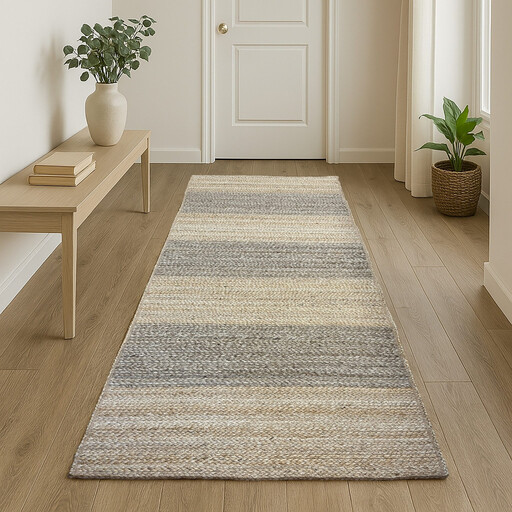
Why this product suits this profile: The two-tone jute look with its zigzag weave complements modern, rustic and nature-inspired interiors. Its length is suitable for larger hallway areas.
The product data specifies the material, dimensions, thickness and surface weight. Buyers can therefore check in advance whether the 1 cm height and 6 kg weight are suitable for their floor.
Jute with 2700 g/m², 250 x 80 cm and a textured natural colour scheme.
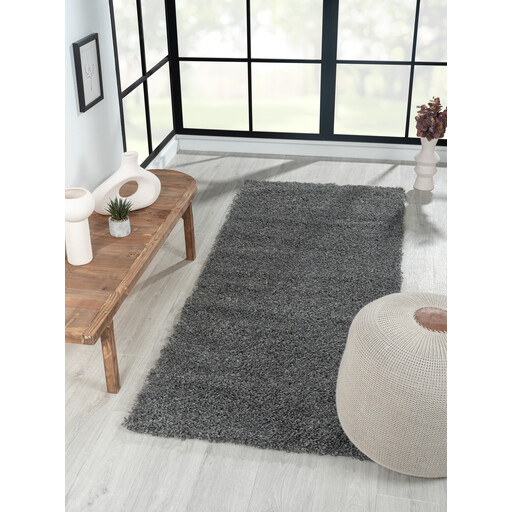
Why this product suits this profile: The deep polypropylene pile is designed to provide a soft feel underfoot. Measuring 200 x 80 cm, the runner can be placed in the bedroom or a shorter hallway.
The stated height of 4 cm means that door clearance and the distance from furniture must be checked. According to the product description, it is suitable for use with underfloor heating.
Polypropylene, deep pile, 200 x 80 cm and, according to the supplier, suitable for underfloor heating.
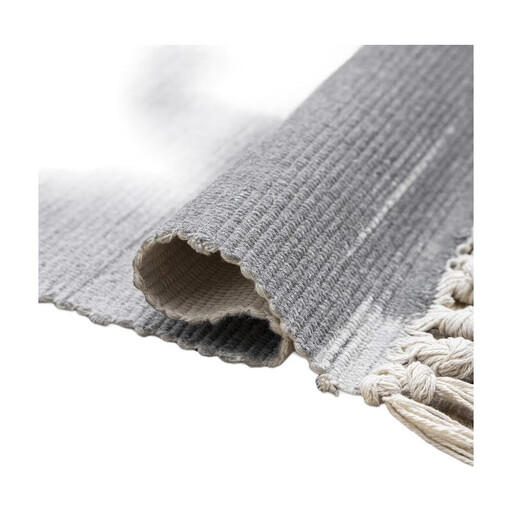
Why this product suits this profile: This model combines a boho look with a textured surface and, according to the product description, is intended for hallways, entrances, kitchens or beside the bed.
The care instructions specify machine washing in a laundry bag or hand washing, followed by air drying. An anti-slip underlay is recommended for greater stability.
A cotton-polyester blend, deep pile, woven tassels and, according to the product information, machine-washable construction.
We have put together a complete, regularly updated list of products that fully meet these strict selection criteria and the safety regulations applicable in the EU.
Before laying out the rug, make sure the floor is free from dust and moisture. On smooth surfaces, a suitable anti-slip mat is recommended; it should not extend beyond the edge of the rug. Start by vacuuming with a setting suitable for the pile height. Deep piles should not be cleaned with harsh brushes unless the manufacturer specifically allows this.
For washable models, follow the specified temperature, detergent, laundry bag and drying method. Jute and other natural fibres should not be soaked. Spilt liquids should be absorbed as quickly as possible without rubbing the texture too vigorously.
This depends on the available floor area and the position of the doors. An 80 x 200 cm rug fits many medium-length hallways, while 80 x 250 cm covers more floor space. Leave sufficient clearance from walls and doors at both ends and along the sides.
A deep pile can be more difficult to clean in the kitchen, as crumbs and liquids may penetrate further. Flat, easy-care and securely fixed models are usually more practical for this area. The specific care and material information is what matters.
Its service life depends on the material, level of use, care, exposure to sunlight and the surface beneath it. In high-traffic areas, you should vacuum regularly, avoid moisture and check the runner for creases or reduced grip. Without knowing the specific conditions of use, it is not possible to give a reliable general lifespan.