What should you look for when buying?
When choosing rusks to enjoy with coffee and cake, first decide whether avoiding added sugar, choosing wholegrain or a particular ingredient is your top priority. Then compare sugar content on a like-for-like basis, such as per 100 g.
| What to look for |
What to check when buying |
Who it matters most to |
| Added sugar and sugar content |
Check for the ‘no added sugar’ label and the ‘of which sugars’ figure per 100 g; if you’re checking the amount you eat, take the portion size into account too. |
If I don’t want added sugar in my rusks with coffee, I still need to know how much sugar they contain. Around 50% of consumers would choose this as their most important reason for buying. |
| Wholegrain and recipe |
Check the wholegrain content in the ingredients list and look for any organic or vegan labelling you want on the specific variety. |
If you particularly value wholegrain or a plant-based recipe with your coffee, you shouldn’t assume these qualities from the product name alone. This would be the top priority for around 30% of consumers. |
| Gluten and allergens |
If you need to avoid gluten, look for an explicit gluten-free label; read the ingredients and any ‘may contain’ information on the pack. |
If certain ingredients aren’t suitable for me, checking for them takes priority over comparing sugar content. This would be the most important reason for buying for around 20% of consumers. |
Brands to help you choose
The details below relate to the specific rusk varieties named, not every product from each brand.
Brandt
Brandt offers a variety of rusks labelled ‘no added sugar’; other varieties from the brand should be considered separately.
- According to REWE, Brandt Markenzwieback rusks with no added sugar contain 4.5 g of sugar per 100 g, or 0.4 g per slice weighing around 9.4 g.
- This variety lists wheat and soya, and may contain traces of egg, milk and sesame. Brandt Zwieback Minis Schoko Vollkorn, listed by REWE, contain 31 g of sugar per 100 g.
Sommer
Sommer Bio Demeter wholemeal rusks combine a ‘no added sugar’ claim with a recipe described as vegan and lactose-free.
- According to REWE, this variety contains 2.4 g of sugar per 100 g; the ingredients list includes 83% wholemeal wheat flour.
- As they contain wheat, these wholemeal rusks are not a gluten-free option.
Schär
Schär Gluten Free rusks are an option if you’re specifically looking for gluten-free rusks.
- The variety listed by REWE is described as gluten-free, lactose-free and vegan, and contains 4.4 g of sugar per 100 g.
- Its ingredients list includes sugar and rice syrup. For this variety, gluten-free does not mean ‘no added sugar’.
Rusks at Joybuy
This selection features wholemeal rusks for your coffee break, with ‘no added sugar’ in the product title. When comparing sugar content with other varieties, check the nutritional information on the specific pack.
 No image available
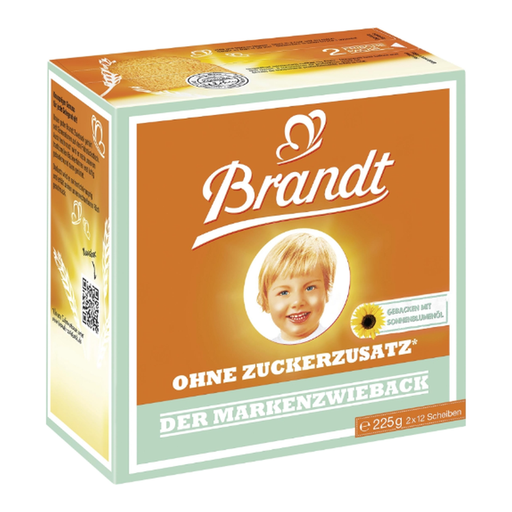
Brandt wholemeal rusks with no added sugar, 225 g
A good choice for your coffee break if you’re looking for wholemeal rusks labelled ‘no added sugar’. The pack contains 225 g. To compare them with other varieties, check the sugar content per 100 g and, if needed, the ingredients and allergen information on the specific pack.
View at Joybuy
Frequently asked questions
Does ‘no added sugar’ mean the same as ‘sugar-free’?
No. Under EU Regulation (EC) No 1924/2006, ‘no added sugar’ refers to sugars and foods added for their sweetening properties. Rusks can still contain sugar: REWE lists 4.5 g of sugar per 100 g for Brandt Markenzwieback rusks with no added sugar.
What’s the difference between ‘reduced sugar’ and ‘no added sugar’?
‘Reduced sugar’ is a comparative claim, while ‘no added sugar’ relates to the ingredients used. Under EU Regulation (EC) No 1924/2006, a claim that a nutrient has been reduced generally requires a reduction of at least 30% compared with a similar product. Check the exact claim used and compare the sugar content per 100 g as well.
Which rusks should I choose if sugar content is especially important to me?
First compare the ‘of which sugars’ figure per 100 g for the same type of product, then check your portion size. Among the specific varieties listed by REWE, Sommer Bio Demeter wholemeal rusks contain 2.4 g of sugar per 100 g, while Brandt Markenzwieback rusks with no added sugar contain 4.5 g per 100 g. Ingredients and allergens may also affect your choice.
Are gluten-free rusks automatically free from added sugar?
No. Schär Gluten Free rusks, listed by REWE, are labelled gluten-free, but their ingredients list includes sugar and rice syrup. Check the gluten-free labelling and added sugar separately.
How should I store rusks once opened?
Follow the instructions on the pack and keep opened rusks away from moisture. The Brandt and Sommer varieties listed by REWE should be stored in a cool, dry place.


