Guests keeping an eye on sugar
You’d like to serve rusks with Sunday coffee and compare the stated sugar content, rather than relying solely on terms such as “reduced sugar” or “no added sugar”.


If you’d like less sugar in your rusks with Sunday coffee, compare the “of which sugars” value per 100 g across the same type of product, and check the exact wording on the pack. “Reduced sugar” describes a comparison with another product; “no added sugar” does not mean sugar-free. Ingredients and allergens may also affect your choice.
You’d like to serve rusks with Sunday coffee and compare the stated sugar content, rather than relying solely on terms such as “reduced sugar” or “no added sugar”.
If someone needs to avoid wheat or milk, check the ingredients and highlighted allergens on the specific pack of rusks before serving.
You’re looking at pack size and individual wrapping for several coffee breaks, while keeping an eye on the sugar content of the variety you choose.
Start with the sugar content per 100 g, and compare like with like. Then check the ingredients and allergens, as well as the pack format for your coffee table.
| Criteria | What to check | Who it matters to |
|---|---|---|
| Sugar content | Compare the “of which sugars” value per 100 g across similar rusks. According to the Austrian Chamber of Labour, “reduced sugar” means at least 30% less sugar than comparable foods. | I want to be able to check the sugar content rather than rely on wording on the packaging. This is the top priority for around 50% of consumers. |
| Ingredients and allergens | Read the ingredients list and highlighted allergens on the current pack, paying particular attention to ingredients your guests need to avoid. | If guests can’t eat certain ingredients, I need to check the specific rusks before serving. Around 30% of consumers give this priority. |
| Pack and shopping | Check the pack size, individual wrapping and availability when planning your shop. If suppliers change, the labelling on the pack you buy is what counts. | I need a suitable pack format for several coffee breaks and a convenient way to buy it. This is the top priority for around 20% of consumers. |
A product with no added sugar may still contain sugar. On its own, the claim doesn’t tell you how much sugar is listed per 100 g.
Use the wording as a guide to the product’s ingredients, and also check the “of which sugars” value in the nutrition information.
“Reduced sugar” refers to a comparable food; it doesn’t necessarily mean the product has a low sugar content in itself. According to the Austrian Chamber of Labour, the reduction must be at least 30%.
Compare the sugar content per 100 g and consider how much you’ll actually eat with your coffee.
EDEKA lists wheat and milk ingredients among those in its GUT&GÜNSTIG rusks. You can’t assume that another type of rusk will be suitable for your guests.
Before serving, check the ingredients list and allergen labelling on the pack you’re using.
ALDI SÜD notes that the nutrition information for its GOLDÄHREN rusks may vary when different suppliers are used.
Use online information to help you narrow down your options, then make your decision based on the labelling on the pack in store.
Brandt offers classic rusks and rusk snacks. For its Protein Crunch Cocoa, Brandt states “no added sugar” and 4 g of sugar per 100 g; this snack isn’t the same as classic rusks.
EDEKA sells classic GUT&GÜNSTIG rusks in a pack containing 3 × 150 g.
GOLDÄHREN is a own-brand range of classic rusks. ALDI Nord describes a 450-g pack with three sealed inner packs.
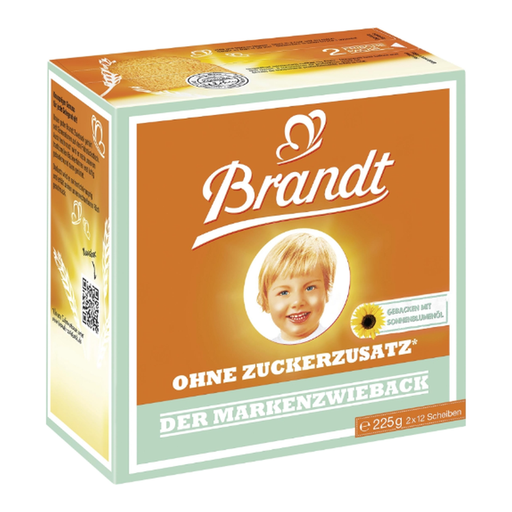
These wholegrain rusks are an option for Sunday coffee if you’re interested in the “no added sugar” claim. Check the nutrition information on the specific pack to decide whether the sugar content suits your needs.
 No image available
This product, described as wholegrain rusks, could be a good fit for your coffee table if you’re looking for a variety with “No Added Sugar” in the title. The pack contains 225 g. Check the ingredients and “of which sugars” per 100 g on the current pack: the wording in the title alone doesn’t prove that the sugar content is low or that it’s reduced compared with classic rusks.
The claim describes a reduction compared with a similar food; it doesn’t necessarily mean the sugar content is low. According to the Austrian Chamber of Labour, the reduction must be at least 30%. You should also compare the “of which sugars” value per 100 g.
No. Rusks can still contain sugar even when no sugar has been added. As well as checking the claim, read the ingredients list and the stated sugar content per 100 g.
Check the ingredients list and highlighted allergens on the current pack. For example, the GUT&GÜNSTIG rusks described by EDEKA contain wheat and milk ingredients; other products have their own labelling.
Keep them somewhere dry and, if possible, in an airtight container. Also follow the storage instructions and best-before date on the specific pack.