Coffee with several people
If you’re catering for several guests or planning several coffee breaks, it’s important to consider not just the total amount, but also whether you can open the rusks in separate portions.


For several coffee breaks in your hotel room, a 450 g pack with clearly labelled inner packs is a good choice if you don't want to open the whole pack at once. Brandt says its 450 g branded rusks come in four freshness packs, while EDEKA lists GUT&GÜNSTIG in three 150 g packs. If ingredients or nutritional values are your priority, check the pack you’re actually buying; a smaller option may suit your needs better.
If you’re catering for several guests or planning several coffee breaks, it’s important to consider not just the total amount, but also whether you can open the rusks in separate portions.
If certain ingredients need to be avoided, check the label on the specific pack before serving. For the classic varieties described here, ingredients such as cereals containing gluten and milk are relevant.
If the recipe or nutritional information matters more than the amount you’ll have in stock, a smaller pack of rusks may be a better option. Compare the information per 100 g and the ingredients list.
First, work out how many separate portions you need for your coffee breaks. Then check the ingredients, nutritional information and the pack actually available where you’re shopping.
| Criteria | What to check | Who is it important for? |
|---|---|---|
| Separate portions | Compare the total weight and number of inner packs: Brandt says its 450 g branded rusks come in four freshness packs, while EDEKA lists GUT&GÜNSTIG as 3 × 150 g. | If you’re spreading the rusks across several coffee breaks, you’ll want to open just one portion at a time. Around 33 % of consumers prioritise being able to open the pack in portions. |
| Ingredients and allergens | Read the ingredients list and allergen information on the pack you’ve bought, including any relevant warnings about possible traces. | If guests need to avoid certain ingredients, you’ll want to check the specific pack before serving. For around 27 % of consumers, this check comes first. |
| Recipe and nutritional values | Compare the ingredients and the sugar, fibre and salt content per 100 g; a spelt label does not mean the product is gluten-free. | Ingredients and nutritional information matter more to me than buying a large pack, even if that means taking less with me. This is the top priority for around 20 % of consumers. |
| Pack available where you’re shopping | Check the local range before you shop. If product information varies, refer to the label on the pack available in store. | If you’re shopping after you arrive, you’ll need a pack that’s available locally and has information you can check there. For around 20 % of consumers, local availability is the deciding factor. |
A 450 g label alone doesn’t tell you how many separate portions you can open. When you’re planning several coffee breaks, the way the pack is divided can make all the difference.
Compare packs that clearly state the number of inner packs: Brandt says its branded rusks come in four freshness packs, while EDEKA lists GUT&GÜNSTIG as 3 × 150 g.
Spelt is a cereal that contains gluten. An organic label or a claim about added sugar won’t answer questions about allergens either.
Check the ingredients and allergen information on the specific pack. To compare nutritional values, use the information per 100 g.
EDEKA notes that its online product information may differ from the packaging. ALDI SÜD says that GOLDÄHREN products may come from different suppliers, so it’s especially important to check the details on the specific pack.
Check the local range and read the label on the pack available before buying, especially if ingredients or nutritional values are important to you.
Brandt describes its classic branded rusks as a 450 g family pack for keeping in the cupboard.
EDEKA lists GUT&GÜNSTIG rusks in a 450 g pack divided into 3 × 150 g.
ALDI SÜD lists GOLDÄHREN rusks in a 450 g pack.
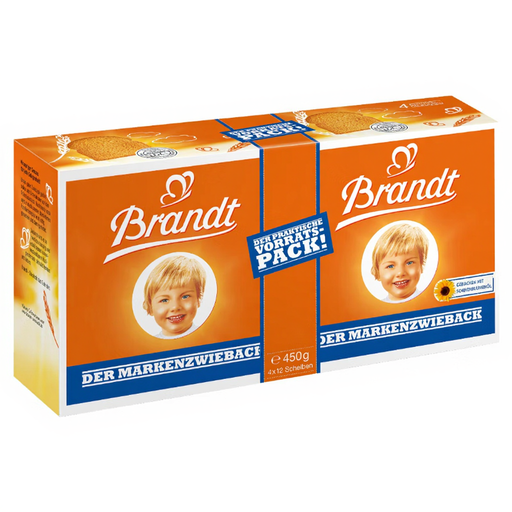
This multipack gives you a larger amount of rusks for several coffee breaks. If it’s important to you that the two units can be kept sealed and fresh separately, check this before choosing.
 No image available
This multipack gives you 450 g in total, divided into two clearly labelled 225 g units for several coffee breaks.
If you want to open just one sealed unit at a time, check the packaging of both units before buying. If you have specific ingredient requirements, read the information on the pack you’re buying.
No. For several coffee breaks, how the pack is divided matters too. Brandt says its 450 g branded rusks come in four freshness packs, while EDEKA lists GUT&GÜNSTIG as 3 × 150 g. Check the inner packs of the product you’re planning to buy.
Don’t decide based on the words ‘classic rusks’ alone. Brandt lists ingredients including wheat, milk and soya in its classic branded rusks, while EDEKA lists wheat, barley and milk in GUT&GÜNSTIG. Before serving, check the ingredients and allergen information on the specific pack.
No, spelt is a cereal that contains gluten. If gluten is a concern for a guest, don’t rely on the spelt label instead of checking the allergen information.
For the Brandt branded rusks described by REWE, the storage advice is ‘store in a cool, dry place’. Also follow the instructions on your pack, especially if an inner portion has already been opened.