If several people regularly eat rusks as a mid-morning snack, a 450 g pack may be a good option. If you eat them less often, smaller packs matter more than the total quantity. Compare the nutritional information and ingredients of the specific variety, too. If you need a gluten-free option, look for a pack that is explicitly labelled as such – a large standard family pack is no substitute for checking.
Which rusks are right for you?
Families who regularly keep rusks in stock
If you serve rusks on several mornings a week, you can compare a 450 g pack with how much your household gets through. Brandt offers this total quantity in a family pack; according to EDEKA, the GUT&GÜNSTIG option is split into three 150 g packs.
Families keeping an eye on ingredients and sugar
When comparing different varieties, the ingredients list and nutritional information per 100 g tell you more than the packaging. This is especially important if you plan to give rusks to children as a regular snack.
Households looking for gluten-free rusks
For these households, the specific product must be explicitly labelled gluten-free. Schär labels its rusks as gluten-free, but its 175 g pack is considerably smaller than the 450 g multipacks considered here.
What should you look for when buying?
First, work out how much rusk your household gets through once a pack is open. You can then compare pack sizes, nutritional information and any allergen labelling you may need.
| What matters |
What to check when buying |
Who it matters to |
| Stocking up and pack sizes |
Compare the pack size, whether it contains separate inner packs, and the storage instructions. The best-before date applies to unopened products stored appropriately. |
When several of us eat rusks regularly, I don’t want to open more than we can get through soon. Around 42% of consumers put having the right quantity to hand, with a suitable amount to open, first. |
| Ingredients and snack portions |
Compare sugar and other nutritional values per 100 g, and use the amount actually eaten to work out the figures for a portion. Only count a product as wholegrain if this is stated on the specific product. |
For a regular mid-morning snack, I want to know what’s in the variety I’ve chosen and how much will be served. Ingredients and portion size are the top priority for around 33% of consumers. |
| Allergens and specific dietary requirements |
Read the ingredients, highlighted allergens and precautionary allergen statements on the pack. If you need a gluten-free option, look for an explicit gluten-free label. |
If someone in my household needs to avoid certain ingredients, the general name ‘rusk’ isn’t enough to help me choose. Suitable labelling is the priority for around 25% of consumers. |
Common selection mistakes
-
Looking only at the total quantity
A large pack is less convenient if rusks are eaten infrequently or you can’t keep them dry after opening. The best-before date doesn’t tell you whether an opened pack will stay crisp.
If you don’t eat rusks regularly, compare smaller packs or multipacks and check the storage instructions.
If too many rusks are left open, their quality may deteriorate and some of your stock may go to waste.
-
Assuming all rusks are gluten-free
The standard varieties described contain gluten-containing cereals. Spelt is a type of wheat, so it is not a gluten-free alternative.
If you need a gluten-free option, check that the specific pack is explicitly labelled as gluten-free, and read its ingredients and precautionary allergen statements.
-
Comparing the packaging rather than the nutritional information
Family-friendly or child-friendly packaging says nothing about the sugar content. Brandt lists 14 g of sugar per 100 g for the branded rusks described here, while EDEKA lists 12.4 g per 100 g for the GUT&GÜNSTIG rusks described.
Read the nutritional information per 100 g and consider how much rusk will actually be eaten as a snack.
Brands and product ranges to consider
Brandt
Brandt sells its branded rusks in a 450 g family pack for households that regularly keep a larger supply in stock.
- For this variety, Brandt lists 14 g of sugar per 100 g and includes ingredients such as wheat, milk ingredients and soya.
- The pack size alone doesn’t tell you how easily your household will get through the contents once opened.
GUT&GÜNSTIG
The rusk variety described by EDEKA contains 450 g in total, split across three 150 g packs.
- The multipack lets you open just one of the three packs to start with.
- EDEKA notes that information on its product page may differ from the packaging. Always refer to the specific pack for ingredients and allergens.
Schär
Schär offers a variety of rusks explicitly labelled gluten-free, wheat-free and lactose-free.
- Schär lists 8.1 g of fibre per 100 g for the 175 g variety.
- At 175 g, this variety isn’t a 450 g family pack. If there are other ingredients you need to avoid, check the details on the specific pack too.
Rusks at Joybuy
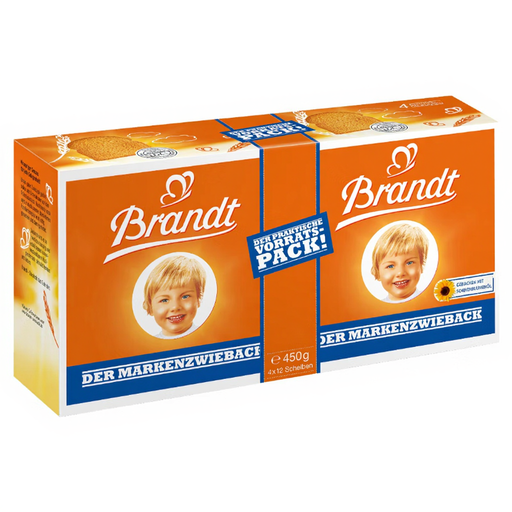
This selection features a 450 g option for households that regularly enjoy standard rusks as a mid-morning snack. If you’d like to open just one of the two 225 g units at a time, check the pack before buying to see whether they are individually sealed.
 No image available
Brandt rusks, twin pack 2 × 225 g
The total quantity of 450 g suits a household where rusks are eaten regularly.
The twin pack contains 2 × 225 g; check the packaging to see whether the two units are individually sealed. The rusks described contain 14 g of sugar per 100 g. If you have specific dietary requirements, read the ingredients and allergen information on the pack itself.
View at Joybuy
Frequently asked questions
When does a 450 g pack make sense for family life?
It’s most practical when several people eat rusks regularly and you can keep the contents dry and get through them once the pack is open. EDEKA sells GUT&GÜNSTIG rusks in a 450 g pack split into three 150 g packs. For any variety, also check the storage instructions and best-before date. The latter applies to unopened products stored appropriately.
Are spelt rusks gluten-free?
No. Spelt is a type of wheat, as EDEKA states for its Mini Spelt Rusks. If you need a gluten-free option, choose a variety explicitly labelled gluten-free and check the current information on the pack.
What should I check if I have allergies?
The ingredients and allergen information on the specific pack are key, including any precautionary allergen statements. The standard rusks described contain gluten-containing cereals; Brandt also lists milk ingredients and soya. Don’t assume this information applies to other varieties without checking.
What should I look for when choosing rusks as a mid-morning snack for children?
Think about the portion you’ll serve and compare the sugar content using the nutritional information for your chosen variety. The Verbraucherzentrale recommends limiting sweets and snacks for children; attractive rusk packaging is no substitute for checking the ingredients and nutritional information.


