Consumers comparing sugar levels
You want to enjoy rusks with your coffee and keep the listed sugar content as low as possible. To do that, compare the nutritional information rather than relying solely on the ‘no added sugar’ claim.


For your morning coffee break, choose rusks by checking the ‘of which sugars’ value per 100 g, rather than relying solely on the ‘no added sugar’ claim. Egle lists 2.2 g of sugar per 100 g for its organic spelt rusks, REWE lists 4.5 g for Brandt original rusks with no added sugar, and Brandt lists 14 g for its classic original rusks. Ingredients and allergen information may further narrow down your options.
You want to enjoy rusks with your coffee and keep the listed sugar content as low as possible. To do that, compare the nutritional information rather than relying solely on the ‘no added sugar’ claim.
As well as the sugar content, it matters whether the ingredients and allergen information meet your requirements. Vegan, lactose-free and gluten-free describe different properties.
If you regularly keep rusks handy for coffee, you may also want to check the pack size, whether they come as individual slices or portion packs, and the storage instructions for the specific product.
Start by comparing the sugar content on the same basis. Then consider the ingredients, pack format and storage instructions to find the rusks that suit your coffee break.
| Criteria | What to check | Who it matters to |
|---|---|---|
| Sugar content | Compare ‘of which sugars’ per 100 g; don’t assume ‘no added sugar’ means sugar-free. | If you’re looking for the lowest possible listed sugar content to enjoy with your coffee, compare products on the same basis; this is the main consideration for around 50% of consumers. |
| Ingredients and allergens | Read the ingredients and allergen information; assess vegan or lactose-free claims separately from the sugar content. | If certain ingredients aren’t suitable for you, the rusks need to meet your requirements even if their sugar content is low. This suitability is the most important buying criterion for around 30% of consumers. |
| Pack and portion size | Check the pack weight, whether it contains individual slices or portion packs, and the storage instructions for the specific product. | For regular coffee breaks, you may want to use the pack over several days and gauge how much you’ll have each time; the right format takes priority for around 20% of consumers. |
Rusks labelled ‘no added sugar’ can still contain sugar. Egle lists 2.2 g of sugar per 100 g for its organic spelt rusks; REWE lists 4.5 g for Brandt original rusks with no added sugar.
If the actual sugar content determines your choice, check the ‘of which sugars’ line per 100 g in the nutritional information.
Müller says Brandt lactose-free original rusks contain 30% less sugar than the original version and lists 9.3 g of sugar per 100 g. REWE, by comparison, lists 4.5 g per 100 g for Brandt original rusks with no added sugar.
Compare the absolute sugar content, and check separately whether you need a lactose-free option.
REWE lists wheat and soya in Brandt original rusks with no added sugar. Egle describes the spelt in its organic spelt rusks as a type of wheat and warns that they may contain traces of sesame.
When you buy, check the ingredients and allergen information on the current pack.
A smaller slice doesn’t change the sugar content per 100 g. According to REWE, one slice of Brandt original rusks with no added sugar weighs around 9.4 g and contains about 0.4 g of sugar.
Use portion information to plan quantities, but continue to compare different recipes per 100 g.
Alongside its classic original rusks, Brandt offers options with no added sugar and a lactose-free recipe.
Egle’s organic spelt rusks with no added sugar may suit consumers specifically looking for a spelt-based, vegan option.
This selection features a Brandt wholemeal option labelled ‘no added sugar’ for your coffee break. Check the nutritional information on the pack to decide whether its listed sugar content suits your needs.
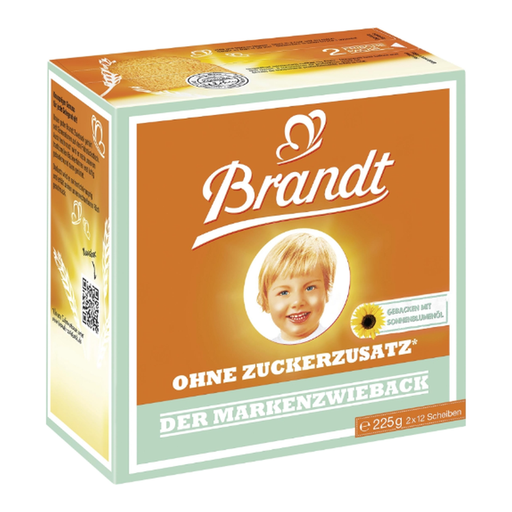 No image available
A good choice for your coffee break if you’re looking for a wholemeal option labelled ‘no added sugar’. Before choosing, compare the sugar content per 100 g on the pack and check the ingredients and allergen information if needed.
No. ‘No added sugar’ doesn’t mean the finished rusks contain no sugar. For the actual amount, check the ‘of which sugars’ value per 100 g on the pack.
Compare the ‘of which sugars’ value per 100 g for each product. Egle lists 2.2 g for its organic spelt rusks, REWE lists 4.5 g for Brandt original rusks with no added sugar, and Brandt lists 14 g per 100 g for its classic original rusks. Ingredients and portion size are separate buying considerations.
This describes a comparison of sugar content; it doesn’t mean the product has the lowest sugar content of all rusk options. Müller says Brandt lactose-free original rusks contain 30% less sugar than the original version and lists 9.3 g of sugar per 100 g.
Not necessarily: Egle explicitly describes the spelt in its organic spelt rusks as a type of wheat. If you need gluten-free rusks, look for the relevant label on the specific product.
Check the product’s pack format and storage instructions. EDEKA24 lists four portion packs for Brandt original rusks in a twin pack and advises storing them in a cool, dry place. However, the format doesn’t tell you anything about the sugar content of another Brandt option.