Guests keeping an eye on sugar
If you’re choosing rusks to enjoy with coffee and want to keep an eye on their sugar content, compare the ‘of which sugars’ value per 100 g. ‘No added sugar’ answers a different question from the nutrition information.


If you’re looking for rusks with no added sugar to serve with Sunday coffee, compare the ‘of which sugars’ value per 100 g too: ‘no added sugar’ doesn’t mean the rusks contain no sugar. REWE lists 4.5 g of sugar per 100 g for Brandt Markenzwieback with no added sugar, and 2.4 g for Sommer Bio Demeter wholemeal rusks. Whether you want wholemeal, as well as the salt content and ingredients, can also influence your choice.
If you’re choosing rusks to enjoy with coffee and want to keep an eye on their sugar content, compare the ‘of which sugars’ value per 100 g. ‘No added sugar’ answers a different question from the nutrition information.
As well as the sugar content, the labels on the specific product matter. REWE lists Sommer Bio Demeter wholemeal rusks as a wholemeal product with no added sugar.
Before serving, check the ingredients and precautionary allergen information on the pack you’ve bought. The varieties described by REWE include wheat; soya is also listed for Brandt Markenzwieback with no added sugar.
Start with the sugar content per 100 g, then consider which other qualities matter for your coffee table. This lets you check claims on the front of the pack against the nutrition information and ingredients list.
| Criteria | What to check when buying | Who it matters most to |
|---|---|---|
| Sugar content | Compare the ‘of which sugars’ value per 100 g, and check the ingredients list as well as the ‘no added sugar’ claim. | If sugar content is my main consideration for Sunday coffee, I want to compare packs using the same measure. This is the top priority for around 50% of consumers. |
| Wholemeal and product labels | Check the wholemeal, organic or vegan claims on the specific product, along with its sugar and salt content. | I want rusks with no added sugar for my coffee table that also suit my preference for wholemeal or organic options. This combination is the main priority for around 30% of consumers. |
| Ingredients and allergens | Read the ingredients and precautionary allergen information on the pack you’re actually serving. | If any guests need to avoid certain ingredients, I check which grains and other allergens are listed before serving. This check comes first for around 20% of consumers. |
Rusks with no added sugar can still contain sugar. REWE lists 4.5 g of sugar per 100 g for Brandt Markenzwieback with no added sugar.
So, compare the ‘of which sugars’ value too, and use the same measure when comparing several products.
Brandt lists 14 g of sugar per 100 g for its classic Markenzwieback; the Brandt Markenzwieback with no added sugar sold by REWE contains 4.5 g per 100 g. These figures relate to different varieties.
Check the full product name and nutrition information on the pack, rather than relying on the brand name alone.
According to REWE, Sommer Bio Demeter wholemeal rusks contain 2.4 g of sugar, 6.8 g of fibre and 1.2 g of salt per 100 g. Each figure helps answer a different question about which product to choose.
Compare the nutrition values that matter for your coffee table on a per-100 g basis.
Brandt Markenzwieback with no added sugar, as described by REWE, contains wheat and soya; egg, milk and sesame are listed as possible traces.
If any guests have allergies, carefully check the current labelling on the exact pack you’re serving.
The Markenzwieback with no added sugar is a standard rusk option to compare with classic Brandt Markenzwieback.
The Bio Demeter wholemeal rusks combine wholemeal ingredients with a ‘no added sugar’ claim in the variety described by REWE.
The organic spelt baby rusks are labelled for use from 6 months, making them a special case rather than simply another option for an adult coffee table.
This selection features Brandt wholemeal rusks with ‘No Added Sugar’ in the product name, described as an accompaniment to coffee. To choose based on sugar content and ingredients, check the details on the specific pack.
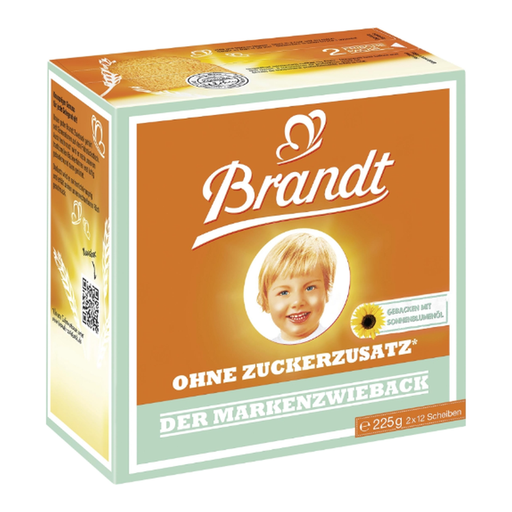 Image unavailable
These wholemeal rusks could be a good option for your coffee table if you’re looking for a product labelled ‘No Added Sugar’. Before buying, compare the ‘of which sugars’ value per 100 g and, if you have allergies, check the ingredients and allergen information on the pack. Nutrition information for a differently named variety of Brandt Markenzwieback cannot be applied to this product.
No. ‘No added sugar’ doesn’t mean the product contains no sugar. For example, REWE lists 4.5 g of sugar per 100 g for Brandt Markenzwieback with no added sugar; the actual amount is shown in the nutrition information for each variety.
Compare the ‘of which sugars’ value per 100 g for each product, and check the exact product name. Brandt lists 14 g of sugar per 100 g for classic Markenzwieback, while REWE lists 4.5 g per 100 g for Brandt Markenzwieback with no added sugar.
The varieties described here aren’t gluten-free alternatives: wheat is listed for Brandt and Sommer, and the spelt in Holle baby rusks is also a type of wheat. If you’re considering another variety, check its specific ingredients and product labelling.
Holle organic spelt baby rusks are specifically positioned as a baby product for children from 6 months, so they aren’t a general choice for adult coffee guests. If you’re giving them to a baby, follow the preparation and supervision guidance on the pack.