People who look after the office biscuit tin
When several colleagues help themselves, it’s best to open a manageable amount and keep the rest dry. Smaller packs can make it easier to top up the tin.


For a shared office biscuit tin, rusks in small, individually sealed packs are a practical choice, provided you keep the tin dry and top it up regularly. With a larger multipack, think about how much you’ll open at once. It’s also important to keep the ingredients and allergen information for the specific variety available to the team.
When several colleagues help themselves, it’s best to open a manageable amount and keep the rest dry. Smaller packs can make it easier to top up the tin.
If a pack is being shared with the team, the information for the chosen variety needs to remain accessible. This is especially important when colleagues have different dietary requirements, so check the ingredients list, highlighted allergens and any ‘may contain’ warnings.
A larger pack is most practical when the tin is topped up frequently and unopened portions can be stored separately. If you’re planning to shop in store, it’s also worth checking availability at your chosen branch.
For the office biscuit tin, first consider how often you’ll top it up and which ingredients are relevant to the team. You can then choose a pack size to suit how quickly the rusks are eaten. If you’re looking for ‘digestives’, bear in mind that rusks and digestive biscuits are not the same thing.
| What matters | What to check when buying | Who it matters to most |
|---|---|---|
| Portioning and storage | Check for individual packs and storage instructions; use an airtight tin for the portion you’ve opened. | If I top up the tin often, I don’t want to open the whole pack at once, and I want to keep the tin dry. This is a priority for around 42% of consumers. |
| Ingredients and allergens | Read the ingredients list, highlighted allergens and ‘may contain’ warnings for the specific variety. Don’t assume that claims such as ‘no added sugar’ mean the product has other particular qualities. | If the tin is for a team, I need to know whether the chosen variety suits my colleagues’ requirements. Ingredients and allergens are the main concern for around 33% of consumers. |
| Pack size and where to buy | Choose a pack size to suit how quickly it will be used, and check local availability if you’re planning to shop in store. | If I shop less often, I want enough in stock without having too many opened rusks left over. Around 25% of consumers prioritise this. |
The quantity alone doesn’t tell you how many rusks will be in the tin once the pack is opened. According to the German Food Federation, the best-before date applies to unopened products stored appropriately.
Choose a multipack to suit how often you top up the tin, and only open individual packs as needed. Keep the tin dry and tightly closed.
If a large quantity is left open for too long, the rusks may lose their crunch and quality, or some may go to waste.
These claims relate to different qualities. For its classic Brandt rusks, Brandt and EDEKA24 list ingredients including cereals containing gluten, milk ingredients and soya. You can’t assume other varieties have the same ingredients.
For every variety you choose, check the full ingredients list, highlighted allergens and any ‘may contain’ warnings on the pack.
A product listing alone doesn’t guarantee stock at your chosen branch. For Goldähren rusks, ALDI SÜD noted that the product was unavailable at the branch checked and that products may vary between suppliers.
Check the listing for your branch before you shop, and read the product information on the pack you actually buy.
Without checking first, you may need to make an extra trip to the shops.
Brandt offers classic branded rusks as well as clearly labelled specialist varieties. EDEKA24 lists four portion packs in a 450-g multipack; this format is not the same as every other 450-g twin pack.
EDEKA24 provides product information for Brandt rusks in 225 g and 450 g packs. In these examples, EDEKA is the retailer, not the manufacturer of the rusks.
ALDI SÜD lists Goldähren rusks in a 450-g pack as another option for stocking up.
This selection includes Brandt rusks in 225-g packs and a twin pack containing two 225-g packs. Compare the pack format with how often you top up the tin, and check the labelling of your chosen variety before sharing it with the team.
 No image available
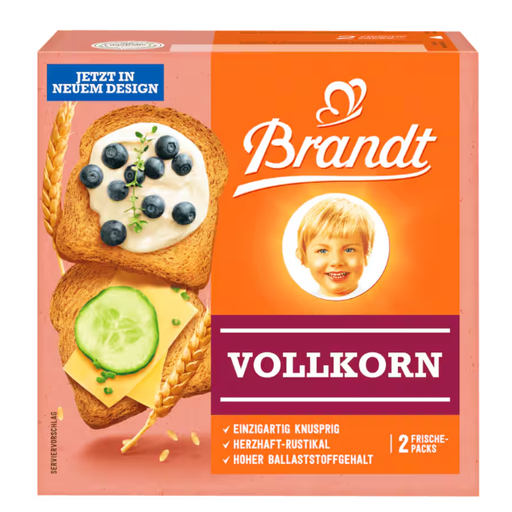
A 225-g pack is a good option if you prefer to fill the biscuit tin in smaller amounts and are looking for wholemeal rusks.
Check the ingredients and allergen information on the specific pack before sharing with the team. Store opened rusks in a dry, airtight container.
 No image available
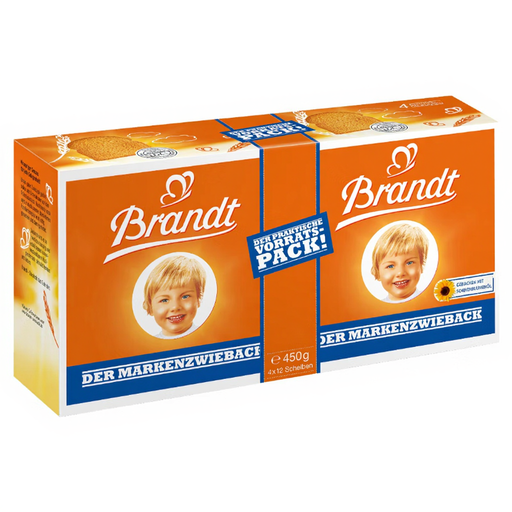
The twin pack suits regular top-ups if you want to open only one of the two 225-g packs at a time.
The total quantity is 450 g. Before sharing with the team, check the ingredients and allergen information on the specific pack, particularly details of milk, soya and egg. Store opened rusks in a dry, airtight container.
 No image available
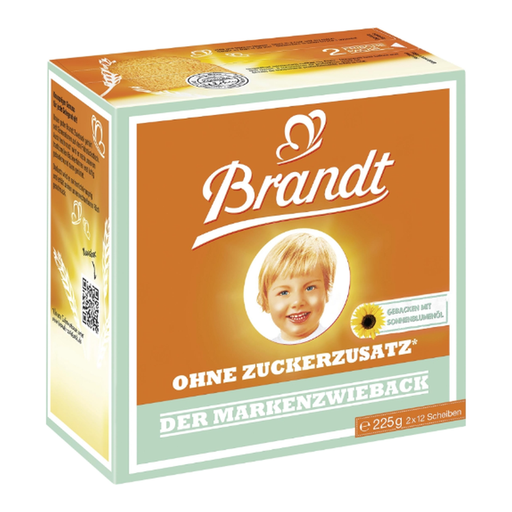
This 225-g variety is an option if you’re specifically looking for rusks labelled ‘no added sugar’.
This claim doesn’t replace the nutritional information or a check of the ingredients and allergens. Before adding them to the office biscuit tin, read the labelling and storage instructions on the specific pack.
Yes, as long as the tin is clean, dry and airtight. Try to transfer only a manageable amount, and keep the original packaging until the rusks have been used so you can check the ingredients, allergens and best-before date.
No. According to the German Food Federation, the best-before date refers to the qualities guaranteed for unopened products stored appropriately; it is not a use-by date. After the date, check the appearance, smell and texture. Don’t eat rusks if they are mouldy or show any obvious unusual changes.
According to Brandt and EDEKA24, ingredients of note in classic Brandt rusks include wheat, barley malt extract, milk ingredients and soya. Also check the ingredients list, highlighted allergens and any ‘may contain’ warnings on the pack you’re actually putting in the tin.
No. The claim about added sugar doesn’t answer questions about gluten, milk or soya, nor does it describe the overall nutritional values. For this variety, read the full labelling on the specific pack.