Office teams looking to avoid added sugar
For a shared tin, look for rusks with the relevant label. As well as the claim on the front of the pack, check the ingredients list, sugar content per 100 g and allergen information.


If you want to avoid added sugar in the office biscuit tin, first check the label on the specific pack of rusks, then compare the sugar content per 100 g. MÜLLER lists 4.5 g of sugar per 100 g for Brandt Markenzwieback with no added sugar; EDEKA lists 12.4 g for GUT&GÜNSTIG rusks, while ALDI SÜD lists 14 g for GOLDÄHREN rusks. If the tin is shared, it’s also important to check the ingredients and allergen information. The figures for the Brandt Markenzwieback mentioned here don’t apply to other Brandt varieties.
For a shared tin, look for rusks with the relevant label. As well as the claim on the front of the pack, check the ingredients list, sugar content per 100 g and allergen information.
You want to know how much sugar rusks contain overall. To compare, check the nutrition information per 100 g for products in the same category, even if a pack says ‘no added sugar’.
If you decant rusks into a shared tin, make sure the ingredients and allergen information remain available. For the Brandt Markenzwieback with no added sugar described by MÜLLER, pay particular attention to wheat and soya, as well as the possible traces listed.
First decide whether avoiding added sugar or choosing a lower overall sugar content matters more to you. Then check whether the specific product can be shared in a tin with allergen information readily available.
| Criteria | What to check when buying | Who it matters to |
|---|---|---|
| No added sugar | Look for ‘no added sugar’ on the specific pack and check the ingredients list; don’t assume this means ‘sugar-free’. | If I want to fill the shared tin with rusks that have no added sugar, simply tasting less sweet isn’t enough. Around 50% of consumers prioritise this. |
| Total sugar | Compare the ‘of which sugars’ figure per 100 g for rusks, and use the nutrition table on the pack you have. | For my comparison, what matters is how much sugar the rusks contain overall, not just what the label says. This is the main priority for around 30% of consumers. |
| Sharing with others | Check the ingredients, allergens and may-contain information; keep the pack details accessible when decanting. | If several people are helping themselves from the tin, I don’t want the allergen information to get separated from the packaging. This takes priority for around 20% of consumers. |
Rusks with no added sugar can still contain sugar. MÜLLER lists 4.5 g of sugar per 100 g for Brandt Markenzwieback with no added sugar.
Always check the ‘of which sugars’ line in the nutrition information as well as the label.
A label alone won’t show you how the total sugar content differs between rusks.
Compare the figures per 100 g within the rusks category, and check the current pack.
The details on the specific pack matter to anyone helping themselves from a shared tin. The Brandt Markenzwieback with no added sugar described by MÜLLER contains wheat and soya; possible traces of egg, milk, sesame and lupin are also listed.
Keep the original packaging or a readable copy of the ingredients and allergen information with the tin.
ALDI SÜD notes that GOLDÄHREN rusks may come from different suppliers, so their nutritional values can vary.
For this product, refer to the nutrition information on the pack you actually buy.
Brandt Markenzwieback with no added sugar is a specific 225-g variety for comparing label claims and nutritional values.
The classic rusks described by EDEKA provide a comparison within the same product category.
ALDI SÜD’s 450-g pack of classic rusks is another point of comparison for nutritional values.
These Brandt wholegrain rusks are labelled ‘no added sugar’, making them an option for an office biscuit tin where that’s a priority. When comparing total sugar and sharing them in a tin, check the information on their own packaging.
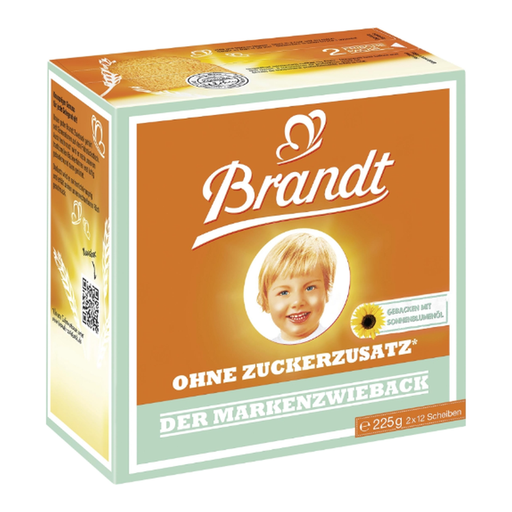 No image available
For an office tin where rusks with no added sugar are what you’re looking for.
Check the sugar content per 100 g on the pack for this wholegrain variety, and keep the ingredients and allergen information accessible when decanting.
No. ‘No added sugar’ doesn’t mean that rusks contain no sugar at all. MÜLLER lists 4.5 g of sugar per 100 g for Brandt Markenzwieback with no added sugar, so it’s also important to check the ‘of which sugars’ figure on the specific pack.
It means the product has less sugar than similar products; it doesn’t automatically mean that no sugar has been added. If you want to check both, look at the label, ingredients list and sugar content per 100 g separately.
Yes, as long as you follow the storage instructions on the specific pack and keep its ingredients, allergen and best-before information accessible with the tin. REWE recommends storing Brandt Markenzwieback with no added sugar in a cool, dry place; don’t assume the allergen information is the same for other varieties.
No. EDEKA lists 12.4 g of sugar per 100 g for GUT&GÜNSTIG rusks, while ALDI SÜD lists 14 g for GOLDÄHREN rusks; the Brandt Markenzwieback with no added sugar described by MÜLLER contains 4.5 g. Check the current pack of GOLDÄHREN in particular, as ALDI SÜD warns that figures may vary between suppliers.