For a morning snack, choose rusks by checking the stated sugar content per 100 g and the ingredients list, rather than relying on the words ‘no added sugar’ alone. The varieties from Sommer, Brandt and Schär listed by REWE also differ in their wholemeal content, gluten-free status and other nutritional values, so the right choice depends on your dietary requirements and tolerance too.
Who is this choice relevant to?
Shoppers comparing sugar content
You want to check the stated sugar content of your morning snack rather than rely on a claim on the front of the pack. The nutritional information per 100 g, your portion size and the ingredients list are all important.
Shoppers considering other nutritional values
You’re looking for rusks and want to compare fibre, protein, energy and salt as well as sugar. Make sure the values are based on the same quantity.
Shoppers with gluten or allergen requirements
You need gluten-free rusks or have to avoid certain ingredients. Check the relevant labelling, ingredients and any ‘may contain’ information before comparing sugar and salt values.
What should you look for when buying?
For a morning snack, start by comparing sugar per 100 g. Then check the nutritional values for your usual portion and any ingredients that are relevant to you.
| What to check |
What to look for when buying |
Who it matters to |
| Sugar content |
Compare ‘of which sugars’ per 100 g and read the ingredients list; ‘no added sugar’ does not specify a particular sugar content. |
If I want less sugar in my morning snack, I need a comparable figure, not just a claim on the pack. Around 45% of shoppers consider this their main priority. |
| Other nutritional values |
Check fibre, protein, energy and salt per 100 g, then work out the values for your portion. |
For my usual snack portion, the other nutritional values matter alongside sugar. This is the main priority for around 28% of shoppers. |
| Ingredients and tolerance |
If needed, check the gluten-free labelling, as well as the ingredients, allergens and ‘may contain’ information. |
If I need to avoid gluten or certain ingredients, the relevant labelling is the first thing that determines which rusks are suitable. Around 27% of shoppers put this requirement first. |
Which common mistakes can you avoid?
-
Assuming ‘no added sugar’ means ‘sugar-free’
These claims don’t mean the same thing: REWE still lists 4.5 g of sugar per 100 g for Brandt Markenzwieback without added sugar.
Whatever the claim on the pack, compare the ‘of which sugars’ line in the nutritional information for similar rusk products.
-
Looking only at the value per slice
According to REWE, a slice of Brandt Markenzwieback without added sugar weighs around 9.4 g. How much you get from your snack depends on how many slices you eat.
First compare products per 100 g, then work out the figures for your usual number of slices.
-
Choosing a speciality variety based on its name alone
Being gluten-free doesn’t tell you anything about the sugar content. Schär Gluten Free Rusks, listed by REWE, contain 4.4 g of sugar and 1.8 g of salt per 100 g; sugar and rice syrup are also listed in the ingredients.
First check that the product has the feature you need, then compare sugar, salt and ingredients separately.
Rusk brands to help you choose
Brandt
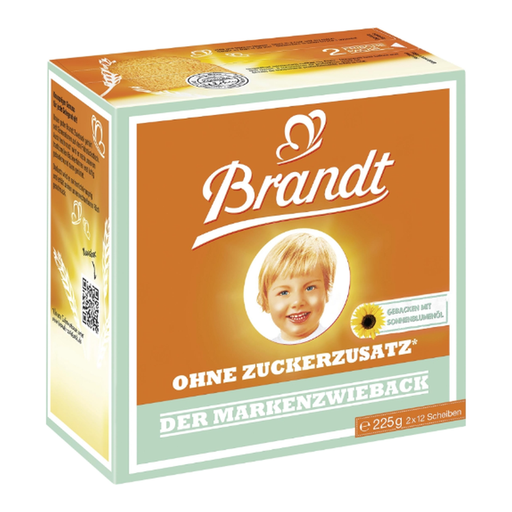
Brandt offers products including Markenzwieback without added sugar. The details below apply to the 225 g variety listed by REWE, not the entire range.
- REWE lists 4.5 g of sugar and 14 g of protein per 100 g; one slice weighs around 9.4 g.
- This variety contains wheat and soya and may contain traces of egg, milk and sesame.
Sommer
Sommer Organic Demeter Wholemeal Rusks, listed by REWE, are a wholemeal variety with no added sugar.
- For the 200 g variety, REWE lists 2.4 g of sugar, 6.8 g of fibre and 13 g of protein per 100 g.
- They contain wheat and are listed as having 1.2 g of salt per 100 g.
Schär
Schär is relevant here for its Gluten Free Rusks, listed by REWE, if you’re looking for a gluten-free variety.
- The 175 g variety is listed as gluten-free, lactose-free and vegan; REWE states that it contains 4.4 g of sugar per 100 g.
- It contains sugar and rice syrup, may contain soya and has 1.8 g of salt per 100 g.
Suitable products at Joybuy
This selection features wholemeal rusks with no added sugar for a morning snack. Check the latest nutritional information to see whether the stated sugar content suits your comparison.
 No image available
Brandt Wholemeal Rusks with No Added Sugar, 225 g
An option if you’re looking for wholemeal rusks with no added sugar for your morning snack. Before choosing, compare the sugar content per 100 g and check the pack for details relevant to your portion size and any ingredients you need to avoid.
View at Joybuy
Frequently asked questions
Are rusks with no added sugar also sugar-free?
No. The two claims don’t mean the same thing: REWE lists 4.5 g of sugar per 100 g for Brandt Markenzwieback without added sugar. Always check the ‘of which sugars’ line in the nutritional information.
Should I compare sugar per slice or per 100 g?
First compare different rusk products per 100 g, then work out the amount for the portion you plan to eat. A slice of Brandt Markenzwieback without added sugar, as listed by REWE, weighs around 9.4 g.
Are wholemeal rusks automatically lower in sugar?
No. Wholemeal on its own doesn’t tell you the sugar content. REWE lists 2.4 g of sugar per 100 g for Sommer Organic Demeter Wholemeal Rusks; check the figures again for any other variety.
Are gluten-free rusks automatically lower in sugar?
No. Schär Gluten Free Rusks, listed by REWE, are gluten-free but contain 4.4 g of sugar per 100 g, with sugar and rice syrup among the ingredients. Check the gluten-free labelling and sugar content separately.


