For classic rusks with tea, “no added sugar” is a sensible starting point; you should also check the “of which sugars” figure per 100 g. REWE lists Brandt Markenzwieback without added sugar at 4.5 g of sugar per 100 g, while Brandt gives 14 g for its regular Markenzwieback. If you’re looking for wholemeal rusks with a recipe labelled vegan and lactose-free, you could consider the Sommer rusks listed by REWE. Brandt Protein Crunch Kakao is a differently formulated, sweet snack with sweeteners, and Brandt states that it contains 23 g of fat per 100 g.
Which option might suit you
Prefer classic rusks with tea
If you like eating rusks plain or with a topping of your choice and want to avoid added sugar, compare the exact product name and the “of which sugars” figure per 100 g. These values can vary between products from the same brand.
Looking for wholemeal and plant-based recipes
If wholemeal ingredients, fibre and vegan and lactose-free labelling are important to you, check these details on the specific product. The Sommer Bio Demeter wholemeal rusks listed by REWE contain wheat; the salt content may also be relevant to your choice.
Prefer a sweet, protein-rich snack
If you’d rather have a cocoa crunch than classic sliced rusks with your tea, look beyond protein and sugar to the other nutritional information too. For Brandt Protein Crunch Kakao, the manufacturer lists sweeteners, milk and soya, as well as fat and energy values you can take into account when choosing.
What to look for when buying
First decide whether you want classic rusks, wholemeal rusks or a sweet crunch snack with your tea. Then compare the nutritional information and ingredients of products in the category that suits you.
| What matters to you |
What to check when buying |
Who it matters most to |
| Sugar in classic rusks |
“Of which sugars” per 100 g and the ingredients list; don’t assume “no added sugar” means “sugar-free”. |
I want to enjoy rusks with my tea and keep the stated sugar value low without switching to a different type of product. For around 42% of consumers, finding classic rusks with less declared sugar is the main priority. |
| Wholemeal and recipe |
Wholemeal ingredients, fibre and salt per 100 g, as well as the labelling and allergens on the specific product. |
If a wholemeal recipe and plant-based ingredients matter more to me at tea time than the familiar classic version, the rusks need to meet those requirements. Around 33% of consumers prioritise wholemeal ingredients and the recipe. |
| Sweet snack with protein |
Protein, sugar, energy and fat per 100 g, as well as sweeteners and declared allergens. |
I’m looking for a sweet crunch snack to enjoy with tea and want to check its protein content, but I don’t want to overlook the other nutritional values. Around 25% of consumers make this their priority. |
Common misconceptions
-
Confusing “no added sugar” with “sugar-free”
These terms answer different questions. For example, the Brandt Markenzwieback without added sugar listed by REWE still contains 4.5 g of sugar per 100 g.
If you want to compare sugar content, check the “of which sugars” line in the nutritional information per 100 g, whatever the product is labelled.
-
Assuming the sugar value tells you the energy content
A single nutritional value doesn’t tell you about the product’s overall composition. Brandt states that Protein Crunch Kakao contains 490 kcal and 23 g of fat per 100 g.
For sweet varieties, compare sugar, energy, fat and saturated fat using the same serving basis.
-
Focusing only on protein in crunchy varieties
According to the manufacturer, Brandt Protein Crunch Kakao contains maltitol and sucralose, as well as milk and soya. Its ingredients list is therefore different from that of a simple rusk.
Check the ingredients and allergen information for your chosen variety if sweeteners or particular ingredients are important to your choice.
-
Assuming wholemeal meets every dietary requirement
The Sommer Bio Demeter wholemeal rusks listed by REWE contain wheat; the product information also gives a salt content of 1.2 g per 100 g.
Don’t base your choice on “wholemeal” alone. Check the ingredients and nutritional information for the specific rusks.
Brands to help you choose
Brandt
Brandt’s classic Markenzwieback, no-added-sugar variety and Protein Crunch Kakao differ in their recipes and nutritional values. So the brand alone won’t tell you much about the sugar content of the pack you choose.
- REWE gives Brandt Markenzwieback without added sugar as containing 4.5 g of sugar per 100 g; Brandt states that its regular Markenzwieback contains 14 g per 100 g.
- According to the manufacturer, Brandt Protein Crunch Kakao contains sweeteners, milk and soya. Brandt states that this cocoa variety contains 490 kcal and 23 g of fat per 100 g.
Sommer
The Sommer Bio Demeter wholemeal rusks listed by REWE are an option if wholemeal ingredients and vegan and lactose-free labelling matter when choosing something for tea time.
- REWE gives this product as containing 2.4 g of sugar and 6.8 g of fibre per 100 g.
- The product contains wheat; the product information also gives a salt content of 1.2 g per 100 g.
Rusks at Joybuy
These wholemeal rusks are an option if you’re looking for rusks with no added sugar to enjoy with tea. To compare the total sugar content, check the nutritional information on the specific pack.
 No image available
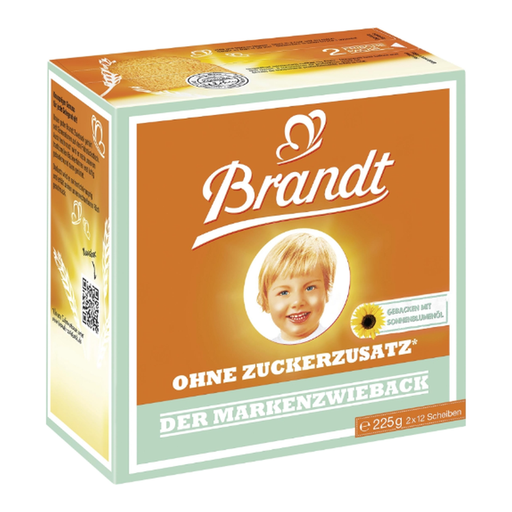
Brandt wholemeal rusks with no added sugar, 225 g
For enjoying with tea if you’re looking for a wholemeal variety and want to avoid added sugar. The product title specifies a 225 g pack and “no added sugar”; to find out how much sugar the rusks contain overall, check the “of which sugars” figure per 100 g on the pack. You can also check the ingredients and allergens there to make sure they meet your requirements.
View at Joybuy
Frequently asked questions
Does “no added sugar” mean the same as “sugar-free”?
No. “No added sugar” refers to the ingredients that have been added, while “sugar-free” refers to the sugar content of the finished food, as explained by Lebensmittelklarheit. So rusks with no added sugar can still show a sugar value in the nutritional information; the label alone doesn’t rule out sweeteners either.
How can I identify rusks with less sugar?
When comparing similar rusks, check the “of which sugars” line per 100 g rather than relying only on a claim on the front of the pack. The ingredients list also shows you what has been used in the recipe.
Can I have rusks with no added sugar and a topping with my tea?
Yes, you can choose your own topping. If you want to take the sugar content of your whole tea-time serving into account, include the topping and the amount you use in your comparison, as well as the rusks.
How should I store rusks after opening?
Follow the instructions on the pack and keep the rusks somewhere dry. For the Brandt and Sommer products listed by REWE, storage in a cool, dry place is recommended; once opened, keeping the pack tightly sealed helps protect the slices from moisture.


