For tea-time rusk lovers
If you’re looking for a dry, crunchy biscuit to enjoy with your tea, you can choose between plain rusks and varieties with different ingredients. Classic rusks are delicious on their own or briefly dipped in tea.


For a classic tea-time treat, plain rusks could be just the thing. If wholemeal content or ingredients matter more to you, compare the details on each pack. “No added sugar” doesn’t tell you the total sugar content, and neither wholemeal nor the term “digestive” proves that a product aids digestion. If you have allergies, always check the information on the specific pack.
If you’re looking for a dry, crunchy biscuit to enjoy with your tea, you can choose between plain rusks and varieties with different ingredients. Classic rusks are delicious on their own or briefly dipped in tea.
If wholemeal content matters to you, check the ingredients list and nutritional information for each variety. For example, REWE states that Brandt Wholemeal Rusks 225 g contain 74% wholemeal wheat flour and 8.5 g of fibre per 100 g.
If you need to avoid certain ingredients, check each variety individually. Information about wheat, barley, milk or soya, as well as possible traces, can vary between types of rusk.
First, consider what matters most to you: the flavour with your tea, the ingredients or a pack size that suits you. Then you can compare the details of the specific varieties you’re considering.
| What to consider | What to check when buying | Who it matters most to |
|---|---|---|
| Flavour and texture | Tell plain rusks apart from flavoured or coated varieties; check the ingredients and product description. | If I mainly want something dry and crunchy with my tea, flavour matters more to me than a particular nutritional profile. Around 30% of consumers might put this first. |
| Ingredients and allergens | Compare wholemeal content, “of which sugars” per 100 g, the ingredients list and allergen information on each pack. | I want to know what’s in my rusks, or I need to avoid certain ingredients, so the exact labelling determines my choice. This could be a priority for around 50% of consumers. |
| Pack size and availability | Check the pack weight, whether it contains individual packs, and current availability from your chosen retailer. | If I’m planning to enjoy rusks over several tea times, I want to find a suitable pack size and make sure I can actually get them. This could be the most important factor for around 20% of consumers. |
Brandt Wholemeal Rusks, listed by REWE, contain wholemeal wheat flour and other declared ingredients. “Wholemeal” doesn’t mean a product is gluten-free or suitable for people with particular allergies.
If you need to avoid certain ingredients, check the highlighted allergens and any “may contain” information on the specific pack.
“No added sugar” and the sugar content shown in the nutritional information mean different things. The Verbraucherzentrale explains the distinction. You can’t work out energy or fat content from the information about added sugar either.
Also check the “of which sugars” line and the energy and fat values per 100 g.
A rusk variety listed online won’t necessarily be available at every location. ALDI SÜD also notes that nutritional information may vary between different suppliers.
Check availability before you shop and, if necessary, compare the information on the pack available to you.
Brandt offers classic and wholemeal rusks, with varieties to suit different tastes and ingredient preferences.
Sommer offers wholemeal rusks for anyone who wants to compare their ingredients in particular.
ALDI SÜD lists GOLDÄHREN Rusks in a 450 g pack, making them an option if you want to stock up.
EDEKA24 lists Alnatura Organic Spelt Rusks 200 g as a spelt option in its range of rusks.
This selection includes Brandt rusks for tea time: a wholemeal variety, a classic twin pack and a wholemeal variety labelled “no added sugar”. If you’re considering the last one, compare the information on the pack with your requirements.
 No image available
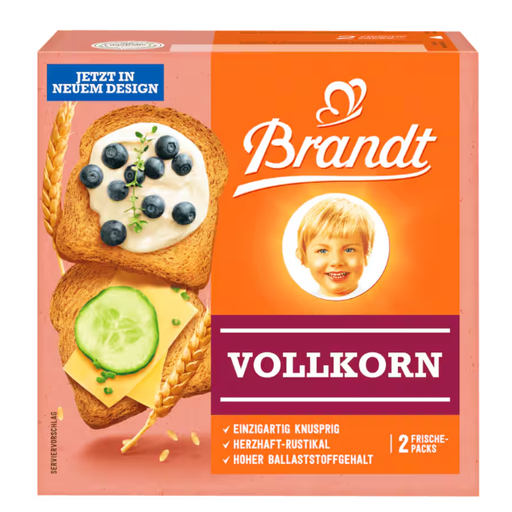
A good option if you’re looking for wholemeal rusks to enjoy with your tea and want to compare ingredients.
REWE states that Brandt Wholemeal Rusks 225 g contain 74% wholemeal wheat flour and 8.5 g of fibre per 100 g. Check the sugar content, ingredients and allergens on the specific pack.
 No image available
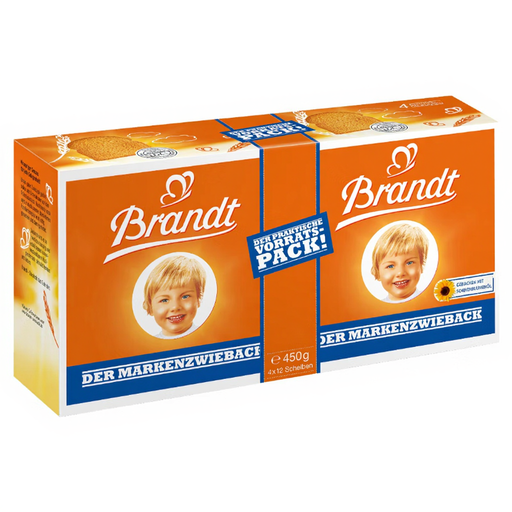
A good option if you want classic rusks with your tea and can make use of two 225 g packs.
Brandt states that its classic branded rusks contain 14 g of sugar per 100 g. If you have allergies, pay particular attention to the ingredients and information on the specific twin pack.
 No image available
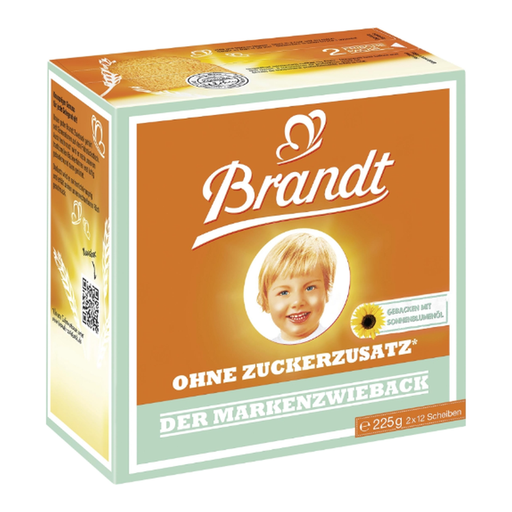
This variety is worth comparing if you’re looking for wholemeal rusks labelled “no added sugar”.
The label doesn’t replace checking “of which sugars” per 100 g, the ingredients list and the allergen information on the pack.
No, the term alone doesn’t prove that a product aids digestion. Instead, you can check the ingredients, nutritional information and, if relevant to you, the allergens listed for the specific variety.
Check the ingredients list and highlighted allergens on each specific pack rather than assuming that one variety has the same ingredients as another. Check any “may contain” information too, if relevant. The Verbraucherzentrale explains food labelling, while the Lebensmittelverband Deutschland covers allergen labelling.
No, “no added sugar” doesn’t automatically mean “sugar-free”. The Verbraucherzentrale explains the difference. You’ll find the product’s sugar content under “of which sugars” in the nutritional information.
Store opened rusks in a dry, tightly sealed container. Joybuy recommends an airtight container or bread bin for Brandt Wholemeal Rusks. Also follow the storage instructions on your pack.