Coffee drinkers who prefer classic rusks
You’d like a crunchy, slightly sweet slice with your coffee and don’t have any specific requirements for the recipe. Even so, it’s worth checking the ingredients and sugar information for classic varieties.


For a classic, crunchy accompaniment to coffee, traditional rusks are the obvious choice if you don’t need a specific recipe. If wholemeal matters to you, compare the wholemeal content and nutritional information. If added sugar or lactose is a deciding factor, look for a variety that is clearly labelled accordingly, and also check the sugar content, ingredients and allergens on the pack.
You’d like a crunchy, slightly sweet slice with your coffee and don’t have any specific requirements for the recipe. Even so, it’s worth checking the ingredients and sugar information for classic varieties.
A wholemeal recipe matters more to you than a more traditional flavour. Compare the wholemeal content and fibre per 100 g, and check the salt and allergen information too.
You’re keeping an eye on added sugar or lactose. A variety labelled accordingly answers only that one question: check the sugar content, other ingredients and allergen information separately.
First decide what matters most to you with your coffee: classic flavour, wholemeal or a specific recipe. Then compare the information on the individual packs.
| What to consider | What to check | Who it matters to |
|---|---|---|
| Classic rusks | Compare the ingredients and sugar per 100 g. | If I mainly want a crunchy, slightly sweet slice with my coffee, I’d rather have a classic recipe than a speciality variety. This is the main priority for around 40% of consumers. |
| Wholemeal and fibre | Check the wholemeal content and fibre per 100 g, and consider salt and allergens too. | I’m looking for a clearly labelled wholemeal recipe, even if that means comparing other nutritional information as well. Around 30% of consumers prioritise this. |
| Added sugar, lactose and allergens | Check the variety name against the ingredients list, sugar per 100 g and allergen information on the pack. | If I want to avoid a particular ingredient, the variety I choose needs to meet that specific requirement; other ingredients matter to me too. For around 30% of consumers, checking a recipe like this is the priority. |
REWE still lists 14 g of sugar per 100 g for Brandt Mini Markenzwieback with no added sugar. So the variety name is no substitute for checking the nutritional information.
As well as the product name, check the “of which sugars” line on the pack.
The Brandt varieties described by REWE contain other ingredients that may affect your choice: the wholemeal rusks contain wheat, barley, milk and soya; the lactose-free variety contains, among other ingredients, wheat, barley malt extract and soya lecithin.
Check the ingredients and allergen information for each variety against your specific requirements.
EDEKA notes that information on the packaging for GUT&GÜNSTIG rusks may differ from the details shown online.
Before eating, check the ingredients, allergen information and pack size of the product you actually receive.
Brandt’s range includes classic rusks, wholemeal rusks and varieties specifically labelled lactose-free or with no added sugar.
The classic rusks described by EDEKA come in a 450 g pack containing three 150 g packs.
ALDI Nord describes GOLDÄHREN rusks as toasted yeast dough slices, sold in a pack containing three sealed inner packs.
These two Brandt products are for coffee drinkers looking for wholemeal rusks or considering a variety labelled “no added sugar”. The information on each pack is what matters when choosing between them.
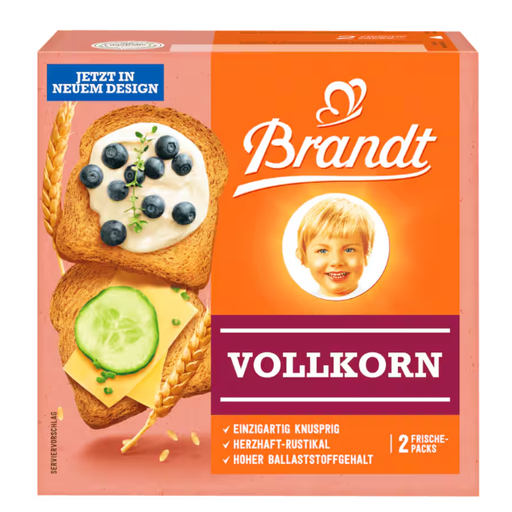 Image unavailable
An option if you’re specifically looking for wholemeal rusks to enjoy with your coffee.
Pack size: 225 g. If you’re looking for a particular fibre content or ingredient, compare the nutritional information and allergen details with those on the pack.
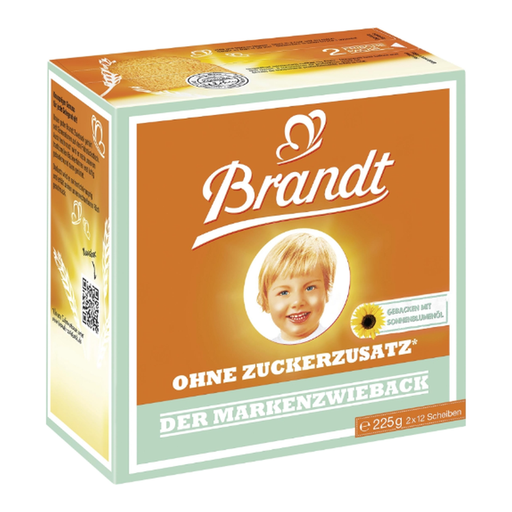 Image unavailable
An option if you’re looking for wholemeal rusks labelled “no added sugar” to enjoy with your coffee.
Pack size: 225 g. The label doesn’t tell you the total sugar content or whether other allergens are present, so check the nutritional information and ingredients on the pack.
Classic rusks are an obvious choice. Brandt describes its Markenzwieback as crunchy; if sugar or particular ingredients matter to you, check the information on the pack too.
No, it depends on which qualities matter to you. For its 225 g pack of Brandt wholemeal rusks, REWE lists 74% wholemeal wheat flour and 8.5 g of fibre per 100 g, as well as ingredients from wheat, barley, milk and soya. Compare the information for the specific varieties rather than relying on their names alone.
No, the terms don’t mean the same thing. For the 120 g pack of Brandt Mini Markenzwieback with no added sugar, REWE lists 14 g of sugar per 100 g. This figure applies to that specific variety and doesn’t automatically apply to other products labelled in the same way.
No, the label doesn’t cover every ingredient. For the 225 g pack of lactose-free Brandt Markenzwieback, REWE still lists wheat, barley malt extract and soya lecithin. Check the ingredients and allergen information for your chosen pack individually.