Organisers keeping allergens in mind
You’re providing snacks for a mixed group and need to check the ingredients and allergen information for the specific variety you buy. Labels such as ‘wholemeal’ or ‘no added sugar’ don’t answer this question.


Choose rusks for a work meeting based on their ingredients and your group’s needs, rather than on a general promise about digestion. Wholemeal, no-added-sugar options and packs with handy portions suit different preferences. If gluten-free food is required, you’ll need an alternative that is explicitly labelled as gluten-free.
You’re providing snacks for a mixed group and need to check the ingredients and allergen information for the specific variety you buy. Labels such as ‘wholemeal’ or ‘no added sugar’ don’t answer this question.
You want to choose between classic rusks, wholemeal rusks and a no-added-sugar variety by comparing their ingredients and nutritional information, without making general claims that one type is easier to digest.
You’re looking for rusks that can be stored dry and served without any preparation. Pack size and sealed individual packs may matter more than the total number of slices.
First, check whether any guests need food with a specific allergen or dietary label. Then compare the varieties you’re considering using their nutritional information, and see which pack format works best for your meeting.
| Criteria | What to check | Who it matters to |
|---|---|---|
| Allergens and special diets | Check the ingredients and allergen information on the specific pack. If gluten-free food is required, include a snack explicitly labelled as gluten-free and keep it separate when serving. | When guests have different dietary requirements, I want to provide suitable options rather than rely on the variety name; around 36% of consumers make this their priority. |
| Wholemeal and fibre | Compare the fibre content per 100 g. Consider whether wholemeal products are a familiar choice for the group. | If wholemeal is unfamiliar to my group, I don’t want to choose a variety as easy to digest based on its name alone; for around 29% of consumers, fibre content and familiar eating habits come first. |
| Sugar information | Compare the ‘of which sugars’ figure per 100 g in the nutritional information, and check the ingredients list too. ‘No added sugar’ doesn’t tell you the total sugar content. | When I’m looking for a variety with no added sugar, I also want to know how much sugar the product contains overall; around 21% of consumers make this a priority. |
| Pack and planning | Choose a pack size and any individual packs that suit your group. Check availability at your chosen store before shopping. | For several meetings, I want to open only the amount I need and shop in good time; around 14% of consumers make this their priority. |
The name ‘rusk’ doesn’t mean every variety will suit all your guests equally well. Wholemeal products won’t necessarily suit everyone’s eating habits just because they contain fibre.
Describe the varieties on offer factually. The German Nutrition Society recommends making the change to wholemeal foods gradually.
Spelt is a type of wheat. The label ‘lactose-free’ also tells you nothing about whether a rusk is gluten-free.
If guests need gluten-free food, choose a product explicitly labelled as gluten-free and serve it separately from other rusks.
This label doesn’t describe the total sugar content or provide any information about allergens. For Brandt Markenzwieback without added sugar, REWE lists 4.5 g of sugar per 100 g, as well as wheat and soya in the product information.
Compare the nutritional information per 100 g and check the ingredients and allergen information on the pack you buy.
A large pack doesn’t necessarily mean you can open its contents in portions for several meetings. Availability may also depend on the store you choose.
Check for individual packs and confirm availability at your store before shopping. For the meeting, open only the amount you want to serve.
Brandt offers classic rusks, wholemeal rusks and a no-added-sugar variety, which you can compare using the information on each pack.
Praum Organic Spelt Rusks are an option if you’re specifically looking for spelt rusks with a short ingredients list.
Organic Demeter Spelt Cloud Rusks are worth considering if you’re choosing a spelt variety made with butter.
The pack format could be useful if you’re planning for a larger group or several meetings.
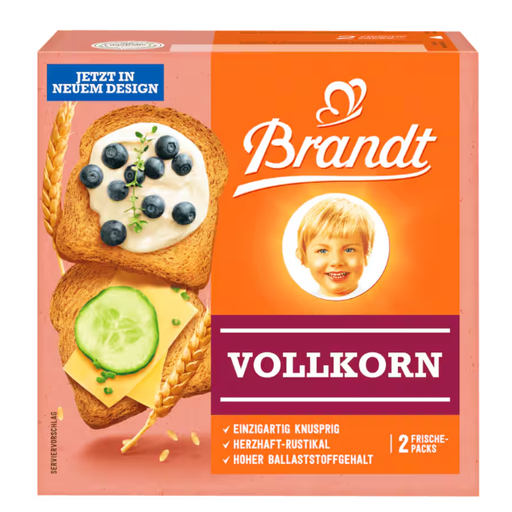
If you’d like to offer a wholemeal variety at your work meeting, the following Brandt rusks are one option. Your choice of variety doesn’t replace the need to check the allergen information on the pack.
 No image available
A wholemeal option for your meeting. The pack contains 225 g; check its ingredients and allergen information before serving.
No. The product name doesn’t mean they’ll suit everyone. If you’re serving wholemeal rusks, take the group’s eating habits into account; the German Nutrition Society recommends switching to wholemeal foods gradually.
No, spelt is a type of wheat. If guests need gluten-free food, choose a snack explicitly labelled as gluten-free instead, and keep it separate when serving.
No. What matters is the ingredients list and allergen information on the specific pack you buy. The Brandt varieties listed by REWE contain wheat; soya is also listed for the no-added-sugar variety.
Store them in a dry place and follow the instructions on the pack. If you only want to serve some of them, sealed individual packs can be handy; ALDI Nord describes these for its 450-g pack of GOLDÄHREN rusks.
Check availability for your chosen store shortly before shopping, especially if you need a particular variety or pack size. A product listing for a different store doesn’t guarantee it’ll be available where you shop.