Shoppers checking sugar information
You want to serve rusks without any preparation, while distinguishing between added sugar and the sugar content shown in the nutrition information.


For a work meeting, rusks with no added sugar aren’t automatically the option with the lowest stated sugar content. Compare ‘of which sugars’ per 100 g, as well as the ingredients and allergen information. REWE lists 14 g of sugar per 100 g for Brandt Mini Markenzwieback ohne Zuckerzusatz; Holle Bio-Babyzwieback Dinkel has 1.8 g, but is marketed as a baby rusk and should only be chosen for the group after careful consideration.
You want to serve rusks without any preparation, while distinguishing between added sugar and the sugar content shown in the nutrition information.
You need to check the ingredients and allergen information for the specific product, for example if anyone attending needs gluten-free products or has an allergy.
You’re looking for an amount you can serve with coffee or tea without any preparation, and weighing up mini formats against the choice of rusk varieties you want to offer.
First, decide whether added sugar, the stated sugar content or individual attendees’ requirements are the priority. You can then work out how many packs you’ll need.
| Buying criteria | What to check | Who it matters to |
|---|---|---|
| Sugar content and labelling | Compare ‘of which sugars’ per 100 g and read the no-added-sugar claim alongside the ingredients list. | If the stated sugar content matters more to me than the wording on the front of the pack, I want to compare the figures directly; around 36% of consumers put this first. |
| Serving format and quantity | Check the net weight and plan how much you’ll need based on the number of attendees. | For a short meeting, I want to be able to put the rusks out without any preparation and have enough for everyone; around 29% of consumers prioritise this practical consideration. |
| Allergens and dietary requirements | Read the ingredients and allergen information on the specific pack; check separately for any required gluten-free labelling. | If someone in the group needs to avoid certain ingredients, I need an appropriately labelled option; around 21% of consumers put this requirement first. |
| Classic rusks for a coffee break | Decide whether classic rusks with added sugar are suitable for the group, or whether it would be better to offer a separate alternative. | I want to serve familiar rusks with coffee or tea, provided there’s no requirement to avoid added sugar; around 14% of consumers prioritise this. |
REWE still lists 14 g of sugar per 100 g for Brandt Mini Markenzwieback ohne Zuckerzusatz. So, a no-added-sugar claim doesn’t tell you the total sugar content.
Before buying, compare the ‘of which sugars’ figure per 100 g and read the ingredients list.
According to REWE, Holle Bio-Babyzwieback Dinkel contains 1.8 g of sugar per 100 g, but it’s marketed for babies from 6 months and contains spelt, a type of wheat.
Only choose it for your work meeting after careful consideration, and check that the ingredients and ‘may contain’ information suit everyone attending.
The ingredients list for Schär Gluten Free Zwieback at REWE includes sugar and rice syrup; it also mentions possible traces of soya.
Check the gluten-free labelling, sugar information and allergens as separate requirements on the specific pack.
Brandt’s 120 g mini pack and larger packs of classic Brandt rusks cater for different quantities. Pack size doesn’t tell you whether the product contains added sugar.
Plan the quantity according to the number of attendees, and check the sugar information for your chosen variety separately.
Brandt offers classic rusks, as well as a mini variety with no added sugar. When choosing rusks for a work meeting, it’s the specific variety that matters.
Holle Bio-Babyzwieback Dinkel is a speciality variety you could consider if you’re making a careful choice for your work meeting.
Schär Gluten Free Zwieback is a variety to check separately if anyone attending needs gluten-free products.
This selection features rusks with no added sugar for a coffee break. Before buying, compare the nutrition information and ingredients on the specific pack with the attendees’ requirements.
 No image available
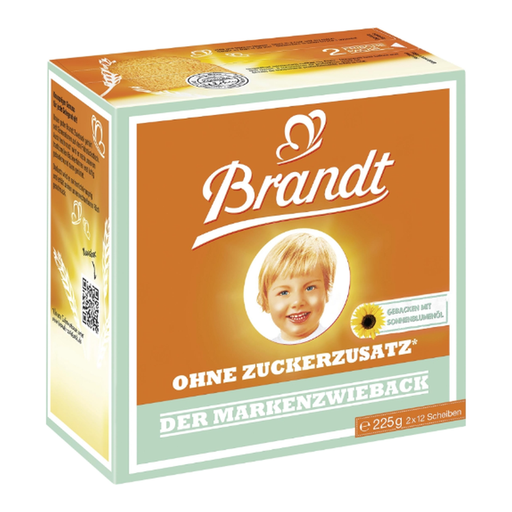
A rusk option you can serve with coffee without any preparation. The pack contains 225 g; check the nutrition information per 100 g, along with the ingredients and allergens, before buying it for the group.
No. Rusks with no added sugar can still contain sugar. REWE lists 14 g of sugar per 100 g for Brandt Mini Markenzwieback ohne Zuckerzusatz; the figure to compare is ‘of which sugars’ in the nutrition information.
For the specific varieties, compare the ‘of which sugars’ figure per 100 g rather than relying solely on a no-added-sugar claim. Also make sure you’re comparing like with like: Holle Bio-Babyzwieback Dinkel is marketed differently from classic rusks for a coffee break.
Check the ingredients and allergen information on the specific pack against everyone’s requirements. Even a variety labelled gluten-free may contain other relevant allergens or ‘may contain’ warnings; REWE mentions possible traces of soya in Schär Gluten Free Zwieback.
Follow the storage instructions on the pack you’ve chosen. REWE recommends storing Brandt Mini Markenzwieback in a cool, dry place; once opened, check the instructions for the specific variety too.