Families hosting guests who value freshness
If you’re stocking up on rusks for several coffee get-togethers, you could choose a pack with confirmed inner portions. That way, you won’t have to open your whole supply at once.


For several coffee get-togethers, a large pack with confirmed inner portions can be practical: REWE lists Brandt Markenzwieback rusks at 450 g with 48 portions, while EDEKA24 describes four portion packs. If guests need to avoid certain ingredients, the relevant labelling takes priority over pack size. You can then compare the quantity, inner packaging and storage instructions.
If you’re stocking up on rusks for several coffee get-togethers, you could choose a pack with confirmed inner portions. That way, you won’t have to open your whole supply at once.
If your guests need to avoid gluten, lactose or particular ingredients, check the labelling, ingredients and ‘may contain’ information on the specific pack before considering its size.
If you’re focusing on how much you’ll use at a single gathering, it’s worth comparing the total quantity in 400 g and 450 g packs. Inner portions may be less important in that case.
First, check which ingredients are suitable for your guests. Then you can decide whether the total quantity, individually usable inner packs or specific product labelling matters most.
| What to consider | What to check | Who it matters most to |
|---|---|---|
| Stocking up and inner portions | Compare the total weight and number of portions; only count on inner packs if they’re specifically stated. | If I want to spread my rusks across several coffee get-togethers, I don’t want to open the whole supply at once. For around 39% of consumers, having a supply that can be portioned is the top priority. |
| Ingredients and allergens | Check the ingredients list, highlighted allergens and ‘may contain’ information for the specific variety. | If a guest needs to avoid certain ingredients, the pack you choose must meet that requirement. This is the most important buying criterion for around 23% of consumers. |
| ‘No added sugar’ claim | Consider the product labelling and sugar content per 100 g separately. | If you’re specifically looking for a no-added-sugar variety, you’ll want to avoid confusing this claim with sugar-free. Around 15% of consumers put this labelling first. |
| Total quantity | Compare the weight in grams with the number of guests you expect; allow separately for smaller speciality packs. | For a large coffee get-together where the rusks will be eaten soon, the amount available is what matters most to me. For around 23% of consumers, total quantity comes first. |
The classic Brandt Markenzwieback listed by REWE contains, among other things, wheat, barley malt, milk ingredients and soya. Pack size doesn’t tell you whether your guests need to avoid these ingredients.
Ask your guests about any dietary requirements and check the ingredients and ‘may contain’ information on the specific pack before choosing a quantity.
The Brandt variety listed by REWE as ‘no added sugar’ still contains 4.5 g of sugar per 100 g.
As well as checking the product claim, read the sugar line in the nutritional information.
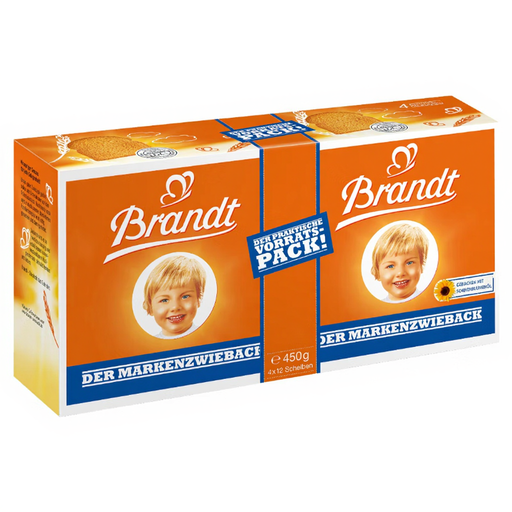
EDEKA24 describes the Brandt 450 g twin pack as containing four portion packs. The total weight alone doesn’t confirm that other packs are divided in the same way.
If you need inner packs for several occasions, look for specific information about the inner packaging.
The consumer advice centre explains that a best-before date relates to the guaranteed qualities of unopened food when stored correctly. It isn’t a use-by date.
Follow the storage instructions on the pack. If you’ve had your supply for a while, check the packaging and the condition of the rusks.
Brandt offers different rusk varieties for coffee get-togethers, including a classic 450 g twin pack and smaller varieties with specific labelling.
The classic Burger Zwieback listed by REWE comes in a 400 g pack, making it an option for coffee get-togethers where total quantity matters.
Praum rusks, listed by REWE, are another classic 400 g option if you’re looking for a larger quantity.
Schär offers a smaller rusk variety labelled gluten-free for guests with this dietary requirement.
The Joybuy selection includes a twin pack of rusks for coffee get-togethers with several guests.
 No image available
The stated total quantity of 450 g could work for a coffee get-together with several guests.
The product name gives the pack size as 2 × 225 g. If you want to spread the quantity across several occasions, check whether the units are individually sealed.
If you have allergies or intolerances, always check the ingredients and ‘may contain’ information on the specific pack.
It depends on the number of guests and whether you’ll use the pack for one occasion or several. REWE lists classic Brandt Markenzwieback at 450 g with 48 portions, Burger and Praum at 400 g each, and Schär rusks at 175 g with 20 portions. If you’re planning for several occasions, it’s also worth checking whether inner portions are confirmed.
Not without checking the specific variety. The classic Brandt Markenzwieback listed by REWE contains wheat and milk ingredients, while Burger and Praum contain wheat. Schär labels its rusks as gluten-free and lactose-free. However, the variety listed by REWE may contain soya, so it’s still important to check the ingredients and ‘may contain’ information on the pack you buy.
No, these two claims don’t mean the same thing. The nutritional information for the Brandt Markenzwieback ‘no added sugar’ variety listed by REWE states 4.5 g of sugar per 100 g.
It isn’t a use-by date. According to the consumer advice centre, it indicates the period during which the manufacturer guarantees the specific qualities of unopened food, provided it’s stored correctly. Store rusks according to the instructions on the pack, and if you’ve kept them for a while, check the packaging and the condition of the product too.