
Lieferung heute & morgen

Qualitätsgarantie

Willkommens-Angebote freischalten: KOSTENLOSE Lieferung | Bis zu 80 % RABATT | Kostenlose 30-Tage-JoyPlus-Testphase
App herunterladen
Rising summer temperatures can diminish the joy of camping and travelling in an RV. An overheated interior not only makes sleeping difficult but also renders daytime stays unpleasant. A motorhome air conditioner is therefore an essential comfort upgrade for many travellers.
However, the market offers a wide variety of models whose technical specifications and features can seem overwhelming at first glance. This article serves as an objective guide. It explains the key differences between unit types and presents a selection of models with their specific features to provide you with a solid foundation for an informed decision.
Before making a decision, several fundamental criteria should be considered. These will help you narrow down the options and find a unit that fits your vehicle and travel habits.
The most fundamental decision concerns the unit type. Both options have specific advantages and disadvantages.
The power supply is a critical factor, especially for travellers who enjoy off-grid camping.
Some air conditioners offer more than just cooling. An air conditioner with a heating function (often implemented via a heat pump) can replace a separate heater on cool nights or during the shoulder seasons, providing year-round utility. Other practical features include remote controls, timers, quiet sleep modes, and smartphone app control.
Here, we present two models with different concepts, suited for various user needs.
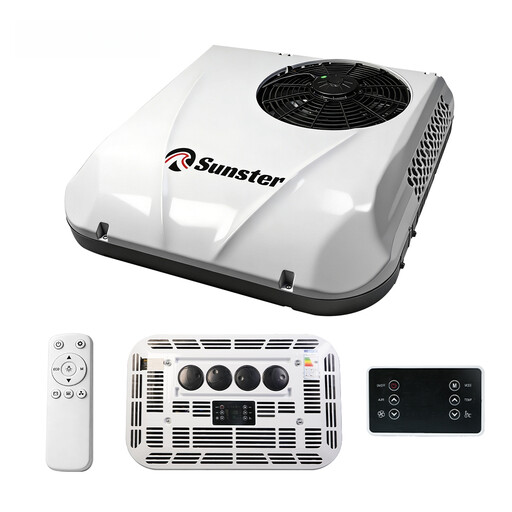
Why it stands out: The Sunster Rooftop Air Conditioner is designed as a permanent, high-performance solution for motorhomes, campers, and trucks. Operating on 12V or 24V DC power, it is built for off-grid use. The DC inverter compressor automatically adjusts its output to ensure high cooling efficiency with optimised energy consumption.
Technical Specifications:
Who it's for: This model is aimed at vehicle owners seeking a fixed, integrated cooling solution and who are prepared for the installation effort involved in retrofitting a rooftop air conditioner. It is ideal for frequent travel to warm regions where consistent and powerful cooling is a priority.
Important Installation Notes: The unit is shipped without refrigerant. 450 g of R1234yf or R134a refrigerant must be added separately. Before filling, the system must be evacuated (put under vacuum) for at least 10 minutes. The required compressor oil (Type POE68) is included.
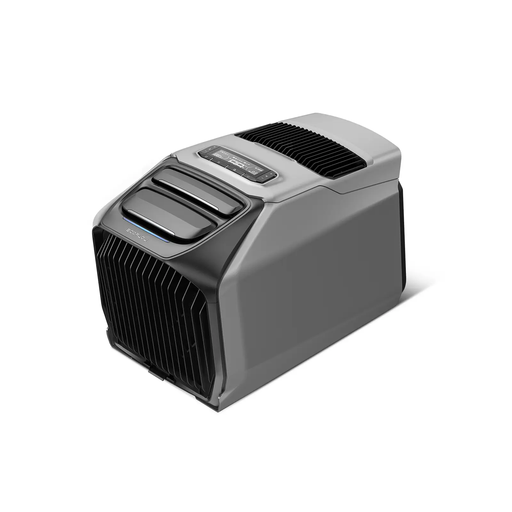
Why it stands out: The EcoFlow WAVE 3 is a prime example of a flexible and multifunctional portable air conditioner. It combines cooling and heating capabilities in a portable design. Its greatest strength is its power versatility: it can be run from a wall outlet, a 12V car socket, solar panels, or an optional add-on battery that provides up to 8 hours of cord-free operation.
Technical Specifications:
Who it's for: The WAVE 3 is the right choice for campers, van life enthusiasts, and anyone who prefers a flexible solution without permanent installation. Its portability allows it to be used in various vehicles (RVs, SUVs, trucks) or even in a tent. The heating function makes it a useful companion all year round.
Important Usage Notes: For efficient operation, the exhaust hose must be vented to the outside. The unit is designed for stationary use, not for use while driving. The optional add-on battery for cord-free operation is sold separately.
If the models presented here don't exactly meet your needs, or if you'd like to compare other alternatives, you can find a broader selection of units in our category.
Discover more models in the portable air conditioner for car camping category.
1. How much power does an RV air conditioner use? Power consumption depends heavily on the model, the selected cooling level, and the outside temperature. A 12V camping air conditioner like the Sunster has a nominal current draw of about 50 A (approx. 600 W). Portable units like the EcoFlow WAVE 3 have a rated cooling power consumption of about 640 W in DC mode. For off-grid operation, a large battery bank (over 100 Ah) and a way to recharge it (solar, alternator) are essential.
2. Can you run an RV air conditioner while driving? Permanently installed 12V rooftop air conditioners are often designed to operate while driving, provided the vehicle's electrical system (especially the alternator) is sufficiently sized to handle the power demand. Portable air conditioners like the EcoFlow WAVE 3 are intended for stationary use, according to the manufacturer, and should be securely stowed while the vehicle is in motion.
3. What should be considered when retrofitting a rooftop air conditioner?Retrofitting a rooftop air conditioner requires some technical skill. Key points include: