
Lieferung heute & morgen

Qualitätsgarantie

Willkommens-Angebote freischalten: KOSTENLOSE Lieferung | Bis zu 80 % RABATT | Kostenlose 30-Tage-JoyPlus-Testphase
App herunterladen
A functional Tyre Pressure Monitoring System (TPMS) is fundamental to the safety and efficiency of any trip in your RV. It continuously monitors tyre pressure and temperature to provide early warnings about potential dangers like slow leaks or overheating. However, the market for aftermarket systems is overwhelming, and not every product delivers on its promises. Many buyers invest in systems that later turn out to be unreliable or unsuitable for their vehicle.
This guide highlights the most common pitfalls to avoid when buying a TPMS and explains which technical parameters truly matter, so you can make an informed decision for your RV, caravan, or truck.
Before choosing a model, you should be aware of the typical weaknesses that often only become apparent during real-world use.
To avoid the problems mentioned above, you should check three core technical aspects before making a purchase. These are the key determinants of a system's reliability and practicality.
The required tyre pressure for RVs and trucks often exceeds that of passenger cars. Therefore, look for a sufficiently high pressure measurement range, ideally up to 13 or 14 Bar (approx. 200 PSI). This ensures the system is also suitable for heavy vehicles and high loads.
At the same time, the number of tyres is crucial. A standard RV needs at least four sensors. For vehicles with dual tyres on the rear axle or for a towing setup with a vehicle and trailer, systems like a TPMS with 6 sensors or more are necessary. Check if the system is expandable in case you plan to add a trailer in the future.
Most aftermarket systems transmit on a frequency of 433.92 MHz. For vehicle lengths over 6-7 metres or when using a trailer, the signal quality can drop significantly. Metal superstructures and other electronic devices can also interfere with the signal.
For a tyre pressure monitoring system for an RV or a TPMS for a trailer, a signal repeater (amplifier) is therefore often essential. It is usually placed in the middle of the vehicle or on the trailer and reliably forwards the signals from the rear sensors to the receiver in the cockpit. Models that include a repeater in the set or offer it as an optional accessory provide a future-proof solution.
Modern TPMS displays are often charged via a USB cable and also feature a solar panel (solar-powered tyre pressure monitor). This allows for largely self-sufficient operation while driving. However, the battery life in the tyre pressure sensors is even more important.
Look for models with replaceable standard button cell batteries (e.g., CR1632 or CR2032). According to manufacturer specifications, these last between two and four years, depending on the type. This makes maintenance simple and cost-effective. External sensors, which are simply screwed onto the valves, allow for an uncomplicated battery change without having to dismount the tyre. For advanced users who want to diagnose problems themselves or pair new sensors, a TPMS programming tool or a TPMS relearn tool can be a useful addition.
Based on the criteria mentioned, we have identified a few products that are particularly well-suited for specific user groups and vehicle types.
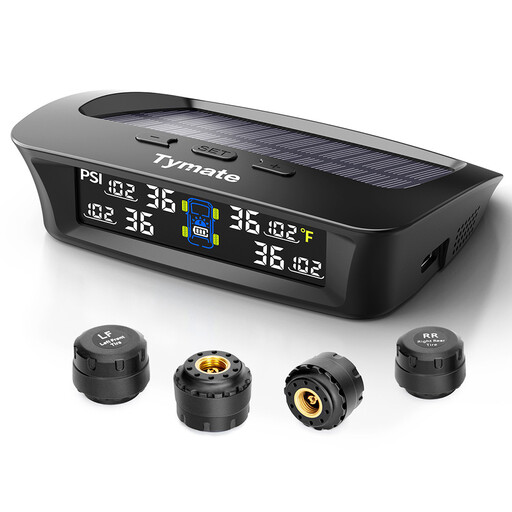
Why this model fits: This system is tailored to the needs of standard vans and RVs without a trailer. It offers a straightforward installation and reliable monitoring for vehicles up to approx. 6 metres in length.
The measurement range of up to 8 Bar (116 PSI) is sufficient for most camper vans and smaller semi-integrated RVs. Since it's designed for shorter vehicles, the problem of signal instability is avoided. The external sensors with replaceable CR1632 batteries are easy to maintain.
Solar-powered colour display with automatic brightness adjustment. Five different alarm modes (including rapid air loss, high temperature). Simple installation by screwing on the sensors.
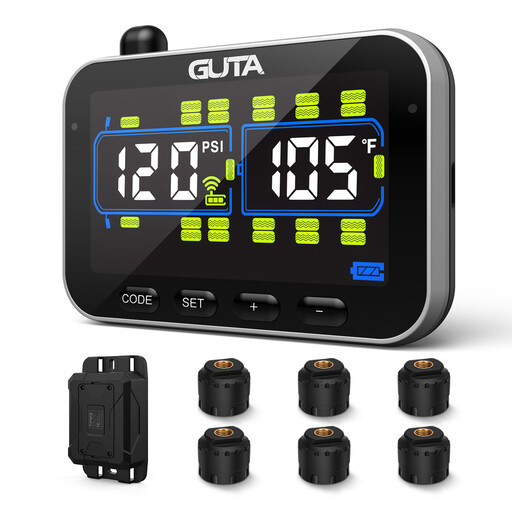
Why this model fits: This set is explicitly designed for long vehicles, heavy RVs, and towing rigs. With six sensors and a signal repeater, it covers the typical requirements for travelling with a trailer.
The included repeater solves the problem of unstable signal transmission over long distances. The high measurement range of up to 14 Bar (203 PSI) is designed for heavy-duty truck and RV tyres. According to the manufacturer, the sensors come pre-paired, which simplifies installation.
Set with 6 sensors and a repeater. High pressure range. Large colour display. Sensors with CR2032 batteries for a longer manufacturer-stated lifespan of approx. 4 years.
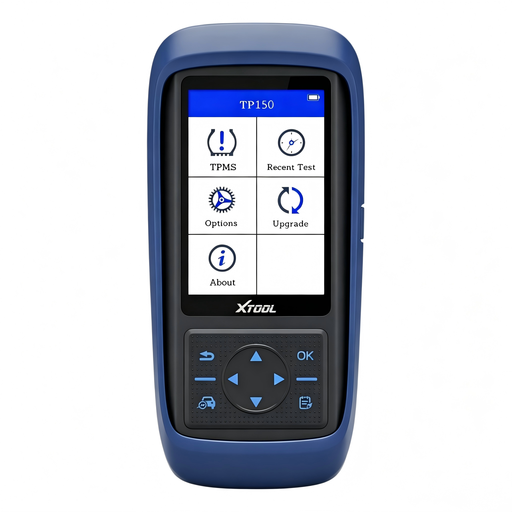
Why this model fits: This is not a monitoring system, but a diagnostic and programming tool. It is ideal for tech-savvy users who want to maintain existing TPMS systems, read fault codes, relearn sensors, or clone defective sensors.
It directly solves the problem of complicated maintenance and faulty calibration. Instead of replacing an entire system, this tool allows you to specifically diagnose and program individual sensors (XTOOL sensors) or reset the warning light.
Activates and reads all common 315/433 MHz sensors. Reads and clears TPMS fault codes. Programs XTOOL universal sensors. Lifetime free software updates via Wi-Fi, according to the manufacturer.
We have compiled a complete, up-to-date list of products that fully meet these strict selection criteria and UK safety regulations.
Retrofitting a TPMS is very easy with systems that use external sensors. These are simply screwed onto the tyre valves in place of the valve caps. The display is then placed inside the vehicle and switched on. The sensors usually connect automatically. Internal sensors, on the other hand, must be mounted inside the tyre by a workshop, which is more complex.
The lifespan of the batteries in the tyre pressure sensors varies depending on the model and manufacturer. A range of 2 to 5 years is common. According to manufacturer specifications, systems with CR2032 batteries often offer a longer runtime than those with CR1632 batteries. It is advisable to choose a system where the batteries can be easily and inexpensively replaced yourself.
Yes, a repeater is strongly recommended for most towing setups. For a total length of about 7 metres or more, or if the trailer's body is made of metal (which significantly dampens the radio signal), a repeater is necessary to ensure stable and reliable data transmission from the rear sensors to the display. Without a repeater, signal dropouts and false alarms are very likely.